Girl, abducted?

On the morning of her fifth wedding anniversary, Amy Dunne goes missing. We’re talking front-door-wide-open, ironing-board-left-on missing. The police in Amy’s small Missouri townโ€”where she’s moved reluctantly from New York to help care for her husband’s ailing misogynistic fatherโ€”discover in their investigation of the house a haphazardly cleaned blood stain, curiously fabricated evidence of a struggle, and one seemingly unconcerned husband: the rather good-looking Nick Dunne. Nick is weirdly evasive, withholding information, glossing over details, even as he proclaims his innocence. He’s joined in the search for Amy by Amy’s parents, a nauseatingly happy couple who have made their living penning children’s books based on their daughter’s life; by Nick’s twin sister, Margo, who’s never gotten along with Amy; by neighbors, former stalkers, volunteers and suspicious acquaintances, any of whom could be the kidnapper, or killer, if only the evidence didn’t point so glaringly at Nick himself. But an emotionally crippled husband does not a murderer make. Right?

Over the last few weeks, Gone Girl just kept popping up in my field of vision, in that way engrossing beach reads seem to during the summer months. It’s already a national bestseller, and is being optioned for a movie. Amazon recommends it to me on a daily basis, and I’ve had no fewer than three people this month ask whether I’ve read it (second only to 50 Shades of Grey, which I get queried on weekly.) Which isn’t to say that I put up much resistance. One-third of the way through a Joyce Carol Oates book last week, I gazed longingly at my Kindle, where Gone Girl waited after being downloaded during an impulsive and possibly alcohol-fueled book-buying spree (because that’s the kind of boozy nerd I am.) Slowly paced and only vaguely engrossing family drama, or quick-and-easy murder mystery….I made my choice and I will own it. 

Continue reading “Girl, abducted?”

Lend me your ears

There’s no greater evidence of my supremely overstocked book inventory than this week’s read, Kazuo Ishiguro’s Never Let Me Go, which I received as either a birthday or Christmas present something like four years ago and which subsequently languished on my shelves long enough for someone to make a movie adaptation, for that movie adaptation to appear in and leave theaters and finally end up on HBO, which is where I recorded it last week.

Of course, outside of the fact that it might be construed as rather insulting to receive and then ignore a gift for half a decade, there is something rather pleasant about being able to read a book and watch the movie in close succession. And the film adaptation of Never Let Me Go, which stars Carey Mulligan, Keira Knightley and Andrew Garfield (he of Spider-Man fame), was all the more enjoyable because I had only just finished the final chapter of the novel. In fact, as adaptations go, it hews incredibly closely to the novel, down to specific pieces of dialogue. No major plot points were changed, and the limited number of omissions were understandable in a story strewn with seemingly innocuous events that together form a broader portrait of a relationship between friends. 

Continue reading “Lend me your ears”

Top 10 things to do in your 20s

It’s cool, she’s 23.

Earlier this week my friend shared with me this article from Thought Catalog on the “21 Ways You Should Take Advantage of Your 20s.” After getting past the fact that I couldn’t possibly accomplish 21 things in one decadeโ€”I have way too many reality shows to watchโ€”I came to the conclusion that I am, by Thought Catalog’s definition at least, terrible at being young. The most enticing part of the whole article for me is the part where she talks about going home early and watching Parks and Recreation.

In any case, since I am such an influential thought leader and general source of worldly insight, I thought I might share my list of the Top 10 Things to Do in Your 20s, because I have opinions too, and because 10 is a much more manageable number than 21. So, here goes:

(Also I realize this has absolutely nothing to do with books, though Thought Catalog does include “reading nonfiction” as one of its 21 things. Ultimately, books are made up of words, and so are blog posts, so there. Relationship established.)

TOP 10 THINGS TO DO IN YOUR 20s
Brought to you by Couldreads, and coffee.

Continue reading “Top 10 things to do in your 20s”

CSI: Cambridge

Suffice it to say that in a kidnapping situation, I would be a hot mess. I mean, not a situation where I was kidnapped, in which case I’d pull a Bette Midler in Ruthless People and spend my isolation losing weight to aerobics shows and befriending my captors, but a situation where someone I know, or someone close to me, was kidnapped. I don’t deal well with uncertainty, and the idea of wondering whether my sister/daughter/dog was dead or not seems far worse than simply knowing it for a fact. Already prone to hermititude, I suspect I’d be one of those people who stops showering and starts wearing the same sweatpants every day. I’d paper over my guest bedroom with maps and crime scenes photographs, held together by that red bulletin board ribbon you only see in police shows. I’d almost assuredly start talking to myself, and I would definitively hire a private detective, who I would without question drive totally insane.

Which brings me to Kate Atkinson’s Case Histories. Dubbed “literary crime fiction,” the novel revolves around retired cop and private detective Jackson Brodie, who finds himself at the center of a run of major cases after years spent trailing cheating wives and looking for lost pets. Among the mysteries to be solved is the 30-year-old disappearance of an eight-year-old Olivia Land, whose sisters Amelia and Julia, now quirky spinster types, hire Jackson to reopen the case after they discover a long-lost stuffed animal Olivia had been holding on the night of her death. There’s also the 10-year-old murder of a young Laura Wyre, whose killer has never been found. Then we have Michelle, who killed her husband in cold blood; and Binky, who’s convinced her cats are being stolen, and Jackson himself, who can’t seem to catch a break in his personal life. All in all, there’s a great deal of uncertainty to be dealt with, and it’s safe to say I have zero interest in ever pursuing a career in police work. 

Continue reading “CSI: Cambridge”

A Profound Experience of Art

In the grand scheme of my life, there are only a few things I feel like I’ve truly wasted, (excluding week-old leftover pizza, or that time I waited three months to get my faucet leak fixed.) I am, generally speaking, pretty good at not squandering professional opportunities, flaking on entire friendships, or letting any chance at free food and alcohol pass me by. But as wasted ambitions go, I have long since admitted to myself a certain dropping of the ball when it comes to one thing: my wholly underutilized Spanish major.

Whenever I tell people I majored in Spanish (alongside the more appropriately chosen journalism), they mostly want to know two things: a) Did I study abroad? and b) Am I still fluent?

The answer to a) is noโ€”I was perhaps the only Spanish major in my year to not go overseas, for reasons I could outline as pragmatic but really boiled down to anxiety about traveling, not wanting to lose my internship, and preferring to stay in New York and drink with my friends. (I was 19; cut me some slack.)

But the answer to b)ย is a little more complex. It’s true that at one time I had a shockingly strong grasp of Spanish, and could raise my hand and rattle off impromptu answers to complicated questions without having to stop and translate my thoughts from English. I could write in the language almost flawlessly, and excluding some difficulty with speedโ€”native speakers talk about a thousand miles a minuteโ€”was pretty adept at understanding it as well, a skill I used primarily to watch telenovelas and eavesdrop on people’s conversations.

These days? I still remember a lot, but my ability to speak fluently has been reduced to about three tenses. The 20-page papers with which I secured my Spanish professors’ approval are now full of vocabulary I’ve long since forgotten, and other than the occasional soap operaโ€”where any gap in understanding is made up for by long pauses and overtly dramatic facial expressionsโ€”my ability to understand spoken Spanish has all but disappeared.

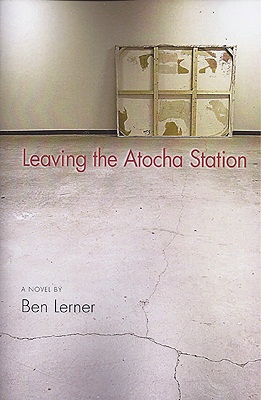
It is perhaps by virtue of this wasted skill that I found myself appreciating Leaving the Atocha Station, the debut novel from 33-year-old Ben Lerner. Adam, Lerner’s protagonist (whose background bears a striking resemblance to the author’s), is studying in Spain as part of a fellowship, in which he is theoretically writing an elaborate poem about the effects of the Spanish Civil War, but is in fact spending most of his time drinking, meandering, and getting lost in his own self-indulgent thoughts. Adam pegs himself as something of a fraud: a Spanish student who doesn’t speak Spanish, a poet who can’t write poetry, and a great thinker perpetually fearful that his great thoughts are little more than nonsense. Continue reading “A Profound Experience of Art”