Please advise

So I’m phoning it in a bit this week: I’m exhausted, coming down with some sort of cold that I plan on ignoring, and in the middle of a 1,000-page Stephen King opus that I totally could have finished in a week if that week were not also the start of fall of television (for me, a month-long frenzy of trying out new cop dramas and quirky comedies before deciding what can feasibly be added to my DVR schedule.)

Fortunately for all of us—all five—I have a spare book to review. Because some sick sad neurotic old cat lady inside of me is already hoarding finished books to fill the inevitable gaps in my blog posting; as though the world would end if I let a week pass without word-vomiting all over the Internet. (Note: It would.)

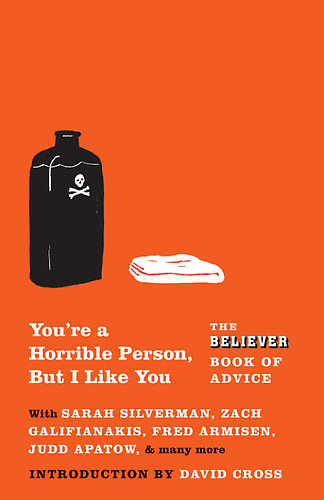
You’re a Horrible Person, But I Like You (from here on out referred to as YAHPBILY) has been a staple in my apartment—appearing intermittently on couches, chairs, counters and yes, in the bathroom—for the last year, during which I would read it in small increments between more ambitious fare. Finally on Friday, when I brought it out with me in lieu of the 1,000-pager (even I’m not that devoted when bar-hopping) I managed to finish this slim volume of hilarity on my 4 a.m. train ride home. Yay productive use of drunk travel!

I suppose there’s no way to not take it easy with a review like this: YAHPBILY isn’t the kind of book one really sits down and reads. It’s a “book of advice,” a slapstick parody of Dear Abby and similar columns, where answers to the questions from “readers” (who are not real people) are provided by a veritable smorgasbord of current comics and actors, including Sarah Silverman, Ed Helms, Zach Galifianakis and Amy Sedaris (among many, many others.)

Continue reading “Please advise”

A Separate Peace: an excerpt

“Everyone has a moment in history which belongs particularly to him.  It is the moment when his emotions achieve their most powerful sway over him, and afterward when you say to this person ‘the world today’ or ‘life’ or ‘reality,’ he will assume that you mean this moment, even if it is fifty years past.  The world, through his unleashed emotions, imprinted itself upon him, and he carries the stamp of that passing moment forever.

“For me, this moment—four years is a moment in history—was the war.  The war was and is reality for me. I still instinctively live and think in its atmosphere.  These are some of its characteristics: Franklin Delano Roosevelt is the President of the United States, and he always has been.  The other two eternal world leaders are Winston Churchill and Josef Stalin.  America is not, never has been, and never will be what the songs and poems call it, a land of plenty.  Nylon, meat, gasoline, and steel are rare.  There are too many jobs and not enough workers.  Money is very easy to earn but rather hard to spend, because there isn’t very much to buy.  Trains are always late and always crowded with ‘servicemen.’The war will always be fought very far from America and it will never end.  Nothing in America stands still for very long, including the people, who are always either leaving or on leave.  People in America cry often.  Sixteen is the key and crucial and natural age for a human being to be, and people of all other ages are ranged in an orderly manner ahead of and behind you as a harmonious setting for the sixteen-year-olds of this world.  When you are sixteen, adults are slightly impressed and almost intimidated by you.  This is a puzzle, finally solved by the realization that they foresee your military future, fighting for them.  You do not foresee it.  To waste anything in America is immoral.  String and tinfoil are treasures.  Newspapers are always crowded with strange maps and names of towns, and every few months the earth seems to lurch from its path when you see something in the newspapers, such as the time Mussolini, who had almost seemed one of the eternal leaders, is photographed hanging upside down on a meathook.  Everyone listens to news broadcasts five or six times every day.  All pleasurable things, all travel and sports and entertainment and good food and fine clothes, are in the very shortest supply, always were and always will be.  There are just tiny fragments of pleasure and luxury in the world, and there is something unpatriotic about enjoying them.  All foreign lands are inaccessible except to servicemen; they are vague, distant, sealed off as though behind a curtain of plastic. The prevailing color of life in America is a dull, dark green called olive drab.  That color is always respectable and always important.  Most other colors risk being unpatriotic.”

It bears repeating

For a long time I thought that I would never re-read books. My refusal was part badge of honor and part common sense. After all, there are bazillions of books in the world, the vast majority of which I will never even know exist, let alone find the time to read, so why waste precious hours on novels I’ve already absorbed?

Then I got older, and books I had in my youth sworn allegiance to as lifetime favorites became little more than dull memories, or overarching sentiments (“yeah…I remember…liking it?”) It was with this in mind that I began slowly and occasionally picking up old favorites, particularly those I thought might seem different to me now that I’m old and wise and at least vaguely understand politics. I’ve read 1984 at least three times, Fahrenheit 451 two and, more recently had a second go at Jonathan Franzen’s The Corrections, which I was inspired to read again after all the (completely justified) hype surrounding Freedom.

A Separate Peace, the 1959 novel by John Knowles, seemed like the perfect candidate for a re-read. It’s one of those books most people know they’ve read, but from which most readers are separated by at least a decade, having been assigned the book in high school or even earlier. I am one of those people: I have vague memories of A Separate Peace from my formative middle-school years, when a novel about two prep school best friends probably resonated with me the same way the Babysitters Club did (I didn’t really babysit, but understood what it was like to spend a lot of time thinking about boys.) But other than some general recollections, I couldn’t tell you before this week what exactly A Separate Peace was about.

Continue reading “It bears repeating”

Seeing: Some of my favorite quotes

“I have yet to hear a single idea that was worth considering for longer than it took us to listen to it.”

“The president of the republic turned pale, he looked like an old rag that someone had distractedly left behind on the back of the chair, I never thought I would live to see the face of treachery, he said, and felt that history was sure to record the phrase, and should there be any risk of history forgetting, he would make a point of reminding it.”

“Sir, I may only be a police inspector who may never make it as far as superintendent, but I’ve learned from my experience in this job that things half-spoken exist in order to say what can’t be fully expressed.”

“He did all this with great concentration in order to keep his thoughts at bay, in order to let them in only one at a time, having first asked them what they contained, because you can’t be too careful with thoughts, some present themselves to us with a cloying air of of false innocence and then, when it’s too late, reveal their true wicked selves.”

“You know very well that the minister finds it highly suspicious that you didn’t go blind when everyone else was losing their sight, and now that fact has become more than sufficient, from his point of view, for him to find you responsible, either wholly or in part, for what is happening now, Do you mean the blank votes, Yes, the blank votes, But that’s absurd, utterly absurd, As I’ve learned in this job, not only are the people in government never put off by what we judge to be absurd, they make use of absurdities to dull consciences and to destroy reason.”

[FULL REVIEW]

Boycott This Book

Listen, I despise Sarah Palin as much as the next self-respecting sane person. I fear a world where that woman becomes president, and I think she’s giving brunettes with glasses a bad name. But I will not buy this fucking book.

I know I’ve in the past defended those who might generally be considered stupid authors, including Snooki. And I stand by that defense; there’s plenty of room in this world for memoirs by celebrities, novels from reality-show stars and illustrated drivel from freakishly beloved tweens. But I take offense to The Rogue, the much-hyped “nonfiction” book written by Joe McGinniss, of “I moved in next to Sarah Palin just to stalk her whole life on the boardwalk” fame.

The New York Times did as good a job as I could of summing up The Rogue’s content (better, in fact, since I will never so much as crack the cover) and I won’t waste digital breath repeating all of it here. All you need to know is that McGinniss spent a significant amount of time hunting down salacious information on the Palins, following up on unsubstantiated rumors and peddling lowbrow gossip, all in the name of “getting to the bottom” of who Sarah Palin really is. Among his more scandalous claims are assertions (from anonymous sources) that Palin in her younger years did cocaine, slept with an NBA player, and had an affair while married to the infamous Todd (because…wouldn’t you?)  Continue reading “Boycott This Book”