Stick to inventing democracy

This book was a waste of time.

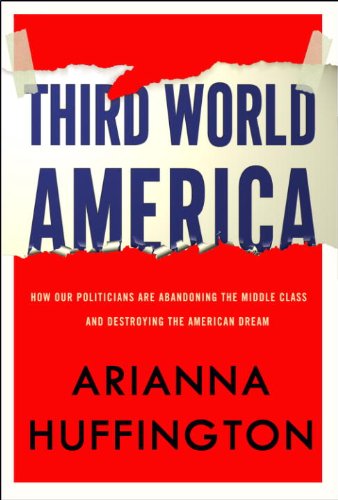
Don’t get me wrong, I’m a fan of Arianna Huffington. She’s incredibly well-spoken, fairly forward thinking, and generally impressive. Her status as a powerful 21st century woman doesn’t hurt either. But Third World America isn’t what I would call her crowning achievement.

To start, I find it somewhat odd that Arianna would bother to write a book in the first place. After all, isn’t this the woman who undermined print journalism (itself a daily operation) in favor of the minute-to-minute coverage that is The Huffington Post? Third World America, though full of compelling statistics and arguments, can’t help but already seem dated. Many of the numbers have no doubt changed in the year-plus since the book was published, and many of the topics have advanced, either incrementally or by massive degrees (the book predates the recent “shellacking” in Congress, as well as everything going on right now in the Middle East). Books on current events can’t help but be felled by the rather slow process that is book publishing; it just feels extra odd that the woman behind such a huge disruptor of old media would have bothered with one at all.

In truth, I wonder whether the medium in general was a bit lost on Arianna (it shouldn’t have been; this is her 12th book). As I mentioned, Third World America is chock full of facts and figures, but doesn’t otherwise ever seem to find a level of depth I expect from nonfiction, and even more from nonfiction books presented as arguments. If you’ve been following economic news over the last two years, nothing in Third World America will come as a surprise to you, or even an “aha” moment. In fact, many of the numbers and quotations Arianna uses are from reports that have been covered by the press, or articles from the press itself (one may have been better served reading the New York Times’ business section over the last 18 months). It’s somewhat ironic that the founder of The Huffington Post, arguably an aggregate of other news, would have penned a book with such similar qualities. Or I guess not ironic at all.

[Sidenote: I take particular issue with one section of the book where Arianna lays into the mainstream media for failing to report on the impending economic disaster before it all went down. Sure, we all know now that there were many distinct voices warning of the financial crisis in the years leading up to it, but to pretend that only traditional media were ignoring those voices is to suggest Ms. Huffington hasn’t looked at her own site in the last two years. In example, she mentions the media’s inane focus on Balloon Boy, which I’m more than certain dominated the front page of HuffPo right alongside every other media outlet. In fact, people often refer to The Huffington Post as one of the most apt examples of vying for page views over journalistic accolades. (As I write this, the HuffPo homepage is full of updates on Libya, but the most popular story is Johnny Depp discussing Angelina Jolie’s mothering style.) Ch’mon Arianna, don’t bite the hands that feeds.]

The book does lay out some distinct proposals for improving the country, many of which I agree with, some of which I don’t, and I would argue that these are the only elements of Third World America that you might not find elsewhere (or that are at least presented more succinctly than one might find elsewhere). But even here, I found my interest stymied by mediocre writing — again, the lack of depth can make the book feel like one really long HuffPo opinion piece — and Arianna’s penchant for overwrought analogies and wordplay. (Example: “Forget Freddy Krueger. The real nightmare is not happening on Elm Street. It’s happening on Main Street.” Example: “Watching the unrelenting geyser-like spew, it struck me as an inverse visual for the plight of America’s middle class: While the thick black oil was being pushed inexorably upward, hour after hour and week after week, the quality of life for tens of millions of hardworking Americans is being pushed inexorably downward–month after month after month.”) Gag.

🏆🏆

Arianna Huffington is a very smart woman, and as such I can’t blame her for wanting to write a best-seller, even if the logic behind it still confounds me (i.e. “I founded one of the most highly trafficked sites on the Internet, but you know what, I think I’ll write a book. Bound to reach more people that way!”) Third World America is a clean and informative introduction to what’s wrong with the country today (or at least what was two years ago) and anyone who doesn’t have their nose perpetually in the business section of the Times or Wall Street Journal would be well-served by absorbing all of this calamitous information in one fell swoop (I should note that it’s an incredibly fast read.) But for everyone else, those who have been following the news, much of this will come as a recap of things you already know, with very little else. Sure, Arianna has some good suggestions for getting America on the up and up, but she could have saved me 250 pages and just written a really nice HuffPo article.


TITLE: Third World America: How Our Politicians Are Abandoning the Middle Class and Betraying the American Dream
————————————————–
AUTHOR: Arianna Huffington
————————————————–
PAGES: 242 (in hardcover)
————————————————–
ALSO WROTE: Like 11 other books
————————————————–
SORTA LIKE: Nickel and Dimed meets Fast Food Nation
————————————————–
FIRST LINE: “Growing up, I remember walking to school in Athens past a statue of President Truman.”
————————————————–

A completely biased book review

David Foster Wallace

Here’s the thing about David Foster Wallace, and the main reason I’m having such a hard time reviewing this book. In my experience, people either love, hate, or haven’t yet read anything by DFW. If they love him, it’s most likely for all the reasons I do—his unique outlook, his superb vocabulary, his singular writing style, his ability to pair poignant observation with subtle humor—and if they hate him, well it’s probably for those exact same reasons. So the only scenario I can really think of to address is the one where you, as a reader, have against all odds managed to dodge his work. In the interest of providing some sort of service to my three-person audience, copied below is a passage from one essay in Consider the Lobster, which gives a fair (though woefully inadequate, in the grand scheme of things) idea of what  exactly it is to read an entire book of words written by DFW. (This particular essay, for reference, is an extremely detailed evaluation of Standard Written English, and the merits or disadvantages of enforcing its use).

“When I say or write something, there are actually a whole lot of different things I am communicating. The propositional content (i.e., the verbal information I’m trying to convey) is only one part of it. Another part is stuff about me, the communicator. Everyone knows this. It’s a function of the fact that there are so many different well-formed ways to say the same basic thing, from e.g. “I was attached by a bear!” to “Goddamn bear tried to kill me!” to “That ursine juggernaut did essay to sup upon my person!” and so on. Add the Saussurian/Chomskian consideration that many grammatically ill-formed sentences can also get the propositional content across—”Bear attack Tonto, Tonto heap scared!”—and the number of subliminal options we’re scanning/sorting/interpreting as we communicate with one another goes transfinite very quickly.

And different levels of diction and formality are only the simplest kinds of distinction; things get way more complicated in the sorts of interpersonal communication where social relations and feelings and moods come into play. Here’s a familiar kind of example. Suppose that you and I are acquaintances and we’re in my apartment having a conversation and that at some point I want to terminate the conversation and not have you be in my apartment anymore. Very delicate social moment. Think of all the different ways I can try to handle it: “Wow, look at the time”; “Could we finish up later?”; “Could you please leave now?”; “Go”; “Get out”; “Get the hell out of here”; “Didn’t you say you had to be someplace?”; “Time for you to hit the dusty trail, my friend”; “Off you go then, love”; or that sly old telephone-conversation-ender: “Well, I’m going to let you go now”; etc. etc. And then think of all the different factors and implications of each option.*

*(Footnote) To be honest, the example here has a special personal resonance for this reviewer because in real life I always seem to have a hard time winding up a conversation or asking someone to leave, and sometimes the moment becomes so delicate and fraught with social complexity that I’ll get overwhelmed trying to sort out all the different possible ways of saying it and all the different implications of each option and will just sort of blank out and do it totally straight — “I want to terminate the conversation and not have you be in my apartment anymore” — which evidently makes me look either as if I’m very rude and abrupt or as if I’m semi-autistic and have no sense of how to wind up a conversation gracefully.  Somehow, in other words, my reducing the statement to its bare propositional content “sends a message” that is itself scanned, sifted, interpreted, and judged by my auditor, who then sometimes never comes back. I’ve actually lost friends this way.”

Bottom line: If you didn’t like the above (excluding a lost-in-translation element that comes with taking an excerpt from a fairly long and involved essay), then DFW is not the man for you. And if you did like it, well hey, I’ve just introduced you to some of the best shit you’ll ever read.

Continue reading “A completely biased book review”

“Europeans are lazy, study says”

There’s a reason they tell you to write what you know.

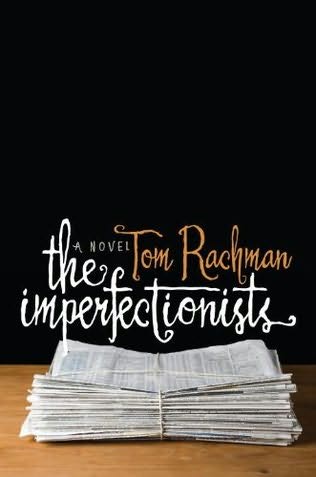
Tom Rachman was a Rome correspondent for the Associated Press and an editor at the International Herald Tribune in Paris, all of which goes a long way towards explaining why his debut novel–a glimpse at the “topsy-turvy private lives of the reporters and editors of an English-language newspaper in Rome”–succeeds so well.

I picked up The Imperfectionists while killing time in Penn Station (damn you, Hudson News!!) “Spectacular,” screamed the cover; “magnificent,” “beguiling.” (Beguiling?) The back cover, too: filled with glowing endorsements.

It’s immediately obvious why not much space was warranted for any sort of Imperfectionists plot summary. Though the book’s various characters are related–all affiliated with the newspaper in question, which is only ever referred to as “the newspaper”–their stories are presented as vignettes, a dozen or so pages each for a handful of the paper’s employees, and even in one case (my favorite vignette) an elderly reader struggling to keep up with the news (on Feb. 18, 2007, she is reading an issue from April 1994). In between these vignettes are even briefer glimpses at the founding of the paper and its evolution from a frivolous collection of briefs into a publication with a real voice and reputation, and back to a budget-starved anachronism in the world of online journalism.

Continue reading ““Europeans are lazy, study says””

A book on the internets, in hardcover

It was with a bit of nostalgia for my college days (where I majored in media theory) that I picked up Clay Shirky’s Cognitive Surplus for this week. Were Clay and I friends, I might tell him he could have picked a less intimidating title, one that wouldn’t make people frown when I tell them what I’m reading. The name won’t scare off anyone who picked up Surplus for the author himself (or anyone who makes a habit of reading manifestos on the merits of new media), but it might scare off some readers who would otherwise be greatly served by hearing what Shirky has to say.

If you’ve got even a little inner media wonk, this is a truly fascinating book. If you don’t, or if you’re turned off by a title that includes the word “cognitive,” then just hang around me, as I’ve spent the better part of the last week describing Shirky’s central ideas to friends, most of whom have at least pretended to find them interesting. Without going into too much detail, the gist of Cognitive Surplus is this: Over the last 50 years, we’ve had a steady increase in free time, most of which we’ve spent watching television (oh, sweet television). It’s only in the last five or so years that we’ve seen the proliferation of media that doesn’t command passive viewership, but rather engagement. In the short term—and for those people who still insist Twitter is about 140-character sandwich descriptions—this just means a lot of frivolity online. But it can also mean great things. If every person in the world has one hour of free time per day, the power of all that time combined is pretty enormous. And if each of those people spends that hour engaging/interacting/contributing instead of consuming, we get things like Wikipedia. Like Twitter-enabled political unrest. Like nonprofits soliciting donations from a worldwide fan base. Like CouchSurfing.com. In other words, it doesn’t all have to be about what you’re eating.There are many more elements to Shirky’s argument, and I’m running the risk of not doing it justice by simplifying it this much. But the central idea, or at least the one that I think would best serve the residual doubters of social media—not just in terms of cultural importance, but as an agent of change—is that the way we interact now isn’t worse, it’s just different. Shirky gives plenty of examples, most of which I enjoyed enough as “Aha!” moments that I won’t give them away here. Instead, I’ll refer to a relevant though unrelated quote that’s encouraged me to make or embrace change in my own life (read: attempt using my stove): “If you always do what you’ve always done, you’ll always get what you’ve always gotten.”

Continue reading “A book on the internets, in hardcover”

It’s about like, art and stuff

By Nightfall, which I’ve written about before and was sad to finish last night, is in many ways hugely different than Gilead. For one, it’s set in present-day Manhattan, and follows the travails of a rather well-off married couple, he an art dealer, she a magazine editor. So yes, a far cry from the spiritual musings of last week.

But in other ways, the books are surprisingly complementary. In Gilead, an older man questions the motives of his best friend’s younger son (himself middle-aged) who reappears in town after a long absence. In By Nightfall, the story picks up when Mizzy (short for “The Mistake”), younger brother of protagonist Peter Harris’ wife Rebecca, appears in the city, having “recovered” from a problem with addiction and looking for a job “in the arts.” Like the narrator of Gilead, Peter is distrustful of (and yet also enamored of) Mizzy. He simultaneously wants to improve him and be rid of him, and perhaps most importantly, he’s concerned—obsessed, even—with what those conflicting emotions mean. (To clarify, the books are hugely different in many other ways, not least of which is Peter’s mild attraction to Mizzy).

Though I loved By Nightfall on several levels—writing, setting, dialogue—the book’s true strength is its characters, who seem so effortlessly real that I keep expecting to run into one of them on the 4 train. Peter and Rebecca as the comfortable married couple, Mizzy as the wayward and frivolous 20-something, Bea (the Harris’ daughter) as the malcontent young female, whose rebellion takes the form of leaving her parents’ SoHo loft for a job in a Boston hotel bar. (Again, the connection with Gilead: What is one to make of their daughter fleeing New York for a mundane existence hundreds of miles away. And how does said flight reflect on one’s attempts at parenting?)It’s hard to decide what By Nightfall is the best portrait of: addiction, marriage, art, New York? All of the above, really. And that’s all I’ll say, both because I don’t want to give away any of the story, but also because there’s a lot of devil in these details. By Nightfall has a plot, of course, a good one at that, but the book is more than anything compelling because it seems real. Not Jersey Shore “real,” not even Intervention real. Real like when you surreptitiously eavesdrop on someone’s conversation. Real like watching a father and son fight at the supermarket. Real like going home. That is, if your home was a loft in SoHo.

Continue reading “It’s about like, art and stuff”