The user is the content

The sad thing is, I actually read a book last week! I just never got around to writing about it, instead hoping that the e-mail of review-related notes I’d sent myself sometime around Tuesday would perhaps magically transform itself into several paragraphs of coherent thought, and then post itself online. Funny how that didn’t pan out.

My book for last week (again, we’re like six days late here) was Marshall McLuhan: You Know Nothing of My Work!, a brief biography of the 1960s media theorist (Marshall McLuhan) by tech/future/dystopia-focused fiction author Douglas Coupland. I picked up this particular book for three reasons. First, both Coupland and Chuck Klosterman (the latter one of my all-time favorite nonfiction writers) were speaking in New York at an event focusing on McLuhan and his contributions to our understanding of the media landscape (which undoubtedly included questions like “What the fuck would he have thought of Foursquare?”) Unfortunately, work prevailed and I wasn’t able to make the event (I’m still bitter) but by then I was halfway through the book and I am not (anymore) the type to give up. Second, among his many other teaching posts, Marshall McLuhan for a brief time taught at Fordham University, my alma mater, and for this reason (plus, you know, his general fame) was brought up with some frequency by my professors at Fordham, some of whom knew him personally (yes, I majored in media theory, let’s all just deal with it). Third and finally, it was short. Like 200 pages short.

For those who don’t know, Marshall McLuhan was a 1960s media theorist known most commonly for the little gem “the medium is the message.” He based his understanding of the media environment (and far more importantly, on how media transforms the way we behave and think) on literature, the Renaissance and other seemingly unrelated topics, which made his ideas at the time (again, ’60s) seem more batshit than prescient. But prescient they were. Here are a few choice McLuhan quotes, most from 1962.

The next medium, whatever it isβ€”it may be the extension of consciousnessβ€”will include television as its content, not as its environment, and will transform television into an art form. A computer as a research and communication instrument could enhance retrieval, obsolesce mass library organization, retrieve the individual’s encyclopedic function and flip it into a private line to speedily tailored data of a saleable kind.

We shape our tools, and afterwards our tools shape us.

The user is the content.

Instead of tending towards a vast Alexandrian library the world has become a computer, an electronic brain, exactly as an infantile piece of science fiction.  And as our senses have gone outside us, Big Brother goes inside. So, unless aware of this dynamic, we shall at once move into a phase of panic terrors, exactly befitting a small world of tribal drums, total interdependence, and superimposed co-existence.

[Terror] is the normal state of any oral society, for in it everything affects everything all the time … In our long striving to recover for the Western world a unity of sensibility and of thought and feeling we have no more been prepared to accept the tribal consequences of such unity than we were ready for the fragmentation of the human psyche by print culture.

Kind of spooky, right? In any case, it’s worth noting that McLuhan has become such a source of soundbites in part because his longer writing, including seminal books like Understanding Media and The Gutenberg Galaxy, aren’t entirely accessible to the average reader (which is to say you have to have a bit of the media nerd in you to really get into them). That particular brand of wonk may not have been what inspired Coupland to write a straightforward and short biography, but his book certainly has the side benefit of laying out some key McLuhan facts without forcing one to dive too deep.

Continue reading “The user is the content”
Stick to inventing democracy

This book was a waste of time.

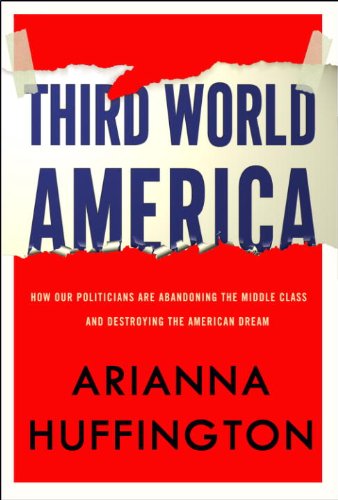
Don’t get me wrong, I’m a fan of Arianna Huffington. She’s incredibly well-spoken, fairly forward thinking, and generally impressive. Her status as a powerful 21st century woman doesn’t hurt either. But Third World America isn’t what I would call her crowning achievement.

To start, I find it somewhat odd that Arianna would bother to write a book in the first place. After all, isn’t this the woman who undermined print journalism (itself a daily operation) in favor of the minute-to-minute coverage that is The Huffington Post? Third World America, though full of compelling statistics and arguments, can’t help but already seem dated. Many of the numbers have no doubt changed in the year-plus since the book was published, and many of the topics have advanced, either incrementally or by massive degrees (the book predates the recent “shellacking” in Congress, as well as everything going on right now in the Middle East). Books on current events can’t help but be felled by the rather slow process that is book publishing; it just feels extra odd that the woman behind such a huge disruptor of old media would have bothered with one at all.

In truth, I wonder whether the medium in general was a bit lost on Arianna (it shouldn’t have been; this is her 12th book). As I mentioned, Third World America is chock full of facts and figures, but doesn’t otherwise ever seem to find a level of depth I expect from nonfiction, and even more from nonfiction books presented as arguments. If you’ve been following economic news over the last two years, nothing in Third World America will come as a surprise to you, or even an “aha” moment. In fact, many of the numbers and quotations Arianna uses are from reports that have been covered by the press, or articles from the press itself (one may have been better served reading the New York Times’ business section over the last 18 months). It’s somewhat ironic that the founder of The Huffington Post, arguably an aggregate of other news, would have penned a book with such similar qualities. Or I guess not ironic at all.

[Sidenote: I take particular issue with one section of the book where Arianna lays into the mainstream media for failing to report on the impending economic disaster before it all went down. Sure, we all know now that there were many distinct voices warning of the financial crisis in the years leading up to it, but to pretend that only traditional media were ignoring those voices is to suggest Ms. Huffington hasn’t looked at her own site in the last two years. In example, she mentions the media’s inane focus on Balloon Boy, which I’m more than certain dominated the front page of HuffPo right alongside every other media outlet. In fact, people often refer to The Huffington Post as one of the most apt examples of vying for page views over journalistic accolades. (As I write this, the HuffPo homepage is full of updates on Libya, but the most popular story is Johnny Depp discussing Angelina Jolie’s mothering style.) Ch’mon Arianna, don’t bite the hands that feeds.]

The book does lay out some distinct proposals for improving the country, many of which I agree with, some of which I don’t, and I would argue that these are the only elements of Third World America that you might not find elsewhere (or that are at least presented more succinctly than one might find elsewhere). But even here, I found my interest stymied by mediocre writing — again, the lack of depth can make the book feel like one really long HuffPo opinion piece — and Arianna’s penchant for overwrought analogies and wordplay. (Example: “Forget Freddy Krueger. The real nightmare is not happening on Elm Street. It’s happening on Main Street.” Example: “Watching the unrelenting geyser-like spew, it struck me as an inverse visual for the plight of America’s middle class: While the thick black oil was being pushed inexorably upward, hour after hour and week after week, the quality of life for tens of millions of hardworking Americans is being pushed inexorably downward–month after month after month.”) Gag.

πŸ†πŸ†

Arianna Huffington is a very smart woman, and as such I can’t blame her for wanting to write a best-seller, even if the logic behind it still confounds me (i.e. “I founded one of the most highly trafficked sites on the Internet, but you know what, I think I’ll write a book. Bound to reach more people that way!”) Third World America is a clean and informative introduction to what’s wrong with the country today (or at least what was two years ago) and anyone who doesn’t have their nose perpetually in the business section of the Times or Wall Street Journal would be well-served by absorbing all of this calamitous information in one fell swoop (I should note that it’s an incredibly fast read.) But for everyone else, those who have been following the news, much of this will come as a recap of things you already know, with very little else. Sure, Arianna has some good suggestions for getting America on the up and up, but she could have saved me 250 pages and just written a really nice HuffPo article.


TITLE: Third World America: How Our Politicians Are Abandoning the Middle Class and Betraying the American Dream
————————————————–
AUTHOR: Arianna Huffington
————————————————–
PAGES: 242 (in hardcover)
————————————————–
ALSO WROTE: Like 11 other books
————————————————–
SORTA LIKE: Nickel and Dimed meets Fast Food Nation
————————————————–
FIRST LINE: “Growing up, I remember walking to school in Athens past a statue of President Truman.”
————————————————–

Oh, God…

Confession time: I didn’t care for Gilead.

Now I know what you’re thinking: The book won a Pulitzer, how bad can it be? Well I’m glad you asked. Gilead isn’t bad, not at all. Rather, it’s one of the more beautiful things I’ve ever read, filled with lines that address spirituality in a way uncommon among modern literature, in a way meant to resonate with people who have themselves considered the implications of being religious in the modern era. In fact, I can’t emphasize enough how truly beautiful and poignant the language in Gilead is.

Unfortunately, no amount of beautiful language could have saved this book for me. Rather, my objection lies with the subject matter. Gilead is told from the point of view of a priest, spending his dying days writing a letter to his rather young son, a letter intended to bequeath upon his kin all the various thoughts and suggestions he might have otherwise shared in fatherhood. Alone, this sounds charming. In practice, Gilead is an exercise in religion, and more specifically in what it might mean for a religious man in the 20th century to decide which parts of his life and thoughts are worth sharing with his child. Lest this still sound appealing, for me personally it read a lot like a father describing to his son his impression of unicorns, and how their supposed presence had affected his outlook on life. Which is to say I found it almost entirely irrelevant. Continue reading “Oh, God…”

Kurt Cobain, The Afterlife

51K7hqIHV7LEtgar Keret is an odd duck.

I could debate whether the quirkiness of his stories is best attributed to a “lost in translation” type of effect, but even that kind of discrepancy wouldn’t be enough to account for how unique they are, and how downright weird. In reading up on the author (thank you Wikipedia) I found that his stories are widely popular among Israeli youth, who see them as something of a reflection on their national ethos. What does this mean? While American 20-somethings are texting and playing video games, young adults in Israel are poignantly preoccupied with thoughts of life and death, heaven and hell, good and evil.

Indeed, many of the stories in The Bus Driver who Wanted to be God touch on some of those central themes: the meaning of life, what happens after we die, the fairness of God. Some reference Israeli youths’ (mandatory) time in the military, while others touch on Holocaust Remembrance Day, for obvious reasons a rather heavy subject there.

Yet despite its dark themes, I would be remiss if I didn’t mention that Bus Driver in particular, and Keret in general, is funny. Not laugh out loud funny, often not even chuckle to oneself funny, but humorous in a darker way, in a way that suggests lamenting the injustices of life is pointless, so laughing about them seems like a good second choice. Continue reading “Kurt Cobain, The Afterlife”

A problem only turkey can solve

Generally, I love books of essays. Really, it’s one of my favorite genres. But there are times, such as incredibly busy pre-holiday weeks when television is calling to me from the next room in all its prime time fall-programming glory, when it’s tough to get through them. Books of essays, that is. Consequently, I don’t think I gave “Half Empty” a fair shake this week.

Don’t get me wrong, I enjoyed it. David Rakoff has an incredibly sharp wit, the kind of negative attitude I appreciate and a more or less unparalleled vocabulary (the closest I’ve seen is David Foster Wallace, who had a thing for multisyllabic words. And I mean multisyllabic). Many of Rakoff’s essays cover topics true to my heartβ€”New York, work, aspirations, cynicism. He skewers the plot of “Rent,” tells how he insulted the now-deceased author of “The First Wives Club” whilst she was in a coma, and gives a poignant-without-being-cheesy account of his second (yes, second) encounter with cancer. He draws a distinction between being negative for negativity’s sake and simply being pessimistic to the point of preparedness (he defends both). There’s even an essay about porn.

So I don’t know why it was so hard for me to get into this book. It wasn’t quite long enough, or quick enough; it wasn’t post-beer train reading, due to the aforementioned vocabulary and his propensity for run-on sentences (something I can relate to). The essays also at times felt too unrelated, like a series of magazine columns plopped together in a book. Except for a bevy of Jewish humor, not much was consistent throughout.

And yet, despite finding myself apathetically underwhelmed by “Half Empty”, I still intend to read “Fraud,” the only Rakoff book remaining to me. And why? Because no matter how grumpy or tired or grumpily tired I found myself last week, this one paragraph, where Rakoff is ending things with his therapist, who then confesses that he will miss their sessions, is so ridiculously dead-on that I suspect perhaps this man and I are actually kindred spirits and my averse reaction to the book has everything to do with a sincere jealousy over his ability to word my darkest interior monologues. Enjoy.

“(Sigh. Should you happen to be possessed of a certain verbal acuity coupled with a relentless, hair-trigger humor and surface cheer spackling over a chronic melancholia and lonelinessβ€”a grotesquely caricatured version of your deepest Self which you trot out at the slightest provocation to endearing and glib comic effect, thus rendering you the kind of fellow who is beloved by all yet loved by none, all of it to distract, however fleetingly, from the cold and dead-faced truth that with each passing year you face the unavoidable certainty of a solitary future in which you will perish one day while vainly attempting the Heimlich maneuver on yourself over the back of a kitchen chairβ€”then this confirmation that you have triumphed once again and managed to gull yet another mark, except this time it was the one person you’d hoped might be immune to your ever-creakier, puddle-shallow sideshow-barker variation on “adorable,” even though you’d been launching this campaign weekly with a single-minded concentration from day one … well, it conjures up feelings that are best described as mixed, to say the least.)

See what I mean?

πŸ†πŸ†

At the end of the day, I think the reason I didn’t love “Half Empty” had everything to do with me: It really did feel a lot like reading my own thoughts, and typically so much of reading (books, at least) is an attempt on my part to escape them. I can hardly begrudge Rakoff his inability to help me cast off the doldrums of everyday life, especially when the book’s title is an indisputable reference to negative thinking. But I can grumpily give it two paper cuts; since he’s a true pessimist, Rakoff would have probably expected no different.


TITLE: “Half Empty
—————————————
AUTHOR: David Rakoff
—————————————
PAGES: 224 (in hardcover)
—————————————-
ALSO WROTE: Don’t Get Too Comfortable“, “Fraud
—————————————–
SORTA LIKE: Dry” meets “A Supposedly Fun Thing I’ll Never Do Again
——————————————
FIRST LINE: “We were so happy. It was miserable.”
——————————————