In time for Mother’s Day

Generally, I tend not to care who authors’ favorite authors are, but when one of my favorite writers, someone whose books I anticipate, says they read “anything by” another author, well, color me intrigued.

This is how I discovered Elizabeth Berg. Augusten Burroughsβ€”author of Running with Scissors, Dry and a really depressing memoir that I didn’t love but read anywayβ€”said in an interview that he reads anything of hers. Anything! I mean sure, I like a lot of writers, but narrow the list to those entire oeuvre I’ve consumed and the pickings get slim. Five, maybe ten tops. (That list is a post for another day.) So Home Safe is my inaugural Elizabeth Berg book.

Home Safe is one of those books that’s kind of about nothing. There’s no tangible conflict (the main character’s husband dies, but the book starts after that), just emotional ones. Writing about these kinds of issues, this ennui that seems endemic of being upper-middle-class Americans with the liberty to feel things like general sadness, isn’t always my cup of teaβ€”sometimes I find myself waiting for the sex and explosions. But there are a lot of authors who do it right, and Elizabeth Berg is one of them, at least based on this book.

The narrative of Home Safe follows Helen, a recent widow (and ugh, don’t spontaneous and inexplicable husband deaths just fuck with your whole perception of the world) and her 20-something daughter Tessa. There are other charactersβ€”Helen teaches a writing class whose students we meet; Helen’s friend Midge, Helen’s parentsβ€”but the book isn’t really about them. It’s about grief, and the way we deal with grief, and it’s about mothers and daughters. It’s especially about mothers and daughters.

When my own mother was in town a few weeks ago, at some point during her visit, she confessed that she worried about me, often. “Why?” I asked. I mean, what’s there to worry about? I have my own apartment, good friends, a solid social life, a great jobβ€”all things considered, my shit is pretty together. “You know,” she said, “like if you’re happy.”

Continue reading “In time for Mother’s Day”

The user is the content

The sad thing is, I actually read a book last week! I just never got around to writing about it, instead hoping that the e-mail of review-related notes I’d sent myself sometime around Tuesday would perhaps magically transform itself into several paragraphs of coherent thought, and then post itself online. Funny how that didn’t pan out.

My book for last week (again, we’re like six days late here) was Marshall McLuhan: You Know Nothing of My Work!, a brief biography of the 1960s media theorist (Marshall McLuhan) by tech/future/dystopia-focused fiction author Douglas Coupland. I picked up this particular book for three reasons. First, both Coupland and Chuck Klosterman (the latter one of my all-time favorite nonfiction writers) were speaking in New York at an event focusing on McLuhan and his contributions to our understanding of the media landscape (which undoubtedly included questions like “What the fuck would he have thought of Foursquare?”) Unfortunately, work prevailed and I wasn’t able to make the event (I’m still bitter) but by then I was halfway through the book and I am not (anymore) the type to give up. Second, among his many other teaching posts, Marshall McLuhan for a brief time taught at Fordham University, my alma mater, and for this reason (plus, you know, his general fame) was brought up with some frequency by my professors at Fordham, some of whom knew him personally (yes, I majored in media theory, let’s all just deal with it). Third and finally, it was short. Like 200 pages short.

For those who don’t know, Marshall McLuhan was a 1960s media theorist known most commonly for the little gem “the medium is the message.” He based his understanding of the media environment (and far more importantly, on how media transforms the way we behave and think) on literature, the Renaissance and other seemingly unrelated topics, which made his ideas at the time (again, ’60s) seem more batshit than prescient. But prescient they were. Here are a few choice McLuhan quotes, most from 1962.

The next medium, whatever it isβ€”it may be the extension of consciousnessβ€”will include television as its content, not as its environment, and will transform television into an art form. A computer as a research and communication instrument could enhance retrieval, obsolesce mass library organization, retrieve the individual’s encyclopedic function and flip it into a private line to speedily tailored data of a saleable kind.

We shape our tools, and afterwards our tools shape us.

The user is the content.

Instead of tending towards a vast Alexandrian library the world has become a computer, an electronic brain, exactly as an infantile piece of science fiction.  And as our senses have gone outside us, Big Brother goes inside. So, unless aware of this dynamic, we shall at once move into a phase of panic terrors, exactly befitting a small world of tribal drums, total interdependence, and superimposed co-existence.

[Terror] is the normal state of any oral society, for in it everything affects everything all the time … In our long striving to recover for the Western world a unity of sensibility and of thought and feeling we have no more been prepared to accept the tribal consequences of such unity than we were ready for the fragmentation of the human psyche by print culture.

Kind of spooky, right? In any case, it’s worth noting that McLuhan has become such a source of soundbites in part because his longer writing, including seminal books like Understanding Media and The Gutenberg Galaxy, aren’t entirely accessible to the average reader (which is to say you have to have a bit of the media nerd in you to really get into them). That particular brand of wonk may not have been what inspired Coupland to write a straightforward and short biography, but his book certainly has the side benefit of laying out some key McLuhan facts without forcing one to dive too deep.

Continue reading “The user is the content”

More than just talk

This week I read a novel by Craig Ferguson. No fahreals, like late night talk show host Craig Ferguson. I know! I was surprised too.

Now, I don’t watch the Late Late Show Craig Ferguson–for one, it’s on mad late–but I do follow him on Twitter and in these postmodern times, I think that counts. In any case, his particular fame (televised) is what made me so intrigued when I came across his book in the store (also I am weak and easily persuaded by celebrity.) Luckily for us all, the book has proven–like chocolate, cough drops and Star magazine–a good impulsive buy. Between the Bridge and the River is a pretty sweet novel.

To clarify – it’s not a sweet novel. I mean, not like “Aw, so sweet.” It’s actually pretty dark, NC-17 even, with the kind of choice descriptions that make you conscious of whether fellow commuters are reading over your shoulder. One gets the sense Ferguson, whose show is on CBS–the network of the elderly–saved up all the words he can’t say, topics he can’t broach and, well, nasty shit he would never dream of bringing up on television, and put it all into one book. Brutal crimes. Perverted sex stuff. Take that, elderly.But I’m simplifying. Between the Bridge and the Water is a lot more than an assemblage of perverse humor. The novel follows an ensemble cast of interlocking characters–some whose relationships prove important, others coincidental (think Crash)–but focuses on two stories: that of brothers Leon and Saul, and that of estranged friends Fraser and George. Both stories are journeys of sorts–Leon and Saul are veritable orphans who run away to become famous, Fraser is publicly disgraced and flees to America, George is diagnosed with cancer and leaves for Paris. Along the way they run into a collective series of situations or semi-dreams that manage to cover everything from religion to Hollywood to death to philosophy. And always with (generally dark) humor.

Continue reading “More than just talk”

Stick to inventing democracy

This book was a waste of time.

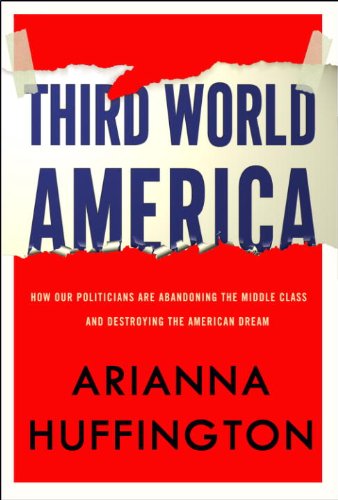
Don’t get me wrong, I’m a fan of Arianna Huffington. She’s incredibly well-spoken, fairly forward thinking, and generally impressive. Her status as a powerful 21st century woman doesn’t hurt either. But Third World America isn’t what I would call her crowning achievement.

To start, I find it somewhat odd that Arianna would bother to write a book in the first place. After all, isn’t this the woman who undermined print journalism (itself a daily operation) in favor of the minute-to-minute coverage that is The Huffington Post? Third World America, though full of compelling statistics and arguments, can’t help but already seem dated. Many of the numbers have no doubt changed in the year-plus since the book was published, and many of the topics have advanced, either incrementally or by massive degrees (the book predates the recent “shellacking” in Congress, as well as everything going on right now in the Middle East). Books on current events can’t help but be felled by the rather slow process that is book publishing; it just feels extra odd that the woman behind such a huge disruptor of old media would have bothered with one at all.

In truth, I wonder whether the medium in general was a bit lost on Arianna (it shouldn’t have been; this is her 12th book). As I mentioned, Third World America is chock full of facts and figures, but doesn’t otherwise ever seem to find a level of depth I expect from nonfiction, and even more from nonfiction books presented as arguments. If you’ve been following economic news over the last two years, nothing in Third World America will come as a surprise to you, or even an “aha” moment. In fact, many of the numbers and quotations Arianna uses are from reports that have been covered by the press, or articles from the press itself (one may have been better served reading the New York Times’ business section over the last 18 months). It’s somewhat ironic that the founder of The Huffington Post, arguably an aggregate of other news, would have penned a book with such similar qualities. Or I guess not ironic at all.

[Sidenote: I take particular issue with one section of the book where Arianna lays into the mainstream media for failing to report on the impending economic disaster before it all went down. Sure, we all know now that there were many distinct voices warning of the financial crisis in the years leading up to it, but to pretend that only traditional media were ignoring those voices is to suggest Ms. Huffington hasn’t looked at her own site in the last two years. In example, she mentions the media’s inane focus on Balloon Boy, which I’m more than certain dominated the front page of HuffPo right alongside every other media outlet. In fact, people often refer to The Huffington Post as one of the most apt examples of vying for page views over journalistic accolades. (As I write this, the HuffPo homepage is full of updates on Libya, but the most popular story is Johnny Depp discussing Angelina Jolie’s mothering style.) Ch’mon Arianna, don’t bite the hands that feeds.]

The book does lay out some distinct proposals for improving the country, many of which I agree with, some of which I don’t, and I would argue that these are the only elements of Third World America that you might not find elsewhere (or that are at least presented more succinctly than one might find elsewhere). But even here, I found my interest stymied by mediocre writing — again, the lack of depth can make the book feel like one really long HuffPo opinion piece — and Arianna’s penchant for overwrought analogies and wordplay. (Example: “Forget Freddy Krueger. The real nightmare is not happening on Elm Street. It’s happening on Main Street.” Example: “Watching the unrelenting geyser-like spew, it struck me as an inverse visual for the plight of America’s middle class: While the thick black oil was being pushed inexorably upward, hour after hour and week after week, the quality of life for tens of millions of hardworking Americans is being pushed inexorably downward–month after month after month.”) Gag.

πŸ†πŸ†

Arianna Huffington is a very smart woman, and as such I can’t blame her for wanting to write a best-seller, even if the logic behind it still confounds me (i.e. “I founded one of the most highly trafficked sites on the Internet, but you know what, I think I’ll write a book. Bound to reach more people that way!”) Third World America is a clean and informative introduction to what’s wrong with the country today (or at least what was two years ago) and anyone who doesn’t have their nose perpetually in the business section of the Times or Wall Street Journal would be well-served by absorbing all of this calamitous information in one fell swoop (I should note that it’s an incredibly fast read.) But for everyone else, those who have been following the news, much of this will come as a recap of things you already know, with very little else. Sure, Arianna has some good suggestions for getting America on the up and up, but she could have saved me 250 pages and just written a really nice HuffPo article.


TITLE: Third World America: How Our Politicians Are Abandoning the Middle Class and Betraying the American Dream
————————————————–
AUTHOR: Arianna Huffington
————————————————–
PAGES: 242 (in hardcover)
————————————————–
ALSO WROTE: Like 11 other books
————————————————–
SORTA LIKE: Nickel and Dimed meets Fast Food Nation
————————————————–
FIRST LINE: “Growing up, I remember walking to school in Athens past a statue of President Truman.”
————————————————–
A completely biased book review

David Foster Wallace

Here’s the thing about David Foster Wallace, and the main reason I’m having such a hard time reviewing this book. In my experience, people either love, hate, or haven’t yet read anything by DFW. If they love him, it’s most likely for all the reasons I doβ€”his unique outlook, his superb vocabulary, his singular writing style, his ability to pair poignant observation with subtle humorβ€”and if they hate him, well it’s probably for those exact same reasons. So the only scenario I can really think of to address is the one where you, as a reader, have against all odds managed to dodge his work. In the interest of providing some sort of service to my three-person audience, copied below is a passage from one essay in Consider the Lobster, which gives a fair (though woefully inadequate, in the grand scheme of things) idea of what  exactly it is to read an entire book of words written by DFW. (This particular essay, for reference, is an extremely detailed evaluation of Standard Written English, and the merits or disadvantages of enforcing its use).

“When I say or write something, there are actually a whole lot of different things I am communicating. The propositional content (i.e., the verbal information I’m trying to convey) is only one part of it. Another part is stuff about me, the communicator. Everyone knows this. It’s a function of the fact that there are so many different well-formed ways to say the same basic thing, from e.g. “I was attached by a bear!” to “Goddamn bear tried to kill me!” to “That ursine juggernaut did essay to sup upon my person!” and so on. Add the Saussurian/Chomskian consideration that many grammatically ill-formed sentences can also get the propositional content acrossβ€””Bear attack Tonto, Tonto heap scared!”β€”and the number of subliminal options we’re scanning/sorting/interpreting as we communicate with one another goes transfinite very quickly.

And different levels of diction and formality are only the simplest kinds of distinction; things get way more complicated in the sorts of interpersonal communication where social relations and feelings and moods come into play. Here’s a familiar kind of example. Suppose that you and I are acquaintances and we’re in my apartment having a conversation and that at some point I want to terminate the conversation and not have you be in my apartment anymore. Very delicate social moment. Think of all the different ways I can try to handle it: “Wow, look at the time”; “Could we finish up later?”; “Could you please leave now?”; “Go”; “Get out”; “Get the hell out of here”; “Didn’t you say you had to be someplace?”; “Time for you to hit the dusty trail, my friend”; “Off you go then, love”; or that sly old telephone-conversation-ender: “Well, I’m going to let you go now”; etc. etc. And then think of all the different factors and implications of each option.*

*(Footnote) To be honest, the example here has a special personal resonance for this reviewer because in real life I always seem to have a hard time winding up a conversation or asking someone to leave, and sometimes the moment becomes so delicate and fraught with social complexity that I’ll get overwhelmed trying to sort out all the different possible ways of saying it and all the different implications of each option and will just sort of blank out and do it totally straight β€” “I want to terminate the conversation and not have you be in my apartment anymore” β€” which evidently makes me look either as if I’m very rude and abrupt or as if I’m semi-autistic and have no sense of how to wind up a conversation gracefully.  Somehow, in other words, my reducing the statement to its bare propositional content “sends a message” that is itself scanned, sifted, interpreted, and judged by my auditor, who then sometimes never comes back. I’ve actually lost friends this way.”

Bottom line: If you didn’t like the above (excluding a lost-in-translation element that comes with taking an excerpt from a fairly long and involved essay), then DFW is not the man for you. And if you did like it, well hey, I’ve just introduced you to some of the best shit you’ll ever read.

Continue reading “A completely biased book review”