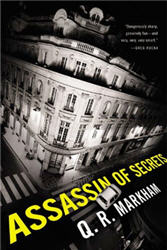
There are two primary types of book scandal—either you write something that isn’t true and say it is (James Frey, Margaret B. Jones, that “Holocaust survivor” who said she lived with wolves) or you say you wrote something that you definitely didn’t (Kaavya Viswanathan). A fairly epic example of the latter came out this week, when it was discovered that Q.R. Markham’s mystery book, Assassin of Secrets, was actually lifted from something like a dozen other books, forcing publisher Little, Brown to pull it from the shelves and Markham to conspicuously fall off the face of the planet.
The Assassin of Secrets story is extra interesting because, unlike some of his plagiarizing predecessors, Markham (the pen name for poet Quentin Rowan, who also happens to be a part-owner of Williamsburg bookstore Spoonbill & Sugartown) made what seems like zero effort to hide his ripping. Here are two sample paragraphs (a comprehensive list is available here).
From Assassin of Secrets: “The boxy, sprawling Munitions Building which sat near the Washington Monument and quietly served as I-Division’s base of operations was a study in monotony. Endless corridors connecting to endless corridors. Walls a shade of green common to bad cheese and fruit. Forests of oak desks separated down the middle by rows of tall columns, like concrete redwoods, each with a number designating a particular work space.”
From Body of Secrets: Anatomy of the Ultra-Secret National Security Agency: “In June 1930, the boxy, sprawling Munitions Building, near the Washington Monument, was a study in monotony. Endless corridors connecting to endless corridors. Walls a shade of green common to bad cheese and fruit. Forests of oak desks separated down the middle by rows of tall columns, like concrete redwoods, each with a number designating a particular workspace.”
In the age of Google, I find it downright amazing that people still think they can get away with this kind of stuff. Which isn’t to say that I expect publishers to spend all their time googling various paragraphs from manuscripts they receive, but rather that authors, whose entire goal is to get their work distributed to as many people as possible, don’t realize (or choose to ignore) that someone somewhere is going to pick up on similarities as blatant as these.
Continue reading “The future will be plagiarized” couldreads