The only best books of 2015 list worth reading (because I combined all the other ones)

NUC_Christmas_Tree_S_Calhoun

It’s that time of year again! Gift wrap, eggnog, awkward family arguments over honey-baked hams. And most important: cookies! No just kidding—books! With another 12 months of publishing under our collective belts (which are currently loosened due to the aforementioned cookies) it’s time for the annual rundown of those books that made our hearts sing and our eyes tear up, books that made us laugh or sob or laugh while sobbing while also taking the train to work.

Per tradition, and ever-aided by an abundance of coffee and a few spreadsheets, I’ve combined 20 year-end book lists into one master file, which features the 10 must-reads of 2015 (i.e. any book that showed up on six or more lists). This year’s list includes some obvious ringers—I don’t think anyone will be surprised to find Ta-Nehisi Coates’s Between the World and Me near the top. But there are also some sleeper hits: Lucia Berlin’s A Manual for Cleaning Women, a compendium of short stories, showed up on seven lists, while Viet Thanh Nguyen’s The Sympathizer, set in 1970s Saigon, also appeared a half-dozen times. Then there are the ones I’ve actually read: Hanya Yanagihara’s A Little Life (I still can’t even find the words to express how much I loved this novel) appeared on 11 lists, and Jonathan Franzen’s Purity and Paul Beatty’s The Sellout also had strong showings. Even Kazuo Ishiguro’s The Buried Giant (which, ehhhhh) made the Top 10.

Continue reading “The only best books of 2015 list worth reading (because I combined all the other ones)”
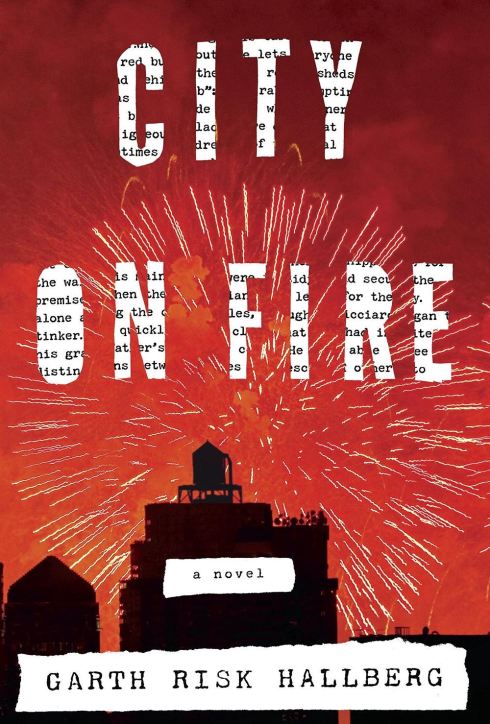
I’m giving up on City on Fire

Garth-Risk-Hallberg-BOOK

Generally speaking, I am loathe to give up on books. The same content loyalty that drove me to read all the Sookie Stackhouse novels and to watch Gossip Girl and Glee to their bitter conclusions means that it takes a real nightmare of a novel for me to throw in the towel.

But I have tried, and failed, three times to get invested in Garth Risk Hallberg’s City on Fire, a debut novel for which Hallberg received a $2 million advance. Set in 1970s New York City, COF follows an ensemble cast of characters whose lives serendipitously connect one New Year’s Eve. The novel careens forward and backward from that moment, detailing the first interactions of the various personalities—the young gay couple, the punk teenager and her doting best friend, the aging journalist and his gruff middle-aged subject—and how those interactions change and grow and are in many cases forever changed after that night. Also there’s an attempted murder.

Continue reading “I’m giving up on City on Fire”

Say hello to My Brilliant Friend

Layout 1

For as many guys as I have been friends with over as many years, I reluctantly maintain that there is something uniquely intimate about a close friendship between women. It is inevitably a companionship against the world, a kinship based on shared experience and perspective and mutual trust as regards an ever-expanding litany of secret thoughts and hopes and fears. Perhaps it is because of this almost inherent intensity that lady BFF relationships are also so often fraught, so frequently burdened by unspoken resentments or unfounded suspicions, by anger or envy. Women know what they’re up against in the world, and sometimes it’s easy to forget who’s on your side.

I haven’t read many novels that truly capture the complexity of these friendships—I’m sure they’re out there, I just haven’t read them—but it’s hard not to feel that in My Brilliant Friend, Elena Ferrante has done it better than most. The story of Elena and Lila, childhood pals who grow up together in 1950s Naples, is the story of so many fast friends, girls who share dolls and schoolbooks but soon find themselves competing for attention, validation and approval. Here, there is the added backdrop of a place and time in which women were held to the highest moral standard and the lowest intellectual one. To advance one’s education at all, let alone as a girl, was far from a given. 

Continue reading “Say hello to My Brilliant Friend”

Three book that say it’s all downhill after college

Screen Shot 2015-11-18 at 1.06.09 AM
Good times were had.

A mere six months into my 30s, I find myself already looking back on college with the same abstract nostalgia one might apply to say…fax machines. Like, wasn’t that so neat at the time? How you could totally put a sheet of paper with stuff on it into a machine and then a machine somewhere else would, moments later, spit out an identical sheet of paper with identical stuff on it? That was cool. Good times were had. Documents were faxed. But now is better: We have email now. Cell phones. AirDrop. Dropbox. The cloud. And if all else fails, the NSA.

I loved college; I made some of my best friends there. College was the last time one could wear pajama pants in public, or don costumes for spontaneously invented themed drinking nights, or go for second helpings of frozen yogurt at no additional charge. But I also enjoy being an adult, and I know—in whatever corner of my brain isn’t penetrated by models and actresses and the implications of every movie and television show ever—that being young is for the birds. Being young is like fax machines: Wasn’t it neat when you could say “I’m going to hit up three different parties tonight” and then you would actually do it? That was cool. Good times were had. But now is better: Now it’s happy hour and then a good night’s sleep.

Continue reading “Three book that say it’s all downhill after college”

I read Leah Remini’s Scientology tell-all so you don’t have to

rs_634x966-151102135713-634.Leah-Remini-Troublemaker.ms.110215

Gone are the days when a Scientology exposé had the impact of a classified document dump—defections from the notoriously insulated religion now occur with all the frequency of Justin Bieber meltdowns. In 2013, Lawrence Wright’s Going Clear documented the experiences of several formerly high-ranking Scientology members; Alex Gibney’s HBO adaptation aired in March. Jenna Miscavige Hill, niece of Scientology leader David Miscavige, wrote a memoir about her time in the church, as have a half-dozen other former practitioners. The secrets of a church that claims its secrets are too mind-blowing for the average person to know have long since been revealed.

Still, Leah Remini’s Troublemaker: Surviving Hollywood and Scientology was highly anticipated. A member of the church for more than 30 years—she joined as a child after her mother started dating a Scientologist—Remini had long been a committed, if not hugely vocal, Scientologist. Her defection was a blow even for a church that knows a lot about bad press.

“Leah Remini has become what she once declared she never wanted to be known as: ‘this bitter ex-Scientologist,'” the church wrote in a statement about the book. “She needs to move on with her life instead of pathetically exploiting her former religion, her former friends and other celebrities for money and attention to appear relevant again.” 

Continue reading “I read Leah Remini’s Scientology tell-all so you don’t have to”