Lobster, considered

I really didn’t want to read this book. Or at least I wasn’t supposed to.

Now don’t get me wrong, I love David Foster Wallace. I think he was one of a kind, which is why it pains me every time I decide to read one of his books. Because I know there are a finite number of them; once I’ve read the last one, fin. …I suppose that’s true of many authors, including the classics’, but the circumstance and timing of DFW’s death make it feel relatable, more familiar. In reading his work, I’ve found myself upset that I’ll never know his insight on the current time period–on Obama or Twitter or the Biebs, on Shake Weight, or Watson or 3D movies–because I know his humor, his neurotic thoroughness and unrelenting cynicism, would have made that insight so unique and perfect. Instead I soak up his inner monologues on things like McCain’s 2000 campaign, and pore over his descriptions of a fictional futuristic world eerily like our actual present. And really wish he was still alive to write.

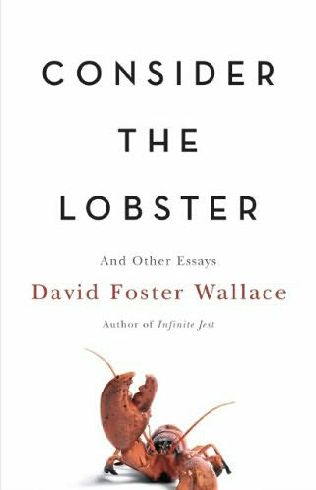
Sigh. Back to the task at hand. So reading any DFW book feels moderately epic. In addition, though I’m a fan of his short stories and novels, I’m partial to his nonfiction books, of which Consider the Lobster is one. Not one, but my last, because I am weak-willed and powerless over a good essay. Also, there’s a lobster on the cover. I can’t be held accountable for that kind of temptation.

Long story short, I’ve decided to drag this one out an extra week, a decision aided by the fact that DFW frequently includes half-page footnotes in footnote-size typeface, and that these footnotes frequently themselves have footnotes in even smaller typeface, so that one feels they’ve read entire pages when they’ve really just managed three lines of a footnote’s footnote. But also, because I want to enjoy it.
“Europeans are lazy, study says”

There’s a reason they tell you to write what you know.

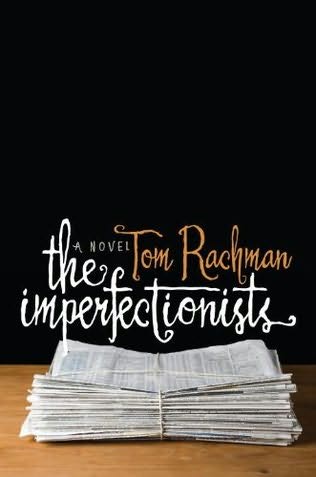
Tom Rachman was a Rome correspondent for the Associated Press and an editor at the International Herald Tribune in Paris, all of which goes a long way towards explaining why his debut novel–a glimpse at the “topsy-turvy private lives of the reporters and editors of an English-language newspaper in Rome”–succeeds so well.

I picked up The Imperfectionists while killing time in Penn Station (damn you, Hudson News!!) “Spectacular,” screamed the cover; “magnificent,” “beguiling.” (Beguiling?) The back cover, too: filled with glowing endorsements.

It’s immediately obvious why not much space was warranted for any sort of Imperfectionists plot summary. Though the book’s various characters are related–all affiliated with the newspaper in question, which is only ever referred to as “the newspaper”–their stories are presented as vignettes, a dozen or so pages each for a handful of the paper’s employees, and even in one case (my favorite vignette) an elderly reader struggling to keep up with the news (on Feb. 18, 2007, she is reading an issue from April 1994). In between these vignettes are even briefer glimpses at the founding of the paper and its evolution from a frivolous collection of briefs into a publication with a real voice and reputation, and back to a budget-starved anachronism in the world of online journalism.

Continue reading ““Europeans are lazy, study says””

A book on the internets, in hardcover

It was with a bit of nostalgia for my college days (where I majored in media theory) that I picked up Clay Shirky’s Cognitive Surplus for this week. Were Clay and I friends, I might tell him he could have picked a less intimidating title, one that wouldn’t make people frown when I tell them what I’m reading. The name won’t scare off anyone who picked up Surplus for the author himself (or anyone who makes a habit of reading manifestos on the merits of new media), but it might scare off some readers who would otherwise be greatly served by hearing what Shirky has to say.

If you’ve got even a little inner media wonk, this is a truly fascinating book. If you don’t, or if you’re turned off by a title that includes the word “cognitive,” then just hang around me, as I’ve spent the better part of the last week describing Shirky’s central ideas to friends, most of whom have at least pretended to find them interesting. Without going into too much detail, the gist of Cognitive Surplus is this: Over the last 50 years, we’ve had a steady increase in free time, most of which we’ve spent watching television (oh, sweet television). It’s only in the last five or so years that we’ve seen the proliferation of media that doesn’t command passive viewership, but rather engagement. In the short term—and for those people who still insist Twitter is about 140-character sandwich descriptions—this just means a lot of frivolity online. But it can also mean great things. If every person in the world has one hour of free time per day, the power of all that time combined is pretty enormous. And if each of those people spends that hour engaging/interacting/contributing instead of consuming, we get things like Wikipedia. Like Twitter-enabled political unrest. Like nonprofits soliciting donations from a worldwide fan base. Like CouchSurfing.com. In other words, it doesn’t all have to be about what you’re eating.There are many more elements to Shirky’s argument, and I’m running the risk of not doing it justice by simplifying it this much. But the central idea, or at least the one that I think would best serve the residual doubters of social media—not just in terms of cultural importance, but as an agent of change—is that the way we interact now isn’t worse, it’s just different. Shirky gives plenty of examples, most of which I enjoyed enough as “Aha!” moments that I won’t give them away here. Instead, I’ll refer to a relevant though unrelated quote that’s encouraged me to make or embrace change in my own life (read: attempt using my stove): “If you always do what you’ve always done, you’ll always get what you’ve always gotten.”

Continue reading “A book on the internets, in hardcover”

By Nightfall: Some of my favorite quotes

Here are some of my favorite quotes from By Nightfall. These are, I should note, prettay prettay long. It’s the kind of book that gets you with entire paragraphs

“He’s one of those smart, drifty young people who, after certain deliberations, decides he wants to do Something in the Arts but won’t, possibly can’t, think in terms of an actual job; who seems to imagine that youth and brains and willingness will simply summon an occupation, the precise and perfect nature of which will reveal itself in its own time.”

“There’s New York, one of the goddamnedest perturbations ever to ride the shifting surface of the earth. It’s medieval, really, all ramparts and ziggurats and spikes and steeples, entirely possible to see a hunchback cloaked in a Hefty bag stumping along beside a woman carrying a twenty-thousand dollar purse. And at the same time, overlaid, is a vast nineteenth-century boomtown, raucously alive, eager for the future but nothing rubberized or air-conditioned about it, no hydraulic hush; trains rumbling the pavement, carved limestone women and men—not gods—looking heftily down from cornices as if from a heaven of work and hard-won prosperity, car horns bleating as some citizen in Dockers passes by telling his cell phone ‘that’s how they’re supposed to be.'””We—we men—are the frightened ones, the blundering and nervous ones; if we act the skeptic or the bully sometimes it’s because we suspect we’re wrong in some deep incalculable way that women are not. Our impersonations are failing us and our vices and habits are ludicrous and when we present ourselves at the gates of heaven the enormous black woman who guards them will laugh at us not only because we aren’t innocent but because we have no idea about anything that actually matters.”

Continue reading “By Nightfall: Some of my favorite quotes”

It’s about like, art and stuff

By Nightfall, which I’ve written about before and was sad to finish last night, is in many ways hugely different than Gilead. For one, it’s set in present-day Manhattan, and follows the travails of a rather well-off married couple, he an art dealer, she a magazine editor. So yes, a far cry from the spiritual musings of last week.

But in other ways, the books are surprisingly complementary. In Gilead, an older man questions the motives of his best friend’s younger son (himself middle-aged) who reappears in town after a long absence. In By Nightfall, the story picks up when Mizzy (short for “The Mistake”), younger brother of protagonist Peter Harris’ wife Rebecca, appears in the city, having “recovered” from a problem with addiction and looking for a job “in the arts.” Like the narrator of Gilead, Peter is distrustful of (and yet also enamored of) Mizzy. He simultaneously wants to improve him and be rid of him, and perhaps most importantly, he’s concerned—obsessed, even—with what those conflicting emotions mean. (To clarify, the books are hugely different in many other ways, not least of which is Peter’s mild attraction to Mizzy).

Though I loved By Nightfall on several levels—writing, setting, dialogue—the book’s true strength is its characters, who seem so effortlessly real that I keep expecting to run into one of them on the 4 train. Peter and Rebecca as the comfortable married couple, Mizzy as the wayward and frivolous 20-something, Bea (the Harris’ daughter) as the malcontent young female, whose rebellion takes the form of leaving her parents’ SoHo loft for a job in a Boston hotel bar. (Again, the connection with Gilead: What is one to make of their daughter fleeing New York for a mundane existence hundreds of miles away. And how does said flight reflect on one’s attempts at parenting?)It’s hard to decide what By Nightfall is the best portrait of: addiction, marriage, art, New York? All of the above, really. And that’s all I’ll say, both because I don’t want to give away any of the story, but also because there’s a lot of devil in these details. By Nightfall has a plot, of course, a good one at that, but the book is more than anything compelling because it seems real. Not Jersey Shore “real,” not even Intervention real. Real like when you surreptitiously eavesdrop on someone’s conversation. Real like watching a father and son fight at the supermarket. Real like going home. That is, if your home was a loft in SoHo.

Continue reading “It’s about like, art and stuff”