
Book bonanza: Part I

In the last four days, I bought 17 books.

Whew. Okay. It’s out. Now you all know that when I say I have a problem with buying books, I don’t mean a small one. I mean that I had to relocate at least 30 books to floor piles (pictured) so that I might reduce the risk of one of my overburdened bookshelves collapsing during the night, thereby giving me a fatal heart attack and forcing some hapless relative to sort through my massive paperback collection while distributing my possessions post-mortem. Now you know that when I say I have a book-buying problem, I mean that I actively facilitate the makings of a serious physical hazard.

In fact, so unchecked is my penchant for bookstores that this weekend marked the first time I actually purchased a book I already owned—Michael Lewis’s The Big Short, which I am (perhaps out of guilt) now reading. In the interest of making lemonade out of lemons, I will award (and mail) the extra copy to a lucky reader, to be determined after the writing of that review. …Similarly, I think it would be in everyone’s best interest if I started finding a way to give away other books, so keep your eyes peeled for more details on that in coming weeks.

Anyway! Book-buying guilt also propelled me into a frenzy of reading this weekend (under the logic that finishing 3 books would somehow justify buying 17) and so I have a wealth of reviews to write. On Friday I finished Don Winslow’s Savages, on Saturday John Green’s Looking for Alaska, on Sunday Nora Ephron’s Wallflower at the Orgy and yesterday Bret Easton Ellis’ The Rules of Attraction. I haven’t read this quickly and productively since that time I had chicken pox and my mom brought me an entire stack of Tiger Beat.

Continue reading “Book bonanza: Part I”
My weekend with Charles Manson

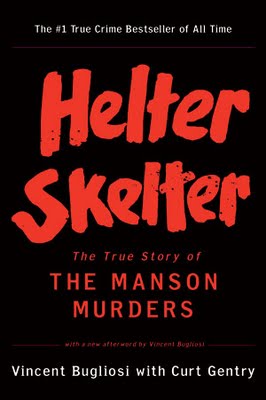
Guys, there are a lot of things I recommend you do in this lifetime—go on a road trip, skydive, eat more than 1,500 calories in a single sitting—but reading the 675-page Helter Skelter in a mere four days is not one of them. That shit will fuck with your head.

I first decided to read Helter Skelter years ago, but for whatever reason—I suppose in part due to its intimidating length—never got around to it.  (Editor’s note: Nick, I apologize for “borrowing” your copy of the book for six years.) Then I stumbled across this well-timed Gawker post last week, which itself came on the heels of my having read Jon Ronson’s The Psychopath Test, and the irony of finishing up a book on the mental state of mass murderers on the 43rd anniversary of one of the most infamous mass murders of all time was too much to overlook: It was Helter Skelter time.

For the unfamiliar, Helter Skelter is the definitive retelling of the events surrounding the 1969 Tate-LaBianca murders, a two-night spree in which seven people were killed—18-year-old student Steven Parent, screenwriter Wojciech Frykowski, coffee heiress Abigail Folger, hairstylist Jay Sebring, actress (and Roman Polanski’s then-wife) Sharon Tate (who was eight months pregnant), supermarket executive Leno LaBianca, and his wife Rosemary LaBianca. All seven murders were exceedingly brutal, with some victims being stabbed upwards of 40 times. After a historic trial, a jury found Charles Manson guilty of the crimes, along with several other members of The Family, a cult-like commune founded by Manson. The murders were intended to set off “Helter Skelter,” the name Manson had given to what he perceived as an imminent race war between blacks and whites. Why Helter Skelter? Manson took the title from a Beatles song he felt was intended (by the Beatles) to warn listeners of this impending revolution. Because obvi.

Continue reading “My weekend with Charles Manson”

The crazies

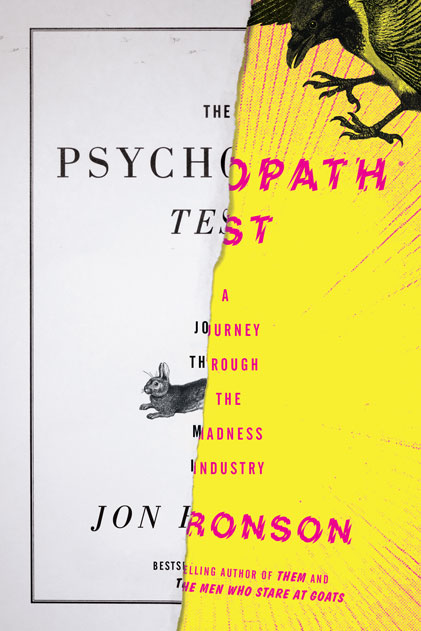
Call it coincidence, but ever since starting Jon Ronson’s The Psychopath Test, a journalistic exploration of the sociopathic, I’m seeing psychos everywhere.

By psychos I don’t mean the creepy guy on the train who stared at me for literally 28 minutes this morning (I counted), or even the recent string of clearly mentally ill Batman/Muslim-hating shooters. I mean the run-of-the-mill everyday people whose lives involve, or are in some scenarios contingent upon, a complete lack of empathy for the problems, stresses, fears and tragedies of others. And also everyone not on Facebook.

In The Psychopath Test, Ronson investigates historical and current definitions of psychopathy, including the famous Hare Checklist, a 20-point diagnostic tool used to identify psychos. He speaks with Bob Hare, and other psychologists, as well as criminals and other persons who have either been openly accused of psychopathy, or whose personal history indicates some susceptibility to it. Throughout the book, Ronson inserts his own ruminations on the subject, and tries—however casually—to ascertain whether a) current definitions or diagnoses of psychopathy are fair or true and b) psychopathy is as prevalent as some of those definitions might suggest.

Continue reading “The crazies”

Game on

P.S. Thanks to Marisa for the recommendation!

The year is 2044, and things are not looking so great. Most of humanity is destitute, including overweight teenager Wade Watts, who lives with his aunt and hundreds of other people in “the stacks,” long rows of mobile homes stacked on top of one another and precariously held together with scaffolding. Wade’s only recourse from the shitty regular world is the OASIS, a massive online game that he, like most of the rest of the global population, is jacked into for the majority of each day. Wade attends school in the OASIS, which is also home to some ten thousand planets, housing everything from offices to complete replications of scenes or environments from Star Wars, Dungeons & Dragons and more.

The OASIS was created by James Halliday, a Steve Jobs-like genius whose love of his creation is matched only by his love of all things 1980s, a nostalgia that extends to any cultural artifact from the time: movies, music, comic books, videogames, etc. Upon his death, Halliday releases a video will that promises ownership of his company (and a $200+ billion fortune) to whoever can uncover an “easter egg” he’s buried in the game. 

Continue reading “Game on”

Naples-gazing

The best part about reading Eat Pray Love in 2012 is getting to tell people you’re doing it: Now that the book has been out for nearly a decade, most people with even a passing interest have already picked it up, and so I was treated to all manner of reactions—ranging from the intrigued to downright disgusted—when I shared with various friends that I was finally reading this runaway bestseller.

As with Never Let Me Go, EPL moved to the top of my pile once HBO started playing the movie, although I’m not entirely sure why I hadn’t gotten around to it sooner. Sure, the book gives off a generally annoying self-help vibe—I left The Strand’s $1 price sticker on the front of mine all week, lest anyone think I’d paid full price for the thing—but there was a time when you couldn’t sit through a subway ride without seeing at least one person reading it. That alone is usually enough to pique my interest (see: Twilight, The Hunger Games, The Girl with the Dragon Tattoo, 50 Shades of Grey.)

More importantly, EPL’s concept is undeniably appealing: Who wouldn’t want to Eat, Pray, Love their life? Sure, maybe I’d forego the crippling depression that motivates Elizabeth Gilbert to start her journey, but I’m definitely on board for the rest of it: taking a year off to relax/eat in Italy, relax/pray in India and relax/relax in Indonesia. I’d perhaps alternate the order, or the goals (my memoir would be called Eat, Eat, Eat) but the overall idea—a fully financed year of self-discovery in three unique cultures—is awesome. In fact, The Great American Bookstore Tour is sort of my own mini-EPL (the truncated domestic version available to those of us who didn’t get six-figure advances on our travel memoirs.)

Continue reading “Naples-gazing”