The Big Girls, no longer my suggested title for an Oxygen dating show about overweight but still sassy single women

The Big Girls, by Susanna Moore

I’m cheating this week. The truth is that I’m still knee-deep (waist-deep I guess, since I’m about halfway through) on The Broom of the System, which is frustrating since it’s the end of the year, i.e. book goal crunch time, and I have big reading/blogging plans for the next few weeks (re-reading Perks of Being of Wallflower, first-time reading Les Miserables and writing some sort of roundup of my favorites of 2012.) But it’s David Foster Wallace, and proper respect must be paid — by which I mean I’m willing to backtrack four times per reading session to make sure I haven’t lost the thread of characters I’m supposed to know about, or connections I’m supposed to have identified. I swear on Honey Boo Boo that I will finish that book this week, especially since I’m officially finished crushing two full seasons of Downton Abbey.

In the meantime, a few weeks ago I finished The Big Girls, by Susanna Moore. I picked this one up at The Strand (I wouldn’t remember things like this except all my Strand books have $1 price tags on them) since I’d read Moore’s In the Cut years ago, and vaguely remember liking it (actually, I remember very little about the book, and more about the eventual movie made from it, which I saw with my mom, which entailed very awkwardly sitting together to watch Meg Ryan and Mark Ruffalo have lots of sex.) Also, see the aforementioned $1—at that price, I’ll buy any book that doesn’t have biologically questionable stains on it.

Continue reading “The Big Girls, no longer my suggested title for an Oxygen dating show about overweight but still sassy single women”

Why [no one really cares that] I left Goldman Sachs

In March of this year, Goldman Sachs executive director Greg Smith wrote an opinion piece in the New York Times titled, “Why I Am Leaving Goldman Sachs,” in which he outlined his decision to end a 12-year tenure with one of the most successful investment banks in the world. In that declaration — which I wrote about back when I reviewed Matt Taibbi’s Griftopia — Smith put the fault on a shifting Goldman culture, where “the interests of the client continue to be sidelined in the way the firm operates and thinks about making money.”

Critics called Smith’s op-ed naive, but I found it decently badass, and so was fairly excited for Why I Left Goldman Sachs, the book. It held the allure of additional juicy Goldman tidbits — like the Times essay’s disclosure that clients were often referred to as “muppets” — and other embarrassing examples of the kind of corporate greed and financial whimsy that lend credibility to the idea of the 99% versus the 1%. I didn’t expect Smith to divulge any massive illegal folly on Goldman’s part, so much as to remind us why we should be angry that these are the people who run the institutions we’ve deemed too big to fail.

Unfortunately, not only does WILGS fail to be particularly earth-shattering with respect to the financial sector, it for the most part fails to be particularly interesting as a book. Smith, a mediocre writer at best, gets lost in the story of his own humdrum advancement at Goldman, and appears to be confused about what does or doesn’t rate as memoir-worthy. While some degree of exposition is to be expected, it’s not until more than halfway through the book that Smith even begins to outline the subject on which its title is based. Nor does the first half feel particularly relevant, except as an overt ploy to qualify his ultimate disillusionment (“Before we get into why I left Goldman, let me explain that I am clearly a smart and awesome person.”) Listen, I don’t care that you took three years of Zulu, Greg. I don’t care that you visited the first-ever Wendy’s, or how good you were at using the trading desk’s time-stamping machine, or where you buy your shirts, unless it’s a shirt store fronting for a purveyor of diamond-encrusted toilets, or something I don’t know, a little more Goldman Sachs.

Continue reading “Why [no one really cares that] I left Goldman Sachs”

It’s complicated

I don’t know why Jeffrey Eugenides set The Marriage Plot in the early 1980s (except that he was himself was a 20-something at the time), but I can say in retrospect why it feels necessary: there wasn’t any Facebook.

The Marriage Plot is about Madeleine Hanna, Leonard Bankhead and Mitchell Grammaticus, all seniors at Brown when we first meet (or hear of) them. Over the course of the novel, told in part through flashbacks, Mitchell meets and falls in love with Madeleine, who meets and falls in love with Leonard, who falls in love back with Madeleine. It would be an almost simplistic love story were it not for the narrative foil of Leonard, who in addition to being the Edward to Mitchell’s Jacob, is also bipolar. Management and treatment of the disease dominate his life, and in turn his relationship with Madeleine. 

Continue reading “It’s complicated”

Cheetos-infused pickles and other reasons the South is that friend we’re kind of embarrassed by but love anyway

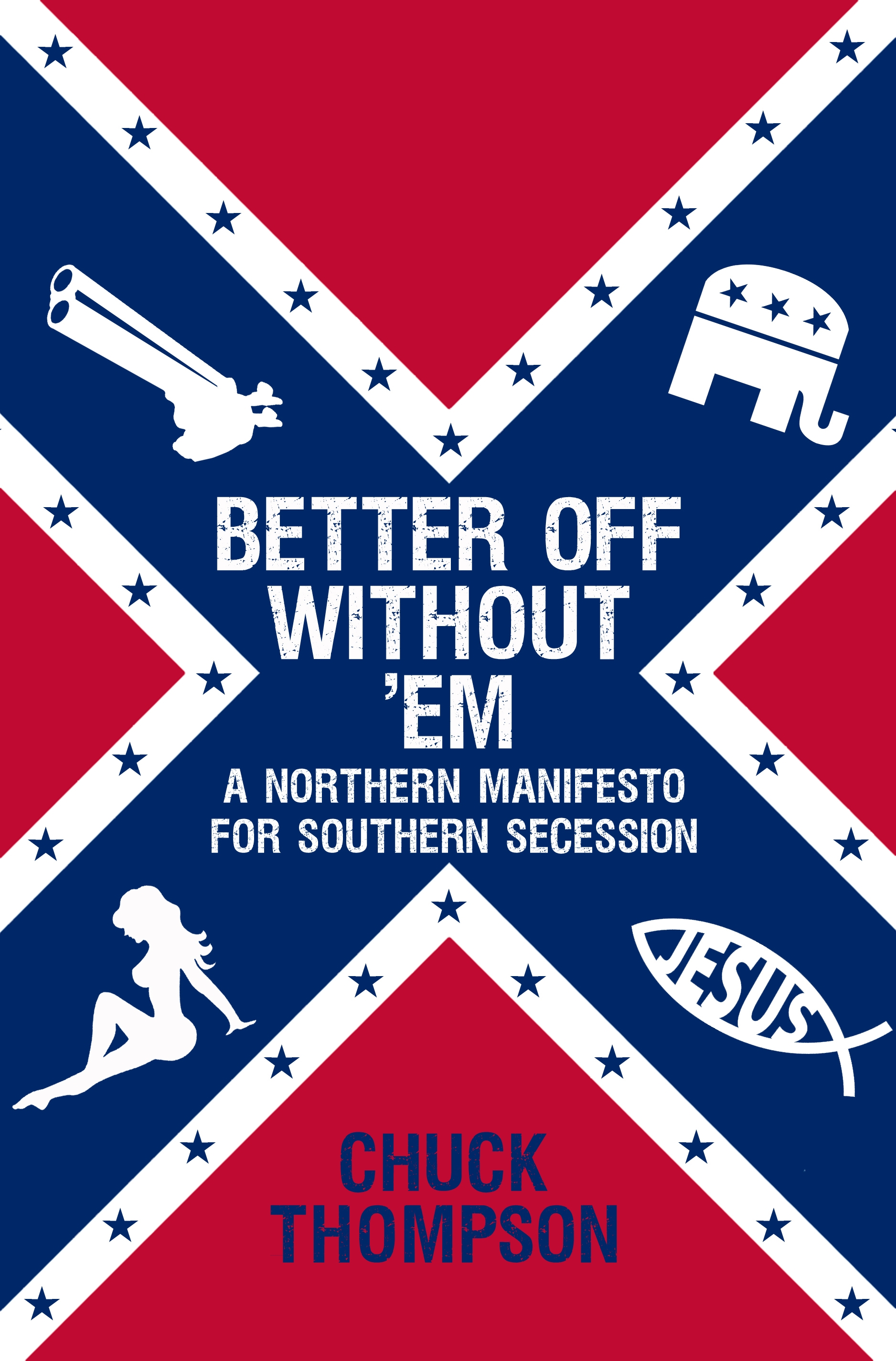
Better Off Without Em Chuck Thompson

In the latest example of America never failing to be hilariously American, residents of basically every state have signed online petitions to secede from the union, something you can apparently do on the White House’s “We the People” website. Of course, signing such a petition — even for those states who managed more than 100,000 signatures (naming no names; Texas) — is very close to meaningless, but whatever, people like to do meaningless things that seem controversial and statement-y, and the media loves to report on those things so ultimately everyone’s happy. In reality, signing a petition to secede from the union is like running away from home and going to the mall. Or worse, since each of the potentially defecting states obviously receives money from the federal government, like running away to the mall and asking your mom to drive you there.

Sidebar though: Am I wrong to think that the We the People site is completely underrated? Obama administration, get on this: A bit of a redesign and this could be the Reddit of legislation. Sure, it might reduce the caliber of political discourse to just a few notches above cat memes, or, based on the current petitions, result in a lot of obscure statues, but it’d be worth it. I mean really, isn’t voting just crowdsourced government?

Anyway, since people in every state have signed one of these petitions, I’m not entirely sure what this post-secession country(ies) would look like (interactive feature idea for We the People 2.0: “make your own USA” map game), but the typical assumption on the subject is to think of the South wanting to secede from the North because of, well, a little thing called precedent. And it’s that particular assumption that makes it so fun to read Better Off Without ‘Em, Chuck Thompson’s impassioned (and at least partially facetious) manifesto for southern secession from the perspective of a northerner.

Continue reading “Cheetos-infused pickles and other reasons the South is that friend we’re kind of embarrassed by but love anyway”

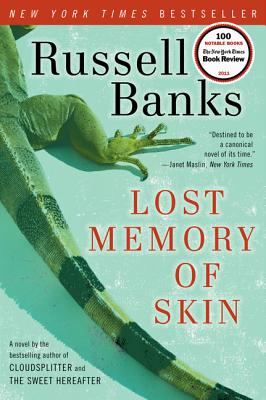
Do not be fooled by the iguana on the cover, Lost Memory of Skin is about sex offenders

Lost Memory of Skin, by Russell Banks

So many accomplishments to speak of this week:

1. I cleaned my apartment! Not in the half-heartedly dusted random surfaces way, but like a for real cleaning, the kind where you move big pieces of furniture and discover weeks’ (months’) worth of hair ties and bottle caps, most of which the cat has pushed together into a central under-couch nest of mischief. Despite my apartment being so small it was until recently technically illegal, this kind of thorough cleaning somehow took me four hours to complete, roughly equivalent to four Weezer albums, which I listened to in order of least favorite to most because obviously that’s just good motivational planning.

2. Per my annual schedule, I completed my Fall Gym Visit. See you in four months, New York Sports Club. (Speaking of which, please stop updating your equipment so frequently that I have to re-learn how to turn on a stationary bike every time I show up. Thx.)

3. I finished, for what feels like the first time in months (a cursory blog review agrees), a really good, really interesting literary novel that made me think about stuff other than which real housewife should legitimately be considered the most famous and whether or not I should buy peanut butter for the express purpose of trying a peanut-butter-and-pickle sandwich.

Continue reading “Do not be fooled by the iguana on the cover, Lost Memory of Skin is about sex offenders”