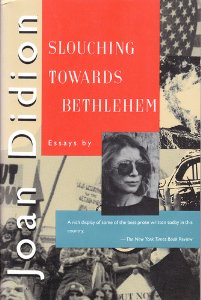
On Williamsburg: A 95% fictional tribute to Joan Didion

slouch

Author’s note: I read my first Joan Didion book this week. (I know, I know. I knooooow.) Naturally, as is to be expected when people say things like “What do you fucking mean you haven’t read Joan Didion?” it was everything. Sheer elegant perfection that I have absolutely no idea how to review. How does the apprentice critique the master? The parishioner judge the pope? So instead I just wrote this. 

*****

The center was not holding. It was a time of celebrities and sensationalism, 24/7 news coverage, mob-like vitriol and profound cultural change. Debt begat debt begat debt. Politics devolved to the starkest red and the muddiest blue; together they became a bruise. I decided to go to Williamsburg. Brooklyn was where they congregated, the mustachioed intellectuals of the next generation, the Great Young Hope, self-named guardians of a nostalgic ethos that valued art and fashion, but also social justice and making things by hand. Williamsburg was a leading franchise of the post-2000 hipster revolution, the era of artisanal bath products and ironic suspenders.

Continue reading “On Williamsburg: A 95% fictional tribute to Joan Didion”
Wild’n Out: Cheryl Strayed makes your summer seem stupid

tumblr_m179qjN8Ec1qd3jsao1_500

I am not, let us say, an outdoorsy person. I have no issue with being outside per se—it’s a nice enough place, depending on location and season and proximity to a bathroom—but it is my lifelong curse to prefer the climate-controlled confines of a manmade building or, at the very least, the squishy satisfaction of an oceanside beach chair. I want to like The Great Outdoors guys, I really do. It’s just that I’m, what’s that word….tip of my tongue….oh yes, that’s it—I’m lazy.

Of course, it doesn’t take a lazy person to appreciate the concept behind Cheryl Strayed’s Wild: a solo 1,000+ mile hike along the Pacific Crest Trail, which is like the Appalachian Trail’s more rugged and less traversed western cousin. The idea—which Strayed developed in the aftermath of her mother’s death, her own bout with adultery and heroin, and her divorce—is ludicrous, particularly for someone as inexperienced with backpacking as Strayed was. (Though it’s worth noting that, presented with the same challenge, I would be even less prepared: After just six hours wearing moderately ill-fitting flats for a wedding last weekend, I limped myself home so pathetically that you would have thought I’d been shot.)

Continue reading “Wild’n Out: Cheryl Strayed makes your summer seem stupid”

If Batman were real and other musings on villainy

i-wear-the-black-hat_original

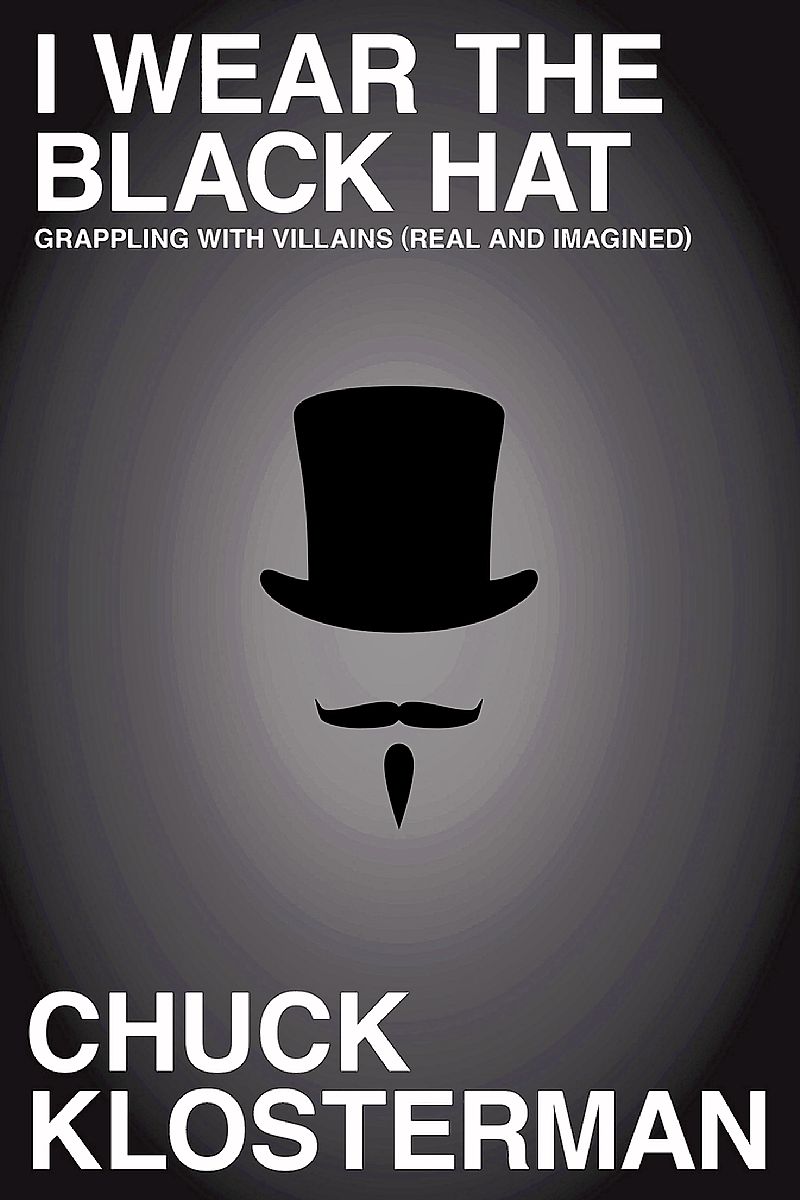
Book-wise, Chuck Klosterman is probably best known for Sex, Drugs, and Cocoa Puffs, his 2003 collection of pop culture essays, or perhaps Killing Yourself to Live, his look at the history of glam rock. More recently, he’s made waves as The Ethicist for the New York Times, a post that comes with its very own silhouette drawing.

Klosterman feels like — and I suspect probably is? — one of those writers that people either adore or really dislike. His style of nonfiction is almost manic, a word-vomit of references and opinions and free-association insights. In a way, CK is like the coked-up friend at the party (coke is what the elderly did before molly, kids), spouting hypotheses on the philosophical difference between Seinfeld and Curb Your Enthusiasm, or the reason the Miami Heat sucked so hard in 2007. He’s got a theory for every topic–though takes care to note that he’s “never had an idea that a hundred other people didn’t have before me.” For me, the kind of person who daydreams curricula for a hypothetical PhD in Reality Television, the Klosterman brand of mania is perfect. But I can understand why not everyone would love it. I guess.

Continue reading “If Batman were real and other musings on villainy”

If Stephen King is a house, The Stand is the front door

stand

Walking to work sometimes—my office is in Times Square—I think idly to myself about the benefits of a post-apocalyptic world. Fewer people. More space. The environment would probably get better. With any luck, Texas would be wiped off the map entirely. “A plague hits, and half of us survive,” I think to myself as I push past Elmos and Darth Vaders lined up like Wal-Mart greeters on 40th Street. “Maybe that wouldn’t be so bad.”

For secret misanthropes like myself, Stephen King’s The Stand is as fascinating as it is horrifying. Felled by a government-created (and accidentally released) superflu known as Captain Trips, the U.S. (and theoretically global) population is eviscerated—only about 1 in 10 people prove immune. Those that survive find themselves cast adrift in a world absent their loved ones, and are scared by the arrival of vivid mass dreams, dreams of a faceless man and a kindly old woman, the former evil, the latter virtuous, the former Satanic, the latter Godly. Propelled by their visions, the country’s remaining residents gather together in two separate locations—Boulder, Colorado for the good’uns, and Las Vegas, natch, for the bad—where they begin to negotiate the formation of new societies, and to prepare for a final showdown between good and evil.

Continue reading “If Stephen King is a house, The Stand is the front door”

I always feel like, somebody’s watching me

watchers

For the vast majority of my adolescence, it would be safe to say that I didn’t care about the news. It’s hard to when you’re a kid—news is just a lot of grown-ups talking about things that seem boring, or complicated, or at the very least not nearly as exciting as Legos. If I’m being honest, it probably wasn’t until college that I really thought, “Huh. Things are going on in the world and I should probably know about them.”

As a result of my youthful Lego predilections—and longstanding struggle to remember things learned in history class—there are enormous gaps in my knowledge of What Hath Happened Before. And yet I, like everyone else, reacted to news of the NSA’s spying operations with a definitive lack of surprise. “Of course the government is spying on us,” I thought to myself while reading Edward Snowden profiles and snickering at the name Booz Allen. “I just assumed they always were.”

I wasn’t alone in this reaction—whether you think Snowden is a hero or villain, outrage over the actual content of his leaks has been relatively muted—and so I thought it might be interesting to fill in some of the missing details. How long have these programs been a thing? Who started them? Why? Should I really be all that worried?

Continue reading “I always feel like, somebody’s watching me”