
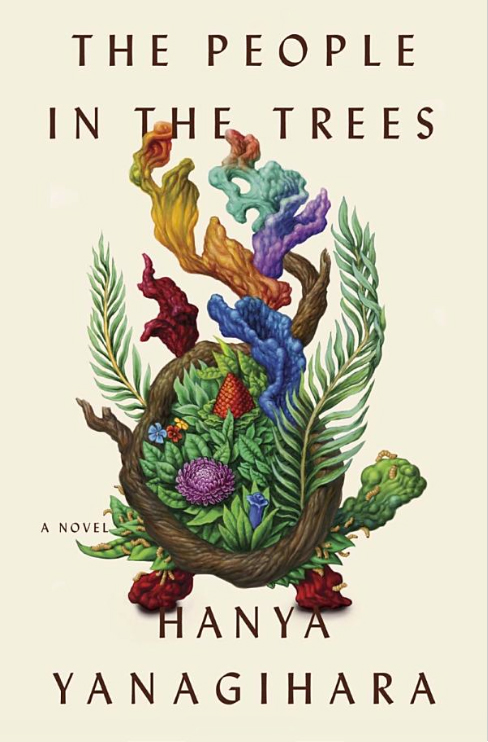
I still haven’t recovered from The People In The Trees

img-thepeopleintreesjpg_171130278616

The Amazon reviews on Hanya Yanagihara’s The People in the Trees are a mixed bag, and fairly so: It’s a beautiful, fascinating and imaginative book—that can at times be highly unpleasant to read.

TPITT is, most immediately, an imagined memoir from doctor Norton Perina—the story is loosely based on IRL doctor D. Carleton Gajdusek—who in his 20’s stumbles upon a lost tribe on a remote Micronesian island. A portion of this tribe, who come to be known as “the dreamers,” suffer from a unique affliction that allows their bodies to stop aging while their minds continue to. Centuries old, while physically middle-aged and mentally childlike, the dreamers prove a career-making discovery for Perina, who goes on to become hugely famous and to adopt dozens of the tribe’s offspring. And yet Perina’s memoir is filtered through a second party, Ronald Kuboderia, a former lab assistant (the NYT review, perfectly, describes him as “Smithers to Perina’s Mr. Burns”) who we discover has asked Perina to write said memoir from prison, where Perina is serving time for pedophilia charges. Like I said: unpleasant.

Continue reading “I still haven’t recovered from The People In The Trees”
You know what’s punk rock about marriage?

51tWJT1BYdL._SY344_BO1,204,203,200_

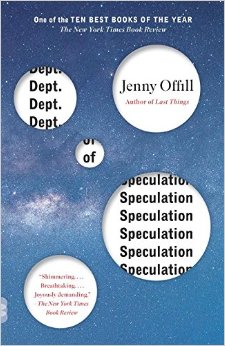
It would be almost be worth my (hypothetical) husband having an affair—maybe worth going through life with a name reminiscent of both “awful” and “offal”—if it meant I could go on to write a book as spectacular as Jenny Offill’s Dept. of Speculation.

A slim treatise on the maturation of a marriage, DOS is so compact as to be easily mistaken for simplistic. There is a husband and there is a wife, who are for all intents and purposes normal. They argue over groceries, money, chores. They have a daughter. They go to therapy (referred to as the “Little Theater of Hurt Feelings”). But don’t be fooled. DOS’s nameless female lead, who refers to herself as I, she or the wife depending on where in the couple’s emotional timeline we are, is one of the most interesting narrators I’ve stumbled across in recent memory. And the book’s unique format—short bursts of text that run the gamut from anecdotes to literary quotes to philosophical musings—belies its sophistication. The otherwise humdrum resonates on a much deeper level here.

Continue reading “You know what’s punk rock about marriage?”

Kazuo Ishiguro’s The Buried Giant, a.k.a. quest love

9159lEtN1aL._SL1500_

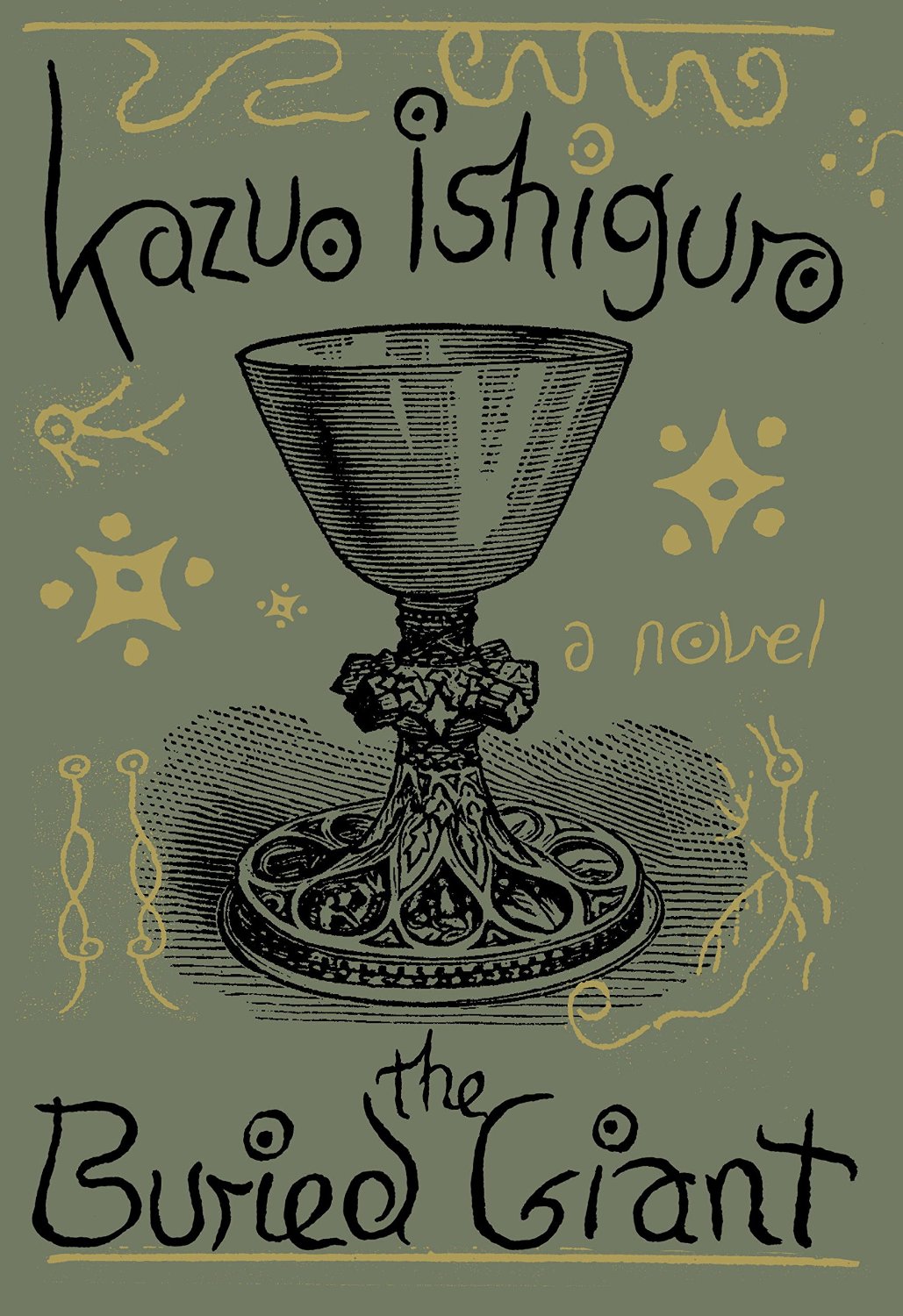
For a book with an actual dragon, The Buried Giant is pretty chill.

Axl and Beatrice—”perhaps these were not their exact or full names, but for ease, this is how we will refer to them”—are an elderly married couple in post-Arthurian Britain, or rather a version of that time and place in which no one can remember anything for more than a few hours. Inspired by vague memories of their son, A&B set off to another village to find him and, as is wont to happen when one goes on journeys in post-Arthurian Britain, are confronted by a series of characters and challenges along the way (including but not limited to: a warrior, a knight, a dragon and a bunch of creepy old ladies). As they travel across land belonging to both Saxons and Britons—formerly warring factions since turned peaceful neighbors—Axl and Beatrice reflect on their lives together and vie to discover things forgotten.

In the Quest genre, TBG follows familiar patterns: misunderstood characters travel from their homes in pursuit of [insert maguffin here], and through a series of distracting but meaningful encounters discover truths that change their perception of themselves, reality or both. These journeys—see: Lord of the Rings, The Wizard of Oz, Alice in Wonderland—are of course stand-ins for life itself, whose maguffin is a mix of happiness and meaning and whose distracting but influential encounters are hard to spot amid all the wearables and Bud Light ads. Seriously, if I saw Gollum reading a newspaper on the subway at rush hour I’m not sure I would bat an eye, let alone absorb a life lesson.

Continue reading “Kazuo Ishiguro’s The Buried Giant, a.k.a. quest love”

Lawrence Wright’s Going Clear is 500 pages of batshit insanity

51vFPxEaajL._SY344_BO1,204,203,200_

It would be difficult to overstate the number of unhinged anecdotes that appear in Lawrence Wright’s 2013 book, Going Clear: Scientology, Hollywood and the Prison of Belief, or in the HBO documentary adaptation that premieres on March 29. There’s the time David Miscavige, the current leader of the church, conducted a game of musical chairs among officers—to the soundtrack of Queen’s greatest hits—telling them that all but the winner would be shipped off to remote Scientology bases. There’s the time L. Ron Hubbard, Scientology’s founder, claimed to have access to an underground space station north of Corsica. And, of course, there’s Tom Cruise. So much Tom Cruise.

Born of interviews with 200 current and former Scientology members, Wright’s Going Clear details Scientology’s 1950s origin story through its present-day troubles, and earned him “innumerable” threatening letters from lawyers representing the church. HBO’s documentary, directed by Alex Gibney, covers a decent portion of Wright’s book, and features interviews with ex-Scientology members that include screenwriter Paul Haggis (35 years in the church) and actor Jason Beghe (13 years), as well as former Scientology higher-ups like Spanky Taylor, a member for 17 years who was John Travolta’s onetime point person; Mike Rinder, church spokesman from 1982 to 2007; and Hana Eltringham Whitfield, a founding member of the Sea Organization (Scientology’s clergy of sorts), who left the church in 1982 after 19 years.

“My goal wasn’t to write an exposé,” Wright tells Gibney early in the documentary. “It was to understand Scientology…. I was interested in intelligent and skeptical people who are drawn into a belief system and wind up acting on those beliefs in ways they never thought they would.”

Continue reading “Lawrence Wright’s Going Clear is 500 pages of batshit insanity”

Americanah is great

51mSJNECGyL._SY344_BO1,204,203,200_

There are few ways to feel whiter than to read a novel written from the perspective of a Nigerian woman who moves to America and discovers how it feels to be black.

More than a decade after coming to America from Lagos, Nigeria, Ifemelu has it pretty good. She’s got a fellowship at Princeton and a handsome professor boyfriend, and makes a decent living writing an anonymous blog about race in the U.S. But Ifem is plagued by thoughts of her past, both in a macro sense—could the only thing righter than leaving Nigeria be going back?—and in a literal one: Ifem’s teenage sweetheart ex, Obinze, is still in Lagos. Granted, he’s married now, but she finds herself thinking about him all the same.

If this sounds like a worldly set up for what is otherwise a traditional “guy meets girl, guy fucks it up with girl, guy and girl eventually reunite” love story, it isn’t. The story of Ifemelu and Obinze is at once traditional and not, and overall far more emblematic of the complications of uprooting one’s life for the ephemeral promise of America than it is of a humdrum long-distance romance. This is not Nicholas Sparks goes to Africa. (Besides, we all know Sparks only writes about white people.)

Continue reading “Americanah is great”