It’s no mystery (just kidding, it is)

Well, I’ve been out of pocket for the last few days and I have to say Internet, I missed you. Not only do I feel very behind on my witty web memes and cute cat photos, but I’ve had nary a moment to engage with all my various personal marketing tools. I’ve barely even tweeted!

Unfortunately I wasn’t holed up all weekend because of a good book, but along the way I did happen to read one. So it’s okay, exhale, there’s still a review this week.

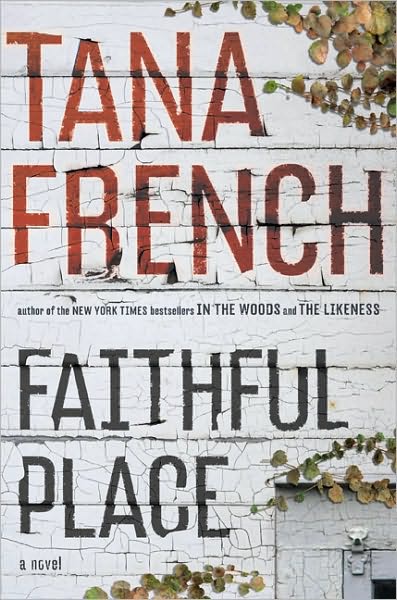
Faithful Place is the third in a series by author Tana French that centers on the undercover squad of a police department in Dublin (Ireland, guys). Although I would argue you should read the first two (mostly because Faithful Place was my least favorite), it isn’t necessary: The third book’s protagonist was but a periphery character in No. 2 The Likeness (though if you’re going to read The Likeness, you should read book No. 1, In the Woods, first. Those two are more closely related.)

Anywho, Faithful Place follows Frank Mackey, an undercover detective who hasn’t been to his hometown (ahem, Faithful Place) to see his family in upwards of 20 years, since he ran away from home at 18 or so. He’s drawn back to his old haunt when some locals find a suitcase that once belonged to his childhood sweetheart (with whom he had intended to run away, and who he’s always assumed blew him off at the last minute). What exactly happened to her, and their plans, is the rest of the story, none of which I intend to give away here.

Continue reading “It’s no mystery (just kidding, it is)”

The littlest gossip girl

Everyone has a Kathy Griffin. That friend, you know the type, who’s effortlessly hilarious, quick with the comebacks, perfect for parties (if you, like me, prefer to bring guests who amuse but also mildly offend the hosts); also the kind of friend who after a few days together starts to grate on you. It’s no fault of theirs, just some people work better in smaller doses. Non-consecutive-day-doses.

Kathy Griffin’s memoir is a lot like her, and like that friend. It’s hilarious, fast-paced and often insightful, but by the end I was ready for a break.

I went into this book not knowing what to expect. Comedians can go both ways when it comes to the written word–sometimes, as is the case with Michael Ian Black, their books are perfection, just slightly more bizarre extensions of their routines (I don’t care what people say about Russell Brand, I find his memoir(s) far more amusing than he is in person). Other times, it doesn’t quite work. You find yourself missing their inflections, or well-placed pauses for laughter. Reading is an isolated activity, and stand-up is a group one. The two don’t always mix.

Griffin’s Official Book Club Selection (which, by the by, awesome title) benefits from Griffin’s stand-up style, which is more long-form storytelling than a series of witty one-liners. Those familiar with her stand-up (or Bravo show) will hear her voice in the writing, but the stories don’t suffer for not being performed on a stage. In fact, the book lets her go further than she probably would to a crowded room—a chapter about her brother, who she suspected of pedophilia (no joke), miiight not have made the best material for a night at Radio City Music Hall. On the page it comes across as insightful and acerbic; one gets the impression humor isn’t so much Griffin’s defense mechanism as it is a lens through which she (and any self-respecting cynic) views the world. In other words, the book isn’t all celebrity gossip and plastic surgery stories; just mostly.

Continue reading “The littlest gossip girl”

In time for Mother’s Day

Generally, I tend not to care who authors’ favorite authors are, but when one of my favorite writers, someone whose books I anticipate, says they read “anything by” another author, well, color me intrigued.

This is how I discovered Elizabeth Berg. Augusten Burroughs—author of Running with Scissors, Dry and a really depressing memoir that I didn’t love but read anyway—said in an interview that he reads anything of hers. Anything! I mean sure, I like a lot of writers, but narrow the list to those entire oeuvre I’ve consumed and the pickings get slim. Five, maybe ten tops. (That list is a post for another day.) So Home Safe is my inaugural Elizabeth Berg book.

Home Safe is one of those books that’s kind of about nothing. There’s no tangible conflict (the main character’s husband dies, but the book starts after that), just emotional ones. Writing about these kinds of issues, this ennui that seems endemic of being upper-middle-class Americans with the liberty to feel things like general sadness, isn’t always my cup of tea—sometimes I find myself waiting for the sex and explosions. But there are a lot of authors who do it right, and Elizabeth Berg is one of them, at least based on this book.

The narrative of Home Safe follows Helen, a recent widow (and ugh, don’t spontaneous and inexplicable husband deaths just fuck with your whole perception of the world) and her 20-something daughter Tessa. There are other characters—Helen teaches a writing class whose students we meet; Helen’s friend Midge, Helen’s parents—but the book isn’t really about them. It’s about grief, and the way we deal with grief, and it’s about mothers and daughters. It’s especially about mothers and daughters.

When my own mother was in town a few weeks ago, at some point during her visit, she confessed that she worried about me, often. “Why?” I asked. I mean, what’s there to worry about? I have my own apartment, good friends, a solid social life, a great job—all things considered, my shit is pretty together. “You know,” she said, “like if you’re happy.”

Continue reading “In time for Mother’s Day”

The user is the content

The sad thing is, I actually read a book last week! I just never got around to writing about it, instead hoping that the e-mail of review-related notes I’d sent myself sometime around Tuesday would perhaps magically transform itself into several paragraphs of coherent thought, and then post itself online. Funny how that didn’t pan out.

My book for last week (again, we’re like six days late here) was Marshall McLuhan: You Know Nothing of My Work!, a brief biography of the 1960s media theorist (Marshall McLuhan) by tech/future/dystopia-focused fiction author Douglas Coupland. I picked up this particular book for three reasons. First, both Coupland and Chuck Klosterman (the latter one of my all-time favorite nonfiction writers) were speaking in New York at an event focusing on McLuhan and his contributions to our understanding of the media landscape (which undoubtedly included questions like “What the fuck would he have thought of Foursquare?”) Unfortunately, work prevailed and I wasn’t able to make the event (I’m still bitter) but by then I was halfway through the book and I am not (anymore) the type to give up. Second, among his many other teaching posts, Marshall McLuhan for a brief time taught at Fordham University, my alma mater, and for this reason (plus, you know, his general fame) was brought up with some frequency by my professors at Fordham, some of whom knew him personally (yes, I majored in media theory, let’s all just deal with it). Third and finally, it was short. Like 200 pages short.

For those who don’t know, Marshall McLuhan was a 1960s media theorist known most commonly for the little gem “the medium is the message.” He based his understanding of the media environment (and far more importantly, on how media transforms the way we behave and think) on literature, the Renaissance and other seemingly unrelated topics, which made his ideas at the time (again, ’60s) seem more batshit than prescient. But prescient they were. Here are a few choice McLuhan quotes, most from 1962.

The next medium, whatever it is—it may be the extension of consciousness—will include television as its content, not as its environment, and will transform television into an art form. A computer as a research and communication instrument could enhance retrieval, obsolesce mass library organization, retrieve the individual’s encyclopedic function and flip it into a private line to speedily tailored data of a saleable kind.

We shape our tools, and afterwards our tools shape us.

The user is the content.

Instead of tending towards a vast Alexandrian library the world has become a computer, an electronic brain, exactly as an infantile piece of science fiction.  And as our senses have gone outside us, Big Brother goes inside. So, unless aware of this dynamic, we shall at once move into a phase of panic terrors, exactly befitting a small world of tribal drums, total interdependence, and superimposed co-existence.

[Terror] is the normal state of any oral society, for in it everything affects everything all the time … In our long striving to recover for the Western world a unity of sensibility and of thought and feeling we have no more been prepared to accept the tribal consequences of such unity than we were ready for the fragmentation of the human psyche by print culture.

Kind of spooky, right? In any case, it’s worth noting that McLuhan has become such a source of soundbites in part because his longer writing, including seminal books like Understanding Media and The Gutenberg Galaxy, aren’t entirely accessible to the average reader (which is to say you have to have a bit of the media nerd in you to really get into them). That particular brand of wonk may not have been what inspired Coupland to write a straightforward and short biography, but his book certainly has the side benefit of laying out some key McLuhan facts without forcing one to dive too deep.

Continue reading “The user is the content”
More than just talk

This week I read a novel by Craig Ferguson. No fahreals, like late night talk show host Craig Ferguson. I know! I was surprised too.

Now, I don’t watch the Late Late Show Craig Ferguson–for one, it’s on mad late–but I do follow him on Twitter and in these postmodern times, I think that counts. In any case, his particular fame (televised) is what made me so intrigued when I came across his book in the store (also I am weak and easily persuaded by celebrity.) Luckily for us all, the book has proven–like chocolate, cough drops and Star magazine–a good impulsive buy. Between the Bridge and the River is a pretty sweet novel.

To clarify – it’s not a sweet novel. I mean, not like “Aw, so sweet.” It’s actually pretty dark, NC-17 even, with the kind of choice descriptions that make you conscious of whether fellow commuters are reading over your shoulder. One gets the sense Ferguson, whose show is on CBS–the network of the elderly–saved up all the words he can’t say, topics he can’t broach and, well, nasty shit he would never dream of bringing up on television, and put it all into one book. Brutal crimes. Perverted sex stuff. Take that, elderly.But I’m simplifying. Between the Bridge and the Water is a lot more than an assemblage of perverse humor. The novel follows an ensemble cast of interlocking characters–some whose relationships prove important, others coincidental (think Crash)–but focuses on two stories: that of brothers Leon and Saul, and that of estranged friends Fraser and George. Both stories are journeys of sorts–Leon and Saul are veritable orphans who run away to become famous, Fraser is publicly disgraced and flees to America, George is diagnosed with cancer and leaves for Paris. Along the way they run into a collective series of situations or semi-dreams that manage to cover everything from religion to Hollywood to death to philosophy. And always with (generally dark) humor.

Continue reading “More than just talk”