In the garden of beasts

In the grand scheme of things, it’s unsurprising that I’ve been interested to read In the Garden of Beasts. For one, it’s about Nazis (indirectly; it’s about the U.S. ambassador to Germany and his family, living in Berlin during Hitler’s ascent to power) and for two, it’s by Erik Larson, whose ability to turn nonfiction into compelling narrative I praised in my review of Devil in the White City. For three, the book was moved to the top of my list after my mom demanded I return it to her over Christmas (I borrowed it from her husband.) Because nothing puts my mom in the holiday spirit like Hitler.

Continue reading “In the garden of beasts”

Some serious people-watching

I’ve often thought that my first novel—I plan to write it in my early 30s and will swiftly rise to meteoric fame and become impossibly rich—will be about reality television. Not because I consider the topic particularly fascinating (to others), but because it is something about which I know a great deal and a subject on which, one might say (I do), I am an unlicensed expert.

Now, if there were anyone in the world to whom I would entrust such a task, in the event that I die a tragic early death at the hands of a rare incurable disease or late-night hobo mugging, it would be Matt McDonough. But if he weren’t around (or happened to die with me at the hands of said hobo), I’d settle for Chuck Klosterman.

Generally speaking, I find that people who’ve read Klosterman tend to fall in one of three camps: (1) Love (2) Hate, or (3) “Sex, Drugs and Cocoa Puffs was pretty good.” Klosterman, like David Foster Wallace, has the sort of unique nonfiction style that earns him both critics and fans, a style to which he is forever associated and from which he struggles to separate himself. As with DFW, some Klosterman adherents are less keen on his fiction, which began in earnest with his 2009 novel Downtown Owl. Before that, Klosterman was known primarily for the aforementioned Sex, Drugs and Cocoa Puffs, as well as Fargo Rock City, Killing Yourself to Live and columns in magazines like Spin and Esquire.

Me, I fall definitively in (1) Love. I agree that his nonfiction is both more accessible and more entertaining, and I agree that he can come across as needlessly self-important. But the topics he loves most—sports, television, music, media’s influence on society—are so generally unimportant (in the grand scheme of world issues) that I find it hard to get worked up about some perceived Klosterman pretension. I can’t begrudge the man his rather strong and overworked opinions on pop culture; I only wish someone would pay me to document my own. 

Continue reading “Some serious people-watching”
Bubba’s words of wisdom

Although I’ve written on this blog of my appreciation for book recommendations, I can say that I’ve never actually immediately read and reviewed something simply because someone told me to—until now.

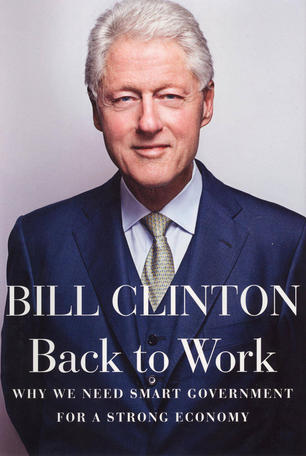
In the interest of savoring Steve Jobs (which is still so very very good), I took a little break from Walter Isaacson’s opus this week for a 200-page detour with Bill Clinton. Yes, gigantic nerd that I am, I actually read Clinton’s oh-so-enticingly-titled Back to Work. (You’re welcome, Aunt Mary.)

Although I suspected this book would be far from riveting, I’d be lying if I said I didn’t go into it intrigued. After all, imagine being Bill Clinton these days. Not recovered-from-heart-surgery Bill Clinton, or my-wife-is-the-secretary-of-state Bill Clinton, or OK-maybe-I-did-have-sexual-relations-with-that-woman Bill Clinton. I mean imagine being the Bill Clinton who left the economy in relatively good shape, with a surplus no less, only to watch it slowly—and then rapidly—deteriorate in the decade after you leave office. Imagine spending eight years building an amazing sand castle, only to have a linguistically challenged Texan come along and stomp on it, send a bunch of sand to Iraq and Afghanistan and then remain notably silent as his cohorts tell everyone that the government sucks at building sand castles anyway, that the entire sand business should be left to the free market, which would never—never—be unfairly advantageous to sand purveyors at the top, at the expense of those at the bottom.

(That analogy didn’t really work but I was committed to it.)

Continue reading “Bubba’s words of wisdom”

Barefoot, fruitarian, genius

For weeks now, I’ve been mad at the Internet. Not for its usual follies—I’m all about animals riding skateboards—but for making it nearly impossible to avoid at least a dozen or more spoilers from the new Steve Jobs biography by Walter Isaacson.

I suppose it’s weird to consider tidbits from one of the most widely anticipated books of the year “spoilers,” but as someone who knew very little about the Apple founder outside of his job title and health status, I had been looking forward to the Isaacson book as a way to learn everything about the man in one fell (500-page) swoop. So you can imagine my frustration when every fifth Tweet (actual proportion exaggerated) for the last three weeks has contained some unanticipated factoid, some “aha” moment from the book that I might have otherwise savored for the first time when I cracked its spine last week.

…Alright, that’s kind of a lie. The truth is I started reading the Jobs book not because I found myself so truly interested in the world’s most interesting man, but because all the cool kids were reading it. (While we’re being honest, I don’t really like biographies. There are very few people about whom I care enough to read their life story, especially when a Wikipedia entry and a few well-researched magazine articles will suffice.) When a book attains a level of commercial success that makes it unavoidable, I simply feel compelled to jump on the bandwagon, slave that I am to pop culture. 

Continue reading “Barefoot, fruitarian, genius”

We’re all in Kansas now

My high school history teacher once told us that politics (or I suppose history in general) is a pendulum—that the order of things is one way until slowly it isn’t anymore, and that this new order is only temporary until the previous status quo comes back again. At the time I thought this a rather interesting way of explaining the trajectory of existence, and a fairly straightforward factoid to remember for the midterm. Only a decade later do I really get how much it also happens to be true.

Thomas Frank’s What’s the Matter with Kansas? came out in 2004, but for all intents and purposes could have been written today, or five years from now. While the book focuses primarily on the last few decades, it indirectly hammers home the pendulum point; history will, for better or worse, repeat itself. We just happen to currently be in a particularly disappointing part of the pendulum swing.

There’s a part of me that feels like I’m the last person on earth to read this book, but knowing that’s never actually the case, here’s a brief summary: Basically Frank set out to assess how middle America in general, and his home state of Kansas in particular, has transformed itself into a bastion of Republicanism, even though conservatives’ belief in the infallibility of the free market is exactly what’s resulted in a reduction in quality of life for the very people that populate middle America. (Whew.) I wish I could sum up every point Frank makes in a few easy-to-read/entertaining paragraphs, but the reality is that this is a heavily researched book, with a lot of interesting points and a lot of infuriating realities. It answers a question (or at least attempts to) that I think many of us have been asking ourselves for the last few years, and in such a way that at the end you feel simultaneously informed yet depressed, knowledgeable yet resigned. This may be an at-times infuriating phenomenon, but it’s not a new one.

Continue reading “We’re all in Kansas now”