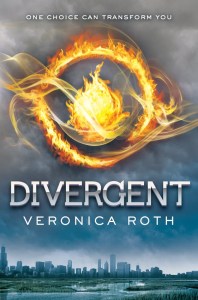
Are teenagers obsessed with post-apocalyptic politics now or what am I missing?

Divergent hc c(2)

After promising my sister that I would spend this past weekend hitting 20% on ye old Les Miserables, I did absolutely no such thing. Instead I got really caught up in this New York Times article about “new adult” books, then proceeded to read five books for teenagers instead. I know: I have the literary tastes of a 14-year-old me.

Of course, having now availed myself of the relevant resources (i.e. teen sex books) I have some things to say about this “new adult” trend, but that’s a post for another day. Instead, my first review of 2013 goes to Veronica Roth’s Divergent, Book #1 in a young adult series that will ring quite a few bells for anyone familiar with young adult series.

(It probably says something about today’s teens that all their literary blockbusters include dystopian future societies where political ideology results in the institutionalized oppression of the masses. Must be that Justin Bieber, influencing them on the causes that count.)

Continue reading “Are teenagers obsessed with post-apocalyptic politics now or what am I missing?”

I made a really detailed graphic explaining all the characters in The Broom of the System, which, incidentally, is a pretty good book

BroomOftheSystem
Exhibit A

In the latest example of my hands having far too much time on them (first example), please take some time to look over Exhibit A: a complex PowerPoint diagram I put together to document the intricate character relationships in The Broom of the System, David Foster Wallace’s now 25-year-old first novel. (Here’s a link to a legible version.)

BOTS, in an extremely simplified sense, is about Lenore Beadsman, a 20-something underemployed receptionist at the publishing house of Frequent and Vigorous, a job made all the less demanding by Lenore’s relationship status with F&V Chief Executive Richard “Dick” Vigorous (as the kids say, “it’s complicated.”) One day in 1990, Lenore gets a call from a Mr. Bloemker, manager at the Shaker Heights Home, where her great-grandmother (also named Lenore Beadsman) has apparently gone missing, along with another two-dozen patients and staff members. In the company of Dick Vigorous, Lenore goes in search of her missing great-grandmotherβ€”both physically and I suppose intellectuallyβ€”along the way discovering or re-discovering various people in her life and in many cases stumbling across histories or idiosyncrasies they had heretofore failed to disclose.

Continue reading “I made a really detailed graphic explaining all the characters in The Broom of the System, which, incidentally, is a pretty good book”

The Big Girls, no longer my suggested title for an Oxygen dating show about overweight but still sassy single women

The Big Girls, by Susanna Moore

I’m cheating this week. The truth is that I’m still knee-deep (waist-deep I guess, since I’m about halfway through) on The Broom of the System, which is frustrating since it’s the end of the year, i.e. book goal crunch time, and I have big reading/blogging plans for the next few weeks (re-reading Perks of Being of Wallflower, first-time reading Les Miserables and writing some sort of roundup of my favorites of 2012.) But it’s David Foster Wallace, and proper respect must be paid — by which I mean I’m willing to backtrack four times per reading session to make sure I haven’t lost the thread of characters I’m supposed to know about, or connections I’m supposed to have identified. I swear on Honey Boo Boo that I will finish that book this week, especially since I’m officially finished crushing two full seasons of Downton Abbey.

In the meantime, a few weeks ago I finished The Big Girls, by Susanna Moore. I picked this one up at The Strand (I wouldn’t remember things like this except all my Strand books have $1 price tags on them) since I’d read Moore’s In the Cut years ago, and vaguely remember liking it (actually, I remember very little about the book, and more about the eventual movie made from it, which I saw with my mom, which entailed very awkwardly sitting together to watch Meg Ryan and Mark Ruffalo have lots of sex.) Also, see the aforementioned $1β€”at that price, I’ll buy any book that doesn’t have biologically questionable stains on it.

Continue reading “The Big Girls, no longer my suggested title for an Oxygen dating show about overweight but still sassy single women”

Why [no one really cares that] I left Goldman Sachs

In March of this year, Goldman Sachs executive director Greg Smith wrote an opinion piece in the New York Times titled, “Why I Am Leaving Goldman Sachs,” in which he outlined his decision to end a 12-year tenure with one of the most successful investment banks in the world. In that declaration — which I wrote about back when I reviewed Matt Taibbi’s Griftopia — Smith put the fault on a shifting Goldman culture, where “the interests of the client continue to be sidelined in the way the firm operates and thinks about making money.”

Critics called Smith’s op-ed naive, but I found it decently badass, and so was fairly excited for Why I Left Goldman Sachs, the book. It held the allure of additional juicy Goldman tidbits — like the Times essay’s disclosure that clients were often referred to as “muppets” — and other embarrassing examples of the kind of corporate greed and financial whimsy that lend credibility to the idea of the 99% versus the 1%. I didn’t expect Smith to divulge any massive illegal folly on Goldman’s part, so much as to remind us why we should be angry that these are the people who run the institutions we’ve deemed too big to fail.

Unfortunately, not only does WILGS fail to be particularly earth-shattering with respect to the financial sector, it for the most part fails to be particularly interesting as a book. Smith, a mediocre writer at best, gets lost in the story of his own humdrum advancement at Goldman, and appears to be confused about what does or doesn’t rate as memoir-worthy. While some degree of exposition is to be expected, it’s not until more than halfway through the book that Smith even begins to outline the subject on which its title is based. Nor does the first half feel particularly relevant, except as an overt ploy to qualify his ultimate disillusionment (“Before we get into why I left Goldman, let me explain that I am clearly a smart and awesome person.”) Listen, I don’t care that you took three years of Zulu, Greg. I don’t care that you visited the first-ever Wendy’s, or how good you were at using the trading desk’s time-stamping machine, or where you buy your shirts, unless it’s a shirt store fronting for a purveyor of diamond-encrusted toilets, or something I don’t know, a little more Goldman Sachs.

Continue reading “Why [no one really cares that] I left Goldman Sachs”
It’s complicated

I don’t know why Jeffrey Eugenides set The Marriage Plot in the early 1980s (except that he was himself was a 20-something at the time), but I can say in retrospect why it feels necessary: there wasn’t any Facebook.

The Marriage Plot is about Madeleine Hanna, Leonard Bankhead and Mitchell Grammaticus, all seniors at Brown when we first meet (or hear of) them. Over the course of the novel, told in part through flashbacks, Mitchell meets and falls in love with Madeleine, who meets and falls in love with Leonard, who falls in love back with Madeleine. It would be an almost simplistic love story were it not for the narrative foil of Leonard, who in addition to being the Edward to Mitchell’s Jacob, is also bipolar. Management and treatment of the disease dominate his life, and in turn his relationship with Madeleine. 

Continue reading “It’s complicated”