Sonali Deraniyagala’s Wave is possibly the saddest book I’ve read in my entire life

ThewaveDeraniyagala

Close your eyes. Okay now open them because obvi you need them to read this. Now think about the saddest thing you can think of—puppies dying, children crying, your local bodega running out of Ranch Doritos, what have you. Now multiply that thing times a million. A billion, even. Wrap it in a layer of terminal illness, crimes against humanity and the possible absence of a benevolent God. Only now—having duly considered the sheer tragedy and injustice of the universe—are you even remotely approaching the inherent and heart-wrenching sadness of Wave.

On vacation with her family in Sri Lanka, Sonali Deraniyagala is merely perturbed when on the morning of December 26, 2004, waves can be seeing crashing over the usually calm beachhead outside their hotel. Within minutes she realizes what’s happening—the Indian Ocean earthquake and tsunami we would later learn killed more than 200,000 was about to hit, and she had minutes, maybe seconds, to get out.

Grabbing her children and her husband, Deraniyagala runs outside, failing to stop and warn her parents—staying in the room next door—of the impending catastrophe. It ultimately doesn’t matter. In the ensuing tidal wave, which floods the Jeep in which Deraniyagala and her family are attempting escape, Deraniyagala’s children and husband die. Her parents’ death—a given, as they never escaped the ultimately-leveled hotel—is just icing on the world’s shittiest cake.

For her part, Deraniyagala is tossed around in the Jeep and ultimately comes to—albeit, still in shock. She is rescued moments before being washed out to sea. Deraniyagala spends a hollow-eyed few days trolling the local hospital, waiting for her family to join the scores of survivors camped out there, but also somehow knowing they won’t. Several weeks after the wave, their bodies are identified, and so begins Deraniyagala’s decade-long grieving process, outlined in Wave, a slim but impactful memoir.

Continue reading “Sonali Deraniyagala’s Wave is possibly the saddest book I’ve read in my entire life”
Sheryl Sandberg wants women to grow a pair

LeanInSherylSandbergCover

The woman of Sheryl Sandberg’s world is a timid creature. She’s smart but not savvy, ambitious but afraid to appear so, confident and driven but plagued by self-doubt. She’s wary of participating in meetings, wary of asking for promotions, wary of taking on new assignments. And don’t even get me started on motherhood—this woman has been ruminating on the work/life balance basically since she learned where babies come from.

For this woman, Sandberg has a wealth of advice, which in its entirety boils down to the central conceit of her book: Lean In. This woman—this hyper-sensitive, underutilized and challenge-averse woman—needs to stop sitting in the back row at meetings, stop taking flak from colleagues, and stop turning down opportunities because she’s unsure about her abilities. She needs to build organic and mutually beneficial relationships with coworkers, and worry less about being liked and more about being respected. She needs to speak her mind with colleagues and bosses, and if and when she decides to throw a bun in the oven, not start sacrificing her career the second she realizes she’s pregnant. She could also stand to snag an understanding, supportive and equally driven husband, who won’t hesitate to pitch in on 50% of the child-rearing and housework. In short, Sheryl Sandberg wants this woman to sack up (which, incidentally, would have been a way better book title.)

Continue reading “Sheryl Sandberg wants women to grow a pair”

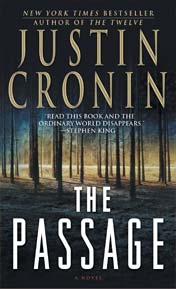
The Passage did an Indiana Jones under the closing door that is my tolerance for vampire books

Passage-small

Clocking in at over 900 pages, The Passage tested my ability to finish a book in fewer than seven days (I lost). Fortunately for author Justin Cronin, I have an unlimited capacity for consuming page-turners late into the night, preferably while munching on Chex Mix. I see your gargantuan paperback, Mr. Cronin, and raise you a fistful of cheese-flavored pretzels bits. It took nine days, but I did it.

Where to begin. So The Passage centers on a government experiment being conducted on twelve willing participants (willing by virtue of the alternative: all are death row inmates) who the U.S. military hopes to turn into fast-healing, super-strong and generally un-killable soldiers. Of course, those of us familiar with a little thing called pop culture know how this ends: fucking vampires.

Continue reading “The Passage did an Indiana Jones under the closing door that is my tolerance for vampire books”

Men are from Earth, women are from Earth

howtobe

It’s only through sheer fortuitous timing that the week I read a book on feminism, Seth MacFarlane goes on national television to offend a zillion people with uninspired jokes about actresses’ boobs. And since I’ve been presented with such a timely opportunity to discuss gender as it’s portrayed in modern society, let’s conduct a bit of a thought exercise—looking at Seth MacFarlane’s Oscar performance through the lens of Caitlin Moran’s How to Be a Woman.

Throughout her book’s 300-odd pages, Moran eschews characterizations of feminism that rely on lofty terminology or soul-searching investigations of social mores. Her own definition on the subject essentially boils down to two key tenets: 1) An environment of equality is one in which, quite simply, “everyone is being polite to each other” and 2) When one is unsure whether or not they’ve been presented with a bit of sexism—or, as Moran sometimes puts it, a bit of “total fucking bullshit”—one must simply ask oneself: “Are the men doing it?”

Continue reading “Men are from Earth, women are from Earth”

Working title: Monks in Space!

canticleOh how I wanted to love this book.

A Canticle for Leibowitz was a recommendation from a friend, an avid Sorry Television reader who makes my day every few weeks when we run into each other socially and talk books. After our most recent such encounter, I dug through my memory bank for his long-ago recommendation and promptly ordered it online. What arrived in my mailbox two days later (thank you Amazon Prime) was this, a weighty paperback whose intimidating cover art is paralleled only by its introduction’s promise of frequent use of Latin. Apprehensive and intrigued, I dug in.

It’s difficult to explain what ACFL is “about,” a struggle not entirely helped by my edition’s vaguely worded back cover, which devotes a third of its real estate to phrases like “one of the most accomplished, powerful, and enduring classics of speculative fiction.” The book opens in post-apocalyptic times—roughly the 26th century—when the human race has long since crippled itself in a nuclear war known as the Flame Deluge. Off the bat, we meet Brother Francis, a monk in the “Albertian Order of Leibowitz,” a monastic order devoted to the preservation of knowledge, a task they accomplish by hoarding, hiding, memorizing and copying books whose value has been drastically reduced by a post-Deluge society that frowns upon literacy. Leibowitz refers to Isaac Edward Leibowitz, a 20th-century electrical engineer employed by the U.S. military, who after being martyred for his devotion to scientific knowledge, was beatified by the Romance Catholic Church (“New Rome”). At the time of the book’s opening, he is a candidate for sainthood. Continue reading “Working title: Monks in Space!”