Crime doesn’t pay, unless you’re Tana French (or a drug dealer, or a thief….OK maybe it pays)

brokenharbor

Six years ago, Tana French had zero books. Today she has four (five if you count The Secret Place, set for publication in 2014) and they are for the most part pretty awesome. Set in Dublin and surrounding neighborhoods, each of French’s novels tracks a high-profile homicide and its investigation by a member/members of the Dublin Murder Squad, a parade of gruff yet nuanced detectives with personal backgrounds that range from the tragic to the merely unfortunate (we’re talking everything from missing/murdered childhood best friends to suicidal moms).

In Broken Harbor, which I feel compelled to admit I finished a few weeks ago at the beach (I’m running behind, okay? DON’T JUDGE ME) the case in question is a triple homicide: Patrick Spain and his two young children are found murdered in their home in a once up-and-coming (or once aspiring-to-up-and-come) beachfront-ish housing development. Wife/mom Jenny Spain barely survives the attack, and is laid up at the emergency room recovering as Detective Mick “Scorcher” Kennedy begins investigating the case. Of course, per the aforementioned personal background requisite, Scorcher has his own history with Broken Harbor (the presciently sad name of the housing development) and so must contend with his own emotional roller coaster as he becomes increasingly obsessed with the murder.

Continue reading “Crime doesn’t pay, unless you’re Tana French (or a drug dealer, or a thief….OK maybe it pays)”
Swimming with the Seths

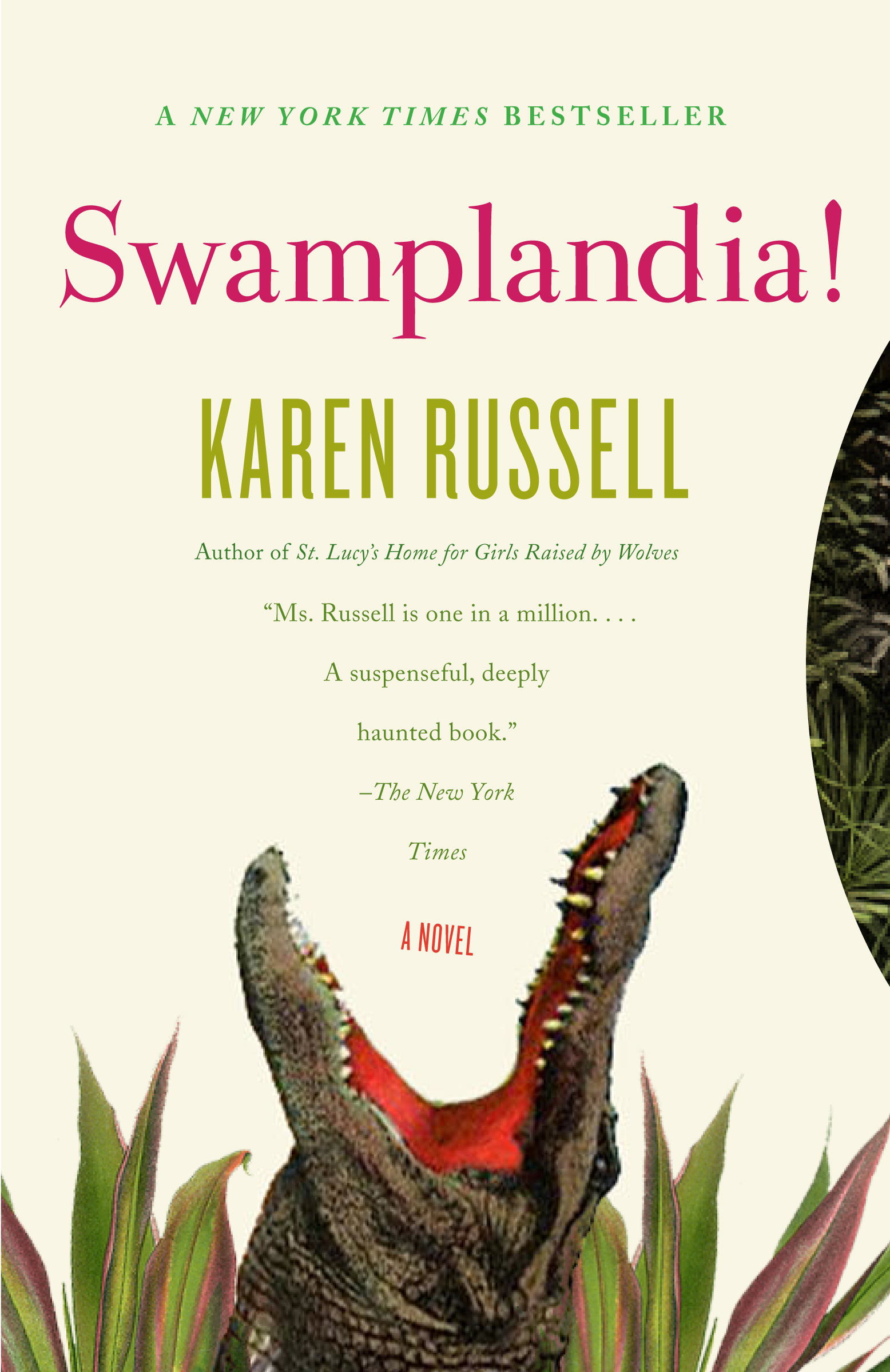
Swamplandia_cover

There’s a strong chance that any attempt on my family’s part to co-operate some sort of theme park would end in both tears and shouted insults regarding business acumen (also probably bankruptcy). You see, we Bindrims are not meant to work in concert, and it’s really in everyone’s best interest that we reserve our interactions for lesser affairs, like the Thanksgiving table. Still, whenever I stumble onto a movie or book predicated on the notion of a family-run entertainment venue (in a fit of boredom, I even watched Dolphin Tale a few weeks ago) I can’t help but envy the unique camaraderie that comes with providing a bit of wacky family-run family fun.

Which brings me to Swamplandia! A gator-wrestling theme park in the Florida Everglades, Swamplandia! is owned and operated by the Bigtree family, whose implied tribal background is just that: implied. In reality, the Bigtrees are made up of dad (the Chief), mother Hilola, daughter Osceola, son Kiwi and daughter Ava, the last of whom is our narrator. The family-run operation — accessible only by boat — is chugging along smoothly until the relatively sudden death of Hilola, who in addition to being the maternal unit is also Swamplandia’s star attraction: Every night she dives headfirst into a pit of alligators in what’s referred to as “Swimming with the Seths” (all of the alligators are named, and referred to as, Seth). After Hilola’s death, her surviving family members are distraught, and Swamplandia struggles to retain its fan base absent a main attraction.

Continue reading “Swimming with the Seths”

Finally digging into The Autobiography of Malcolm X

3 X slideshow

I decided to dive into The Autobiography of Malcolm X after last week’s 50th anniversary of the March on Washington, during which people like Barack Obama and Oprah touted how far our nation has come on civil rights in the last five decades. Said Obama in his speech: “To dismiss the magnitude of progress, or to suggest, as some have, that little has changed, dishonors the courage and sacrifice of those who paid the price to march.”

A week later, having delved into the life and thoughts of one of the country’s most recognizedβ€”and contentiousβ€”civil rights leaders, I find myself wondering whether Malcolm X would entirely agree

TAMX begins in Lansing, Michigan, where Malcolm Little is a generally good kid and upstanding student until the day he visits a relative in Boston and his mind is blown by all the hustle and bustle and black people. That tripβ€”coupled with a teacher’s admonition that Little could never be a lawyerβ€”inspires in him a certain frustration, and Malcolm soon drops out of school and moves to Boston, and later Harlem, where he becomes a small-time hustler: selling weed, shepherding men to prostitutes, robbing apartments, etc.

At 20, back in Michigan, Malcolm is arrested for robbery and sentenced to 8-10 years in prison (a sentence he notes is harsher for his choice of accomplices: white women) where he reads a shit-ton of books and discovers the Nation of Islam, a Muslim offshoot-slash-cult that promotes self-sufficiency, asceticism, surrender to Allah and that “the collective white man had acted like a devil in virtually every contact he had with the world’s collective non-white man.” (Which, true.)

Continue reading “Finally digging into The Autobiography of Malcolm X”

But I don’t own anything in orange

orange

Along with hoards of other Netflix subscribers, I settled into my couch earlier this month to power through Orange is the Black, the much-hyped new series from the same distribution network (channel? online service? whatevs) whose House of Cards occupied the better part of my February.

For the uninitiated, OITNB is the story of Piper Chapman, a yuppie blonde whose past indiscretions–a brief stint smuggling drug money–come back to haunt her when her erstwhile lady lover/cartel supervisor (?) sells her out to the cops almost a decade later. In the show, Piper is sent to a minimum-security women’s correctional facility to serve her 12ish months, alongside (because of course) said lady lover, who’s also locked up for her cartel involvement. The show, which touches on themes like class, gender, sexuality and race (among others) is a touching, insightful and extremely witty look at the realities of prison in America, the country that currently has as many people locked up as there are in all of Houston.

Netflix’s OITNB is based on a memoir of the same name, written by Piper Kerman, who was incarcerated for 13 months at the women’s federal correctional institute in Danbury, Connecticut (plus a few weeks at other facilities). 

Continue reading “But I don’t own anything in orange”

On Williamsburg: A 95% fictional tribute to Joan Didion

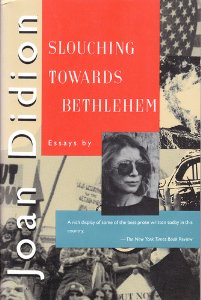
slouch

Author’s note: I read my first Joan Didion book this week. (I know, I know. I knooooow.) Naturally, as is to be expected when people say things like “What do you fucking mean you haven’t read Joan Didion?” it was everything. Sheer elegant perfection that I have absolutely no idea how to review. How does the apprentice critique the master? The parishioner judge the pope? So instead I just wrote this. 

*****

The center was not holding. It was a time of celebrities and sensationalism, 24/7 news coverage, mob-like vitriol and profound cultural change. Debt begat debt begat debt. Politics devolved to the starkest red and the muddiest blue; together they became a bruise. I decided to go to Williamsburg. Brooklyn was where they congregated, the mustachioed intellectuals of the next generation, the Great Young Hope, self-named guardians of a nostalgic ethos that valued art and fashion, but also social justice and making things by hand. Williamsburg was a leading franchise of the post-2000 hipster revolution, the era of artisanal bath products and ironic suspenders.

Continue reading “On Williamsburg: A 95% fictional tribute to Joan Didion”