I am completely beside myself about We Are All Completely Beside Ourselves

WeAreAllCompletely_paperback

If there’s anything to be said for going into a book completely clueless, it should be said about Karen Joy Fowler’s We Are All Completely Beside Ourselves. I didn’t go into it clueless (as I am categorically incapable of not reading back-cover blurbs) but a friend of mine did, and I’ve spent the better part of my standard review prep period (read: eating cashews and staring out the window) thinking about how different my experience with WAACBO would have been if I didn’t know from the very first page that Fern, the absentee sister about whom narrator Rosemary Cooke is writing, is [SPOILER] a chimp.

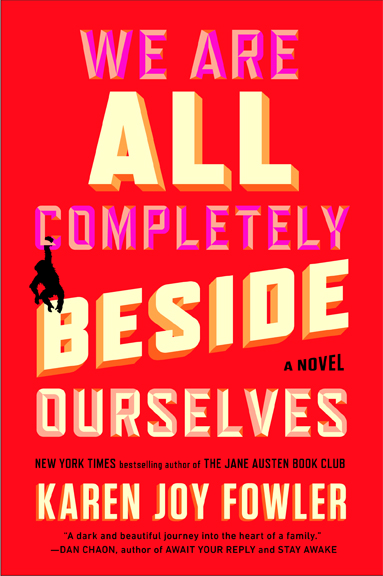
This information, while crucial to the novel’s plotβ€”WAACBO is, in fact, Rosemary’s adult reflection on growing up with, and then without, Fernβ€”isn’t officially revealed until page 77, which is a hell of a long time to leave the species of a main character intentionally ambiguous. And yet, whether by accident or tacit agreement among everyone involved with the publishing and promotion of this book, it is a hard spoiler to avoid: WAACBO’s cover (my version, at least) has a chimp on it, and Rosemary’s most pertinent quote on the matterβ€””I tell you Fern was a chimp and already you aren’t thinking of her as my sister”β€”is included in the plot summary on the back cover. Somewhat less egregiously, We Are All Completely Beside Ourselves has since its publication attained a reputation as an “animal rights novel,” which to the uninformed reader certainly begs the question: Wait, there’s an animal?

It is this facet of WAACBO, its unique presentation of the moral questions surrounding the scientific use of animals, that makes it impossible for me to review the novel without mentioning that Fern is indeed a chimpanzee. Apologies if you feel slighted by my decision, but let me assure you: This is a book whose spoilers are incidental, a beautifully written and impactful thought experiment that deserves every accolade it has already received, plus many more. Nuanced and engrossing and extremely relevant, WAACBO may be the best book I’ve read this year.

Continue reading “I am completely beside myself about We Are All Completely Beside Ourselves”

15 years late, I’ve joined the Neil Gaiman fan club

neverwhere

For even for the most casual observer of book publishing today, Neil Gaiman is something of a household name. He’s an author that seems almost serendipitously ubiquitous–one morning there’s an interview in the New York Times, a week later your friend mentions she loved Smoke and Mirrors, four days after that you scroll past a Facebook status praising American Gods. Nearly a decade ago now, those types of impromptu nudges finally drove me to pick up a paperback copy of Neverwhere at The Strand, and it’s languished on various bookshelves in my apartment ever since.

See, I am, for reasons that elude even me, oddly wary of fantasy books. If I had to guess, I would say it stems from some childhood fear of being nerdier than I already wasβ€”for most of my formative years I was rocking glasses, braces and a head of hair that went from bowl cut to rat’s nest before I caught on to conditioner somewhere in middle school. Indeed, those torturous limbo grades can be an unfortunate time for the acquisition of new interests, as one is misguidedly forming Opinions about things just a few years shy of the momentous realization that other people’s Opinions about things matter way less than they seem to. Perhaps I saw a foray into fantasy booksβ€”and all the cultishness and costumes and collectibles my 10-year-old self thought that impliedβ€”as a bridge too far, a surefire way to limit my romantic prospects to boys with Star Trek t-shirts and Magic: The Gathering cards. Little did I know those boys would grow up to be hipsters and I’d end up dating them anyway.

Continue reading “15 years late, I’ve joined the Neil Gaiman fan club”

Night Film is two parts Hitchcock, one part Stephen King

18770398

When 24-year-old Ashley Cordova is found dead in an abandoned warehouse, veteran journalist Scott McGrath is determined to get to the bottom of it, even though all signs point to suicide. McGrath, a once celebrated investigative reporter, is still reeling from his public fall from grace years earlier, a discrediting prompted by his repeating an anonymous and disparaging tip about Ashley’s father, Stanislav Cordova, a fastidiously reclusive horror film director, who sued McGrath for slander over the remark.

Intrigued by Ashley’s death, and still hung up on the story that sunk his career, McGrath finds himself teaming up with an unlikely duo of “meddling kids“β€”Hopper, a drug dealer whom Ashley contacted shortly before her death, and Nora, a coat-check girl/aspiring actress who was one of the last people to see Ashley alive. The group’s research takes them deep into the world of Stanislav Cordova, an investigation author Marisha Pessl relays through both narrative and a series of photos, screen grabs of online news stories and pages from Cordova-themed message boards. The man that emerges is a Hitchcock-meets-Eli-Roth eccentric whose brief but cultish career left a trail of scarred employees and rabid fans in its wake.

Continue reading “Night Film is two parts Hitchcock, one part Stephen King”

On The Goldfinch, Dickens and haters

527141df7cd2b.preview-300

You know that uniquely torturous last week of work before you go on vacation, when you’re obsessively checking weather reports and find yourself spacing out to to thoughts of fudge and salt-water taffy? That’s me right now, just four days shy of my annual sojourn to the peaceful post-Labor Day rhythms of Ocean City, New Jersey. My bag is half-packed and I’ve got my reading list sorted (new Tana French, new-ish Marisha Pessl, new-adjacent Karen Joy Fowler); all I need is to survive the next 93 hours. It’s exactly like that James Franco movie, except less time and I’m not trapped and at the end of everything I anticipate still having both arms.

Little has been able to hold my attention since the 10-day New Jersey forecast became relevant, with the exception of The Goldfinch, the much-discussed winner of the 2013 Pulitzer Prize for fiction and Donna Tartt’s first novel since The Little Friend in 2002 (and before that, The Secret History in 1992). I’d been delaying starting The Goldfinch for months, both because it’s exceedingly long (around 800 pages) and because people have Opinions about The Goldfinch, and sometimes it’s hard to get objectively invested in a book when one is aware, however vaguely, of the existence of Opinions. But surely, I thought as I searched for the door-stopper of a galley copy I’d plopped onto my bookshelf six months ago (ultimately traded for the e-book within 10 pages), surely a Pulitzer Prize winner can’t be bad. Surely I couldn’t hate it. And so with some trepidation, and a quiet symphony of Atlantic Ocean waves playing at the edge of my subconscious, I dove in.

Continue reading “On The Goldfinch, Dickens and haters”

I want to get drunk with Scott McClanahan

scott-mcclanahan-collected-works

The table of contents for Scott McClanahan’s The Collected Works Vol. 1 reads like a set list for a night of boozy storytelling. There’s “The Homeless Guy,” “The Chainsaw Guy” and “My Dad and the Cop.” There’s “Kidney Stones” and “Hernia Dog” and “The Prettiest Girl in Texas.” Truly, even before you read the first line of the first entry in this slim collection of stories, you have a sense of McClanahan the guy, and a sense of his work: These are tales like those we tell in person, over beers and among friends. They’re sometimes funny and sometimes bleak, and they reveal as much about ourselves as they do about anyone else in them.

I stumbled onto The Collected Works because of its cover (adages be damned), which is a cute (and legally ballsy?) imitation of a Penguin Classic, noticeably irreverent only on second glance. None of the 28 stories in the collection is more than a few pages, and most end in pseudo-philosophical punchlines that sometimes make you want to laugh and shed a tear at the same time. As author Sam Pink writes in the afterword:

“[McClanahan] writes in a way that is conscious of both his own absurdity and that of others, without overdoing either. He makes it really easy to like the narrator and to learn from the narrator’s experiences. Scott also knows how to balance humor and sadness.”

Continue reading “I want to get drunk with Scott McClanahan”