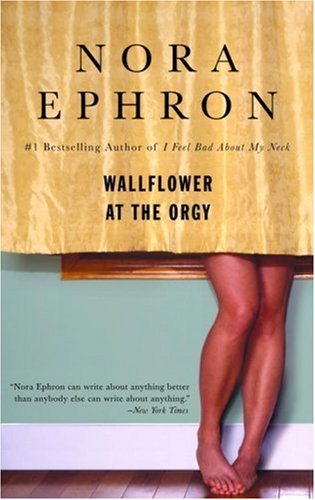
Wallflower at the Orgy

I’m running behind this week, which I could lie and chalk up to something altruistic—”So sorry, I’ve been busy curing cancer”—or even something moderately acceptable, like watching the Republican National Convention, but the truth is that I’ve been doing none of those things (no really, I haven’t been curing cancer). The truth is I’ve been out of pocket because I’m too busy watching two seasons of The Vampire Diaries in less than two weeks. The truth is that Netflix is ruining my life.

Fortunately for all of us, I have a backlog of books to review, and I’m going on vacation next week (worry not, the laptop is coming), during which time I’ll spend my days riding bikes, lounging by pools, eating foods with cheese in/on them, and reading. I may even do some of those things at the same time. Long story short, there are plenty of reviews ahead, and theoretically plenty of blog posts from a more insightful and upbeat, and less stressed and cynical, version of myself. But we are talking the Jersey shore here, so let’s not get too optimistic.

Continue reading “Wallflower at the Orgy”

A short review of short stories

Etgar Keret strikes me as a weird dude. Like, if we went out to lunch, I’m not sure what we’d talk about. Somehow I suspect the short story author—whose vignettes generally cover such weighty fare as life and death, heaven and hell, and suicide bombers—would not care to hear me expound on the merits of this season’s Bachelorette contestants. Somehow I think maybe I’d run out of things to say.

Suddenly, a Knock on the Door is Keret’s latest volume of short stories, a former collection of which I’ve reviewed on this blog in the past. It’s a quick read—none of the stories are more than a few pages—and equally as odd as previous Keret books I’ve read. Interestingly, when people talk about short story authors they like (not that I have these types of conversations with any regularity), I often mention Keret, in part because a) I don’t really love short stories, so have a limited inventory of writers to bring up and b) whether or not I love each of his books (I don’t), I have to admit that what Keret does is seriously unique. His stories are funny, but not about funny things; they’re also serious, but not depressing. Maybe sarcastic? Maybe tongue-in-cheek? It’s hard to tell.

Have you ever met one of those people that’s just hard to read? (no pun intended) Like they’re just incredibly deadpan and you’re not always sure if it’s dry humor or if maybe they’re slightly autistic and don’t understand humor or general social interaction? Etgar Keret’s books are like those people—you’re never 100% sure what he’s trying to say, but you know he’s trying to say something. If nothing else, it’s interesting thing to watch (i.e. read).

Anywho, I’ve been plowing through books lately—I see it as my body preparing for summer hibernation, during which I sit within one foot of my air-conditioner at all times and read books or marathon-watch old shows on television—so Keret’s 188-page Suddenly, a Knock on the Door was a blip in my otherwise busy roster of longer reads. It’s a quirky little book—he strikes me as a quirky little guy—and if you’re into that sort of thing, you should read it, too.

🏆🏆

TITLE: Suddenly, a Knock on the Door
———————————————-
AUTHOR: Etgar Keret
———————————————-
PAGES: 188 (in paperback)
———————————————-
ALSO WROTE: The Nimrod Flipout, The Bus Driver Who Wanted to Be God
———————————————-
SORTA LIKE: Miranda July meets Jonathan Safran Foer
———————————————-
FIRST LINE: “‘Tell me a story,’ the bearded man sitting on my living-room sofa commands.”
The Great White Hype

Based on the success of Malcolm Gladwell’s books—approximately 8 zillion sold and counting—I went into Outliers with moderately high expectations. For a nonfiction author to attain Gladwell’s level of notoriety, even with a platform like the New Yorker, I assumed one of two things must be true: Either he’s a phenomenal writer, or every book includes a $50 Red Lobster gift certificate in the back flap. Sadly, neither is the case.

Now, in fairness, Outliers is not a bad book. The idea is compelling—Gladwell seeks to identify the stories behind some of the world’s most successful people, without settling for “Oh Bill Gates is just like, super awesome with computers” logic. His overall point—explained through multiple interesting examples—is that factors like upbringing, cultural background and circumstance play a very large role in success. And once you start reading, it’s kind of a “duh” realization. In fact, any kid who’s ever been the youngest in his elementary school class (sorry late birthdays!) realizes that even something as uncontrollable as your birth month can have every effect on your ability to stand out in a crowd.  Continue reading “The Great White Hype”

Is everyone hanging out without me?

Alright, so maybe I slacked off a little. MAYBE, instead of spending the last week writing book reviews with all the gusto of a person with nothing to do except eat takeout and watch old sitcoms, I instead just ate takeout and watched old sitcoms. I’ll admit it, I fell off the wagon a bit.

Fortunately, that doesn’t mean I haven’t been reading. In fact, I spent most of Christmas Eve Eve hunkered down in a ForeverLazy with my grandmother’s memoir, interrupted only by my mother popping in to berate me for bothering to read it (the memoir is, for the record, just as poorly written as I suspected, and just as unintentionally hilarious.) I spent the train ride to my mom’s house reading Mindy Kaling’s Is Everyone Hanging Out Without Me?, and the train ride back reading The Sibling Effect, a Christmas gift from said mom. I spent most of last week on The Night Eternal, the third and final installment of the Guillermo del Toro/Chuck Hogan collaboration (which actually inaugurated this blog) and most of this week (so far) on Bag of Bones, a Stephen King novel that was recently turned into a (hopefully good because I recorded it) made-for-TV movie on A&E. 

Continue reading “Is everyone hanging out without me?”

Please advise

So I’m phoning it in a bit this week: I’m exhausted, coming down with some sort of cold that I plan on ignoring, and in the middle of a 1,000-page Stephen King opus that I totally could have finished in a week if that week were not also the start of fall of television (for me, a month-long frenzy of trying out new cop dramas and quirky comedies before deciding what can feasibly be added to my DVR schedule.)

Fortunately for all of us—all five—I have a spare book to review. Because some sick sad neurotic old cat lady inside of me is already hoarding finished books to fill the inevitable gaps in my blog posting; as though the world would end if I let a week pass without word-vomiting all over the Internet. (Note: It would.)

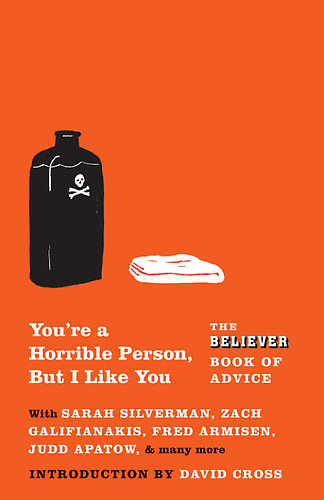
You’re a Horrible Person, But I Like You (from here on out referred to as YAHPBILY) has been a staple in my apartment—appearing intermittently on couches, chairs, counters and yes, in the bathroom—for the last year, during which I would read it in small increments between more ambitious fare. Finally on Friday, when I brought it out with me in lieu of the 1,000-pager (even I’m not that devoted when bar-hopping) I managed to finish this slim volume of hilarity on my 4 a.m. train ride home. Yay productive use of drunk travel!

I suppose there’s no way to not take it easy with a review like this: YAHPBILY isn’t the kind of book one really sits down and reads. It’s a “book of advice,” a slapstick parody of Dear Abby and similar columns, where answers to the questions from “readers” (who are not real people) are provided by a veritable smorgasbord of current comics and actors, including Sarah Silverman, Ed Helms, Zach Galifianakis and Amy Sedaris (among many, many others.)

Continue reading “Please advise”