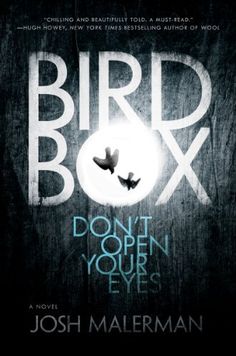
Bird Box is creepy as hell and I like it

83296177dfebdbf60972d38be97824cf

No one is sure how it started. Or what started it. One day there was a report of a man in Russia who was riding in a truck with his friend. He asked the friend to pull over and then attacked him, removing his lips with his fingernails. A few days later, another report: five thousand miles east of St. Petersburg. A mother buries her children alive and then kills herself with broken dishes. Then a video; a man trying to attack the videographer with an axe, and eventually succeeding. No one knows what spurs the attacks or why, just that people see somethingβ€”just, somethingβ€”and then violently murder those around them before killing themselves. The only way you can be sure to avoid catching it, whatever it is, is to avoid opening your eyes.

No it’s okay. I’ll wait while you shit your pants.

Continue reading “Bird Box is creepy as hell and I like it”

Serial fans should be getting down with Tana French

books31f-1-web

If you have ears and you haven’t been listening to Serial, you frankly don’t deserve them.

The beloved podcast, a pseudo-real-time deep dive into the 1999 murder of high school student Hae Min Lee and the conviction of her ex-boyfriend Adnan Syed, dropped its 10th episode today. Which means right now listeners all over the country are spending Thursday as they always do in this, our post-Serial world: debating the merits of a 15-year-old homicide investigation, and emphatically declaring or protesting Adnan’s proclaimed innocence. Somewhere, during a quick bite at the office cafeteria, coworkers are arguing over the inherent shadiness of Adnan’s accuser, Jay. Somewhere, a wife is screaming at her husband: “But what about the Nisha call!?!

As runaway hits go, Serial lives up to its hypeβ€”and I say this as someone who generally keeps the Podcasts app in her phone”s “NOPE” folder, along with Stocks and iTunes U. The program is smart and thought-provoking, and bizarrely compelling for something you experience as only a listener.

Continue reading “Serial fans should be getting down with Tana French”

Amy Poehler on life, comedy, & humping Justin Timberlake

2D274905957270-YesPlease.blocks_desktop_medium

I generally try not to review two lady memoirs in a row (for variety’s sake, if not to avoid alienating my strong contingent of ultramasculine readers) but when an advance copy of Amy Poehler’s Yes Please falls into one’s lap, one does not let opportunity pass them by. One does spend all of Sunday eating mozzarella sticks in bed while laugh/cry/nodding at Poehler’s engaging, insightful and overall A+ addition to the Lady Library, whose other contributors (Fey, Kaling, SilvermanGriffin, Dunham) have graced Sorry Television in the past. One does, after spilling marinara sauce on one’s pillow and accidentally eating a mozzarella stick the cat licked, ruminate on whether one is in fact living her life to the fullestβ€”engaging in behavior likely to engender the sort of chance encounters, dedicated friendships and hard-won professional achievements Poehler documents in her book. One does, briefly, regret not having been a teenager in the 80s, for the #tbt photo possibilities alone. One does, not briefly, feel proud to be a woman.

It would be wrong to try and rank the titles in the Lady Library from best to worst, or funniest to least funny, or most predictable to most surprising. It feels barely not wrong to call it the Lady Library, and I only do so because those books above are in many ways about being female, in a male-dominated world (comedy, Hollywood, America, Earth), and with all the assumptions and expectations womanhood implies. But if I had to rank the ladybooks, like if someone put a gun to my head and said “Quick! What’s your favorite female comedian’s memoir?”β€”I dunno, it could happenβ€”I’d have to call it a tie: Between, naturally, Tina Fey and Amy Poehler.

Continue reading “Amy Poehler on life, comedy, & humping Justin Timberlake”

On The Road is the original ‘Why I left New York’ essay

kerouac-on-the-road-611x940

In a cosmic sense, I think it’s fair to blame Jack Kerouac for the glorification of Leaving New York. Ever since On The Road “defined a generation” in 1957, people exhausted by the hardscrabble urine-scented life of an NYC resident can feel validated, self-righteous even, over their decision to pack up and Go West, to set down new roots in the sunny climes of San Francisco and LA, or the laid-back liberal enclaves of Denver and Portland.

As Kerouac did (under the guise of “Sal” in On The Road) people who leave New York seem almost immediately overcome by the compulsion to write about their departure, and for all the other things OTR has become since its publicationβ€”an American classic, the signature novel of a social movement, a favorite book of recreational drug users everywhereβ€”it is also the OG of “Why I Left New York” rants. In his rambling and disorganized account of several years road-tripping back and forth across the country with Neal Cassady (Dean Moriarty in OTR) and a rotating cast of other since-canonized Beatniks (also represented by fictional alter egos), Kerouac beautifully romanticizes trading in his New York life (technically Paterson, NJ, but still) for a whirlwind and often penniless tour to and from and across the western half of the country, a tour filled with charismatic hitchhikers and negligent gas station attendants and drugs and alcohol and women and old friends whose wives are never happy to see Sal and Dean show up on their doorsteps.

On the Road has a reputation, as many books of this genre do, of being exhausting to read, or at least difficult to engage with. Kerouac wrote the novel as if writing a letter to a friend, and it feels like it: sentences run on and seem unedited, punctuation is sparse, characters are introduced with a presumed familiarity that makes the reader feel like they’ve stumbled across a stranger’s journal, not a book written for public consumption. But once acclimated to the formatβ€”sort of drug memoir meets travel diaryβ€”I found OTR engaging enough, like listening to a friend who’s had a few too many Red Bull/vodkas tell you about their European backpacking trip, or finding yourself on a long cab ride with a chatty driver who has a soothing voice and an interesting life story. While Kerouac wastes little energy on the character development of anyone except Dean (who is, more than anyone, the novel’s main character and most vibrant “creation”), it is the style and feel of On the Road that allows the reader to understand Sal, and in turn Kerouac, and to appreciate the former’s fictional insights as the latter’s real ones.

Continue reading “On The Road is the original ‘Why I left New York’ essay”
Night Film is two parts Hitchcock, one part Stephen King

18770398

When 24-year-old Ashley Cordova is found dead in an abandoned warehouse, veteran journalist Scott McGrath is determined to get to the bottom of it, even though all signs point to suicide. McGrath, a once celebrated investigative reporter, is still reeling from his public fall from grace years earlier, a discrediting prompted by his repeating an anonymous and disparaging tip about Ashley’s father, Stanislav Cordova, a fastidiously reclusive horror film director, who sued McGrath for slander over the remark.

Intrigued by Ashley’s death, and still hung up on the story that sunk his career, McGrath finds himself teaming up with an unlikely duo of “meddling kids“β€”Hopper, a drug dealer whom Ashley contacted shortly before her death, and Nora, a coat-check girl/aspiring actress who was one of the last people to see Ashley alive. The group’s research takes them deep into the world of Stanislav Cordova, an investigation author Marisha Pessl relays through both narrative and a series of photos, screen grabs of online news stories and pages from Cordova-themed message boards. The man that emerges is a Hitchcock-meets-Eli-Roth eccentric whose brief but cultish career left a trail of scarred employees and rabid fans in its wake.

Continue reading “Night Film is two parts Hitchcock, one part Stephen King”