
Three books to make you uncomfortable

Tis the season of the beach read, and nothing says beach read like Hitler and slavery.

9780804138833

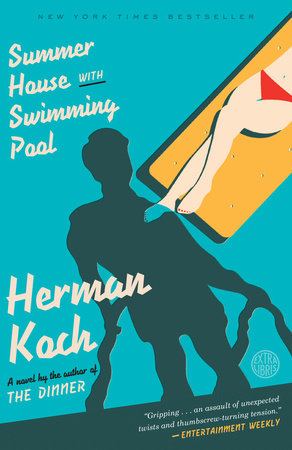
TITLE: Summer House With Swimming Pool
AUTHOR: Herman Koch
PAGES: 387 (in paperback)
ALSO WROTE: The Dinner
SORTA LIKE: Tom Perrotta meets Bret Easton Ellis
FIRST LINE: “I am a doctor.”

Summer House With Swimming Pool is Koch’s second novel translated into English from the original Dutch (I reviewed the first, The Dinner, a few weeks ago). Like The Dinner, SHWSP is a creepy suspenseful family drama involving parents’ actions when it comes to their children.

Doctor Marc Schlosser and his family—wife Caroline and daughters Julia and Lisa—find themselves becoming friends with Marc’s patient, famous actor Ralph Meier, and his family, whom the Schlossers ultimately join on a vacation at the Meier’s summer house. While Marc wiles away his vacay passively loathing Ralph (while half-assedly wooing Judith), both families are suddenly affected by a tragic event that forces them to contend with their true feelings about each other.

Continue reading “Three books to make you uncomfortable”

The Frank And Claire Underwood of Amsterdam

15797938

Every single person in The Dinner, Herman Koch’s 300-page bottle episode of a psychological thriller, is just the absolute worst.

Set in Amsterdam (the book is translated from its original Dutch), The Dinner is about two couples who go to a fancy dinner together to discuss a pressing matter involving their respective children. Paul Lohman, attending the evening’s festivities with his wife Claire, is a former teacher with a petulant attitude and an impatient streak, both of which he exercises freely against his brother Serge, who, along with his wife Babette, makes up the rest of the dinner party. Serge’s burgeoning candidacy for Netherlands prime minister is but one of many things about him that irks the shit out of Paul.

Continue reading “The Frank And Claire Underwood of Amsterdam”

Station Eleven is your weekly reminder that the world is going to end soon

StationElevenHCUS2

In the precious reading time afforded by my daily commute, the world is often ending. Sometimes its Armageddon by plague (The Stand, The Dog Stars, Blindness); sometimes by zombies or vampires (World War Z, Warm Bodies, The Strain); sometimes by nature (The Age of Miracles). Every so often the end comes by way of nuclear war (A Canticle for Leibowitz), or global destitution (Ready Player One), or deadly sightings of something or someone as-yet unidentified (Bird Box). The method doesn’t matter; what does is the universal consensus among the fiction-writing community that shit is going to hit the fan at some point, and that humans are not emotionally prepared for that cleanup.

Despite a heretofore limitless appetite for end-of-the-world novels, I went into Station Eleven—which served six dutiful months un-cracked on my nightstand—feeling a bit burned out on the genre. What could Emily St. John Mandel say that so many others hadn’t already? What point could she make that would separate Station Eleven from the dozens of post-apocalyptic books that have come before, whose conclusions can be summed up in a few tweets: Fate is fickle; people are inherently bad, or inherently good, depending on the author. Humanity is resilient. These notions—sometimes mixed in with bits of zombie and/or vampire lore—are the main tenets of fiction’s collective Hot Take on the end of the world. Winter Is Coming, and people will do anything for a coat. 

Continue reading “Station Eleven is your weekly reminder that the world is going to end soon”

Americanah is great

51mSJNECGyL._SY344_BO1,204,203,200_

There are few ways to feel whiter than to read a novel written from the perspective of a Nigerian woman who moves to America and discovers how it feels to be black.

More than a decade after coming to America from Lagos, Nigeria, Ifemelu has it pretty good. She’s got a fellowship at Princeton and a handsome professor boyfriend, and makes a decent living writing an anonymous blog about race in the U.S. But Ifem is plagued by thoughts of her past, both in a macro sense—could the only thing righter than leaving Nigeria be going back?—and in a literal one: Ifem’s teenage sweetheart ex, Obinze, is still in Lagos. Granted, he’s married now, but she finds herself thinking about him all the same.

If this sounds like a worldly set up for what is otherwise a traditional “guy meets girl, guy fucks it up with girl, guy and girl eventually reunite” love story, it isn’t. The story of Ifemelu and Obinze is at once traditional and not, and overall far more emblematic of the complications of uprooting one’s life for the ephemeral promise of America than it is of a humdrum long-distance romance. This is not Nicholas Sparks goes to Africa. (Besides, we all know Sparks only writes about white people.)

Continue reading “Americanah is great”

The Girl On The Train is Gone Girl’s brother from another mother

w544850

Gone Girl is like the Uber of popular fiction—it became huge very quickly, lives up to its hype and now serves as a linguistic benchmark for equivalent genre-defining success. Seems every new thing is the Uber of something now. Likewise, every best-seller whose plot is even vaguely mystery-adjacent seems now sagely tallied in the column “Gone Girl Afterglow,” a category of books defined by our apparent lingering fascination with sultry whodunits whose screenplay adaptations may or may not include brief glimpses of Ben Affleck’s penis.The Girl on the Train has, in short order, joined that column—it’s been at the top of the fiction lists for weeks. But in this case at least, the comparison is apt. Which is all a long-winded way of saying: If you liked Gone Girl, you will absolutely like The Girl on the Train.

In a recent NYT interview, Richard Price said of books he loved: “I didn’t read them; I snorted them,” which strikes me a great way to describe a page-turner. To be sure, I snorted TGOTT, just like I snorted Gone Girl. And TGOTT’s plot is similar: Every day from the window of her commuter train, Rachel catches a glimpse of “Jess and Jason,” a seemingly happy couple who live in a house not too far from the tracks. A down-on-her-luck alcoholic still mourning the end of her marriage, Rachel comes to emotionally rely on her J&J sightings, which is why she’s shocked one day to spot Jess kissing another man. When Jess goes missing a few days later, Rachel is determined to suss out the culprit, while also trying to remember what, if any, part in Jess’s disappearance she may have played herself.

Continue reading “The Girl On The Train is Gone Girl’s brother from another mother”