Being a zombie is cheaper

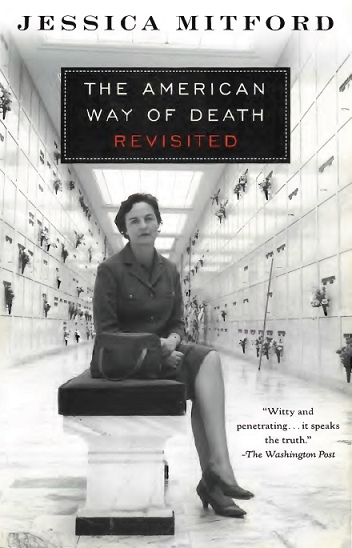
A coworker stopped by my desk earlier today and got a glimpse of this week’s newly finished read: Jessica Mitford’s The American Way of Death Revisited. “Oh you know,” I said sheepishly, surreptitiously trying to stuff the book under some papers. “Just some light summer reading.”

Indeed, it is appropriately Kira that I spent most of July 4 alternating between watching A&E’s Hoarders, peeking at the haphazard and totally dangerous fireworks being set off by my neighbors and finishing up a book about our country’s determination to profit off of our respective unavoidable deaths. Yay capitalism! Yay America!

The American Way of Death may sound familiar to you detail-oriented readers: I mentioned it a few weeks ago in my review of Mary Roach’s Packing for Mars. See, I first bought this book back in college after reading Roach’s Stiff: The Curious Lives of Human Cadavers and despite what at the time seemed like a suddenly insatiable need to learn more about the topics raised in Roach’s book (embalming, decomposition, grave-robbing…you know, the usual), I seem to have given up on The American Way of Death around July 2007, just 100 pages shy of finishing. The book then survived one apartment move and multiple bedroom reconfigurations before I discovered it this weekend. (“Casket price gouging and funereal regulatory intervention? Sounds like Independence Day reading to me!”)

Continue reading “Being a zombie is cheaper”
Aggressively marketed nachos

I know I joke around a lot about having only one or two readers and, for the most part, I’m not joking. Like seriously, I see the numbers. There are about five of youโ€”six on a good dayโ€”and I’m grateful for every one. But on this lovely day in June, I find myself particularly grateful to one reader in particular (no, not you mom) who by virtue of her totally enviable job in book publishing, sent me some freebies in a very official-seeming package that arrived at my office yesterday, forcing me to gloat to my coworker (another reader, bless her) about how totally awesome I am and how probable it is that in the not-so-distant future I will be far too famous for my book blog to bother with a regular 9-to-5 and she should probably get on my schedule now if she wants to still be friends in 2012.

So thanks, new favorite reader (I am withholding your identity because I don’t want to get you in trouble for sending books to a reviewer with a 5-person audience one cannot predict the magnitude of attention you would get if I mentioned you by name.) It’s nice to write book reviews; it’s even nicer to think that someone, somewhere out there is enjoying them.

On to The Ask! I first heard about this book sometime last year, when it was reviewed not once but twice in the New York Times. (Seriously NYT, something like 200,000 books are published a year and you can’t bother to limit it to one review per? I just don’t know how my imminent memoir about growing up an upper-middle-class suburban white girl will ever break through.) Since I am criminally awful at summarizing the actual plots of booksโ€”have you guys noticed?โ€”I’ll just steal a paragraph from Lydia Millet’s review:

โ€œThe Askโ€ describes a crisis in the life of one Milo Burke, a deeply cynical academic development officer, earnest binger on doughnuts, avid consumer of Internet porn, and devoted father and husband. Detailing the meltdown of Miloโ€™s career and marriage, โ€œThe Askโ€ takes place in an exhausted and passive institutional workplaceโ€”the kind of futile office space we know from such cinematic offerings as, well, โ€œOffice Space.โ€ … When Milo loses his job, then gets a chance to have it back if he can reel in a big fishโ€”a major gift from an old college friend whoโ€™s now a Machiavellian tech millionaireโ€”he starts down a grim and spiraling path.

That’s enough (unlike the Times, I don’t believe in giving away a novel’s entire plot in a review.) The bottom line: The book is about Milo, a definitive sad sack with artistic aspirations but limited motivation, who alternates his time between grandiose ruminations on “the meaning of it all” and just run-of-the-mill complaining. โ€œWe were stuck between meanings,” he writes. “Or we were the last dribbles of something. The fall of the Soviet Union, this was, the death of analog. The beginning of aggressively marketed nachos.โ€ (Confession: This was the easiest quote to pull as it was referenced in not one, but both Times reviews. SERIOUSLY NYT, GET IT TOGETHER.)

Continue reading “Aggressively marketed nachos”

Intergalactic, planetary

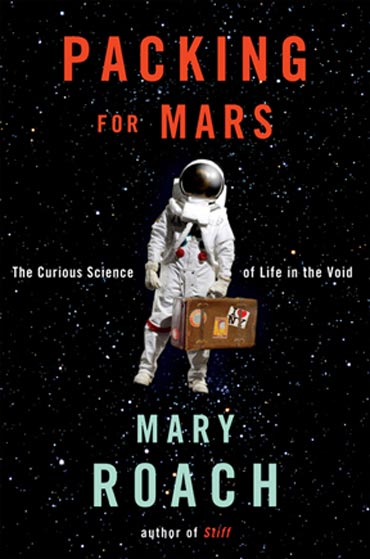
Imagine pooping in a plastic bag about six feet away from a good friend. Now imagine doing it in space. Now imagine imagining scenarios like this one while packed into a train crammed with commuters you hope won’t notice the frequency of the word “feces” in the book you’re holding, and you’ll get a sense of how truly awesome it is to read Mary Roach.

I first got into Roach in freshman year of college, when her debut book, Stiff: The Curious Lives of Human Cadavers, made me legitimately interested in what happens to our bodies after we die (no really, legitimately interested. I subsequently read Jessica Mitford’s The American Way of Death, which was just as fascinating, though far less hilarious). Since then, I’ve read each of Roach’s three subsequent books within a month of their release: Spook: Science Tackles the Afterlife, Bonk: The Curious Coupling of Science and Sex and most recently Packing for Mars: The Curious Science of Life in the Void. The last of these I finally finished over the weekend (after realizing that the chances of my polishing off 550-page The Corrections in time for this week’s review were slim to none).

Continue reading “Intergalactic, planetary”

Sex and drugs and house

I suppose it’s appropriate that I would be reviewing Brave New World during a particularly stressful week at work. After all, in Aldous Huxley’s faux-utopian novel, there is no stress. Everyone’s happy with their station in life and during those brief moments when they aren’t, during the hours one might otherwise ruminate on daily obstacles, there’s government-approved and -distributed soma, as close an approximation to Xanax as one might have conceived in the early 1930s.

I don’t know how I managed not to read Brave New World up until this point, but just in case you haven’t either, here’s the basic idea: The novel is set in a future society where women no longer give birth biologically; couples aren’t married, “everyone belongs to everyone else.” On the social level, this means that everyone sleeps with everyone else, women and men are discouraged from forming relationships longer than a few months (and should never be exclusive). On the biological level, this means that birth has become a science. Embryos, created and brought to term in what are essentially human-producing factories, are split into different castesโ€”Alphas, Betas, Gammas, etc.โ€”and conditioned based on their predetermined station in life. Moreover, the lower the caste, the more humans are created from one egg, a scientific achievement knows as the “Bokanovsky Process.” So while an Alpha is a one of a kind, a human conditioned only to respect the values of this new society (togetherness, happiness, tranquility, consumption), an Epsilon may be one of 40+ identical “twins” created from the same egg, and created to be of lower intellect and expectation, the ideal humans to …man elevators, or work in factories, without even the ability to want something better for themselves.

Continue reading “Sex and drugs and house”

In time for Mother’s Day

Generally, I tend not to care who authors’ favorite authors are, but when one of my favorite writers, someone whose books I anticipate, says they read “anything by” another author, well, color me intrigued.

This is how I discovered Elizabeth Berg. Augusten Burroughsโ€”author of Running with Scissors, Dry and a really depressing memoir that I didn’t love but read anywayโ€”said in an interview that he reads anything of hers. Anything! I mean sure, I like a lot of writers, but narrow the list to those entire oeuvre I’ve consumed and the pickings get slim. Five, maybe ten tops. (That list is a post for another day.) So Home Safe is my inaugural Elizabeth Berg book.

Home Safe is one of those books that’s kind of about nothing. There’s no tangible conflict (the main character’s husband dies, but the book starts after that), just emotional ones. Writing about these kinds of issues, this ennui that seems endemic of being upper-middle-class Americans with the liberty to feel things like general sadness, isn’t always my cup of teaโ€”sometimes I find myself waiting for the sex and explosions. But there are a lot of authors who do it right, and Elizabeth Berg is one of them, at least based on this book.

The narrative of Home Safe follows Helen, a recent widow (and ugh, don’t spontaneous and inexplicable husband deaths just fuck with your whole perception of the world) and her 20-something daughter Tessa. There are other charactersโ€”Helen teaches a writing class whose students we meet; Helen’s friend Midge, Helen’s parentsโ€”but the book isn’t really about them. It’s about grief, and the way we deal with grief, and it’s about mothers and daughters. It’s especially about mothers and daughters.

When my own mother was in town a few weeks ago, at some point during her visit, she confessed that she worried about me, often. “Why?” I asked. I mean, what’s there to worry about? I have my own apartment, good friends, a solid social life, a great jobโ€”all things considered, my shit is pretty together. “You know,” she said, “like if you’re happy.”

Continue reading “In time for Mother’s Day”