Bubba’s words of wisdom

Although I’ve written on this blog of my appreciation for book recommendations, I can say that I’ve never actually immediately read and reviewed something simply because someone told me toโ€”until now.

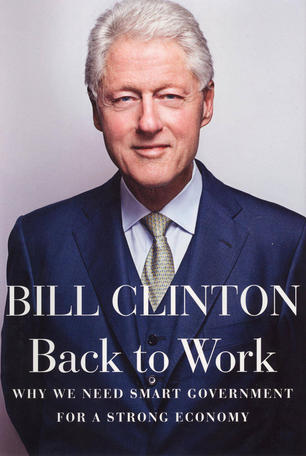
In the interest of savoring Steve Jobs (which is still so very very good), I took a little break from Walter Isaacson’s opus this week for a 200-page detour with Bill Clinton. Yes, gigantic nerd that I am, I actually read Clinton’s oh-so-enticingly-titled Back to Work. (You’re welcome, Aunt Mary.)

Although I suspected this book would be far from riveting, I’d be lying if I said I didn’t go into it intrigued. After all, imagine being Bill Clinton these days. Not recovered-from-heart-surgery Bill Clinton, or my-wife-is-the-secretary-of-state Bill Clinton, or OK-maybe-I-did-have-sexual-relations-with-that-woman Bill Clinton. I mean imagine being the Bill Clinton who left the economy in relatively good shape, with a surplus no less, only to watch it slowlyโ€”and then rapidlyโ€”deteriorate in the decade after you leave office. Imagine spending eight years building an amazing sand castle, only to have a linguistically challenged Texan come along and stomp on it, send a bunch of sand to Iraq and Afghanistan and then remain notably silent as his cohorts tell everyone that the government sucks at building sand castles anyway, that the entire sand business should be left to the free market, which would neverโ€”neverโ€”be unfairly advantageous to sand purveyors at the top, at the expense of those at the bottom.

(That analogy didn’t really work but I was committed to it.)

Continue reading “Bubba’s words of wisdom”

We’re all in Kansas now

My high school history teacher once told us that politics (or I suppose history in general) is a pendulumโ€”that the order of things is one way until slowly it isn’t anymore, and that this new order is only temporary until the previous status quo comes back again. At the time I thought this a rather interesting way of explaining the trajectory of existence, and a fairly straightforward factoid to remember for the midterm. Only a decade later do I really get how much it also happens to be true.

Thomas Frank’s What’s the Matter with Kansas? came out in 2004, but for all intents and purposes could have been written today, or five years from now. While the book focuses primarily on the last few decades, it indirectly hammers home the pendulum point; history will, for better or worse, repeat itself. We just happen to currently be in a particularly disappointing part of the pendulum swing.

There’s a part of me that feels like I’m the last person on earth to read this book, but knowing that’s never actually the case, here’s a brief summary: Basically Frank set out to assess how middle America in general, and his home state of Kansas in particular, has transformed itself into a bastion of Republicanism, even though conservatives’ belief in the infallibility of the free market is exactly what’s resulted in a reduction in quality of life for the very people that populate middle America. (Whew.) I wish I could sum up every point Frank makes in a few easy-to-read/entertaining paragraphs, but the reality is that this is a heavily researched book, with a lot of interesting points and a lot of infuriating realities. It answers a question (or at least attempts to) that I think many of us have been asking ourselves for the last few years, and in such a way that at the end you feel simultaneously informed yet depressed, knowledgeable yet resigned. This may be an at-times infuriating phenomenon, but it’s not a new one.

Continue reading “We’re all in Kansas now”

Scary Stories 3: still scary

So my original plan for this week was to read What’s the Matter with Kansas?, Thomas Frank’s 2004 book on middle America’s confusion over which political party has their best interests at heart. But then I figured that, as a serious lover of Halloweenโ€”costumes and candy; what’s not to love?โ€”I shouldn’t miss an opportunity to read something more seasonally appropriate. I mean, Kansas is scary in its own way (the way everything about politics is scary right now) but not “boo” scary, not ax murderer scary, not hold-your-pee-for-hours-because-you-don’t-want-to-get-out-of-bed-and-get-your-ankles-sliced scary. For that, I turn to Scary Stories 3.

People tend to have one of two reactions when I describe this bookโ€”general apathy/lack of recognition, or sheer terror. For those in the latter category, Scary Stories 3 (and in all likelihood its two prequels) is the incarnation of childhood fear, and of the power that stories about ghosts and monsters and spiders that lay eggs in people’s faces (!) had over us. For me personally, Scary Stories 3 is the book that I wouldn’t let my mother keep in my room because I was afraid of its actual physical presence. It’s also the book I convinced myself changed color overnight, and whose illustrations I can still remember today, more than a decade after first being introduced to them. Scary Stories 3 doesn’t remind me of trick-or-treating, or the time the “sunflower” costume my mom made for me was too hot to wear and I basically asked my neighbors for candy wearing a green sweatsuit. Nope, it reminds me of being freaking petrified of things as a child, in a way that’d be hard to replicate today unless I was approached by a demon or knife-wielding homeless man who swore to kill me and/or made that throaty noise from The Ring.

Continue reading “Scary Stories 3: still scary”

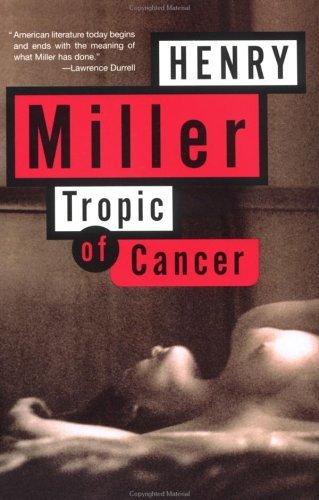
Tropic of Cancer is totally NSFW

Henry Miller would have loved the Internet.

I don’t mean like role-playing games or white text on black MS DOS screens, for which he was, technically speaking, still alive. I mean like today’s Internet, all self-absorbed and indulgent like it is. All “this is what I ate for breakfast, and this is who I hung out with, and this is the boring shit we did.” That Internet Henry Miller would have been all about.

It’s actually a fun activity to read books written before 1950 and mine them for unintentionally prescient quotes. Tropic of Cancer, the seminalโ€”trust me, semen-sounding words will not be the raunchiest elements of this postโ€”autobiographical novel from Miller, is full of these kinds of snippets, lines like “so fast and furiously am I compelled to live now that there is scarcely time to record even these fragmentary notes.” Seriously, the man would have loved Twitter.

I had few expectations going into Tropic of Cancer, about which I knew essentially two things: (1) It is perhaps the most banned book of all time, whose 1934 publishing predated its actual release in the U.S. by nearly 30 years, and (2) there’s a boob on the cover. And honestly, I think some part of me figured that 1934 smut couldn’t possibly be 2011 smut; like maybe Miller would talk about how he had “lain” with some ladies, or kicked it with a few prostitutes, but that’s it. Hilariously, however, my illusions about this book’s PG-13 rating were dispelled somewhere around page 5 (fahreals NSFW):

Continue reading “Tropic of Cancer is totally NSFW”

The greatest show on Earth

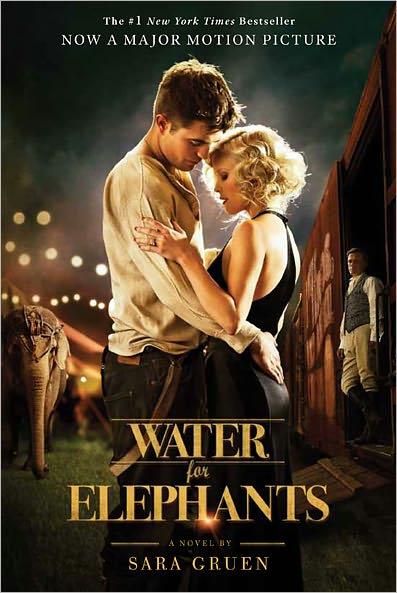
Oddly enough, the most persuasive recommendation I received for Water for Elephantsโ€”the circus-themed love story whose movie adaptation stars Reese Witherspoon and sparkly manpire Robert Pattinson himselfโ€”came from a marine. During a visit to NYC in May, a high school friend of mine, only recently back from a year in Afghanistan, was scouring my bookshelves when he stopped on H2OFE and exclaimed his appreciation for it. Granted, one’s standards for entertainment are probably different after a few months of living in a tent surrounded by sand, but I thought it only patriotic to abide by the glowing endorsements of the armed forces. (After just a few minutes of mockery.)

I am, it’s worth noting, probably the last person on the planet to read Water for Elephants. For one, I’ve never been a big fan of historical fiction. But the paperback’s super melodramatic cover also discouraged me from carrying it around on the L train, amid all the New Yorker subscribers and casual readers of ancient philosophy. And mustaches.

Not one to shy from my mistakes, I’ll be the first to admit that Water for Elephants is about as good as my marine friendโ€”and the novel’s bestseller statusโ€”suggest. Set in the 1930s, it follows protagonist Jacob Jankowski who runs away from home to (inadvertently) join the circus. While there, he meets Marlena, the beautiful ..horse lady performer (?), who is married to August, the seemingly schizophrenic animal trainer. Jacob obviously falls in love with Marlena, August obviously figures it out, and a fairly predictable narrative ensues, amid a thoroughly researched portrait of circus life in the heyday of Ringling Brothers, when circuses still came to people by train and no one had ever heard of a $14.99 plastic souvenir cup.

Also, there’s an elephant.

Continue reading “The greatest show on Earth”