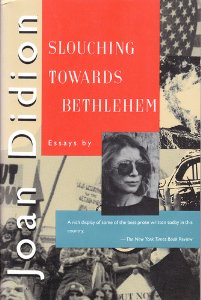
On Williamsburg: A 95% fictional tribute to Joan Didion

slouch

Author’s note: I read my first Joan Didion book this week. (I know, I know. I knooooow.) Naturally, as is to be expected when people say things like “What do you fucking mean you haven’t read Joan Didion?” it was everything. Sheer elegant perfection that I have absolutely no idea how to review. How does the apprentice critique the master? The parishioner judge the pope? So instead I just wrote this. 

*****

The center was not holding. It was a time of celebrities and sensationalism, 24/7 news coverage, mob-like vitriol and profound cultural change. Debt begat debt begat debt. Politics devolved to the starkest red and the muddiest blue; together they became a bruise. I decided to go to Williamsburg. Brooklyn was where they congregated, the mustachioed intellectuals of the next generation, the Great Young Hope, self-named guardians of a nostalgic ethos that valued art and fashion, but also social justice and making things by hand. Williamsburg was a leading franchise of the post-2000 hipster revolution, the era of artisanal bath products and ironic suspenders.

Continue reading “On Williamsburg: A 95% fictional tribute to Joan Didion”
Wild’n Out: Cheryl Strayed makes your summer seem stupid

tumblr_m179qjN8Ec1qd3jsao1_500

I am not, let us say, an outdoorsy person. I have no issue with being outside per se—it’s a nice enough place, depending on location and season and proximity to a bathroom—but it is my lifelong curse to prefer the climate-controlled confines of a manmade building or, at the very least, the squishy satisfaction of an oceanside beach chair. I want to like The Great Outdoors guys, I really do. It’s just that I’m, what’s that word….tip of my tongue….oh yes, that’s it—I’m lazy.

Of course, it doesn’t take a lazy person to appreciate the concept behind Cheryl Strayed’s Wild: a solo 1,000+ mile hike along the Pacific Crest Trail, which is like the Appalachian Trail’s more rugged and less traversed western cousin. The idea—which Strayed developed in the aftermath of her mother’s death, her own bout with adultery and heroin, and her divorce—is ludicrous, particularly for someone as inexperienced with backpacking as Strayed was. (Though it’s worth noting that, presented with the same challenge, I would be even less prepared: After just six hours wearing moderately ill-fitting flats for a wedding last weekend, I limped myself home so pathetically that you would have thought I’d been shot.)

Continue reading “Wild’n Out: Cheryl Strayed makes your summer seem stupid”

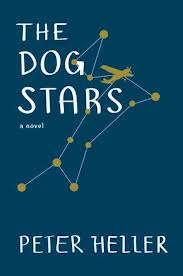
The Dog Stars is one of the best books you’ll read…ever?

dogstars

The Dog Stars is one of those books that seems ubiquitous. I spent the better part of last year passing it on bookstore tables, seeing it pop up on recommendation lists and idly imagining its contents. What could this slim novel possibly be about. Astronomy? Air travel? Flying puppies?

Well last week I got my answer. After a series of emphatic text messages from a friend—”dog stars is really good. really really good”—I decided to take a breather from my delightfully compelling (but extremely dense) NSA-related nonfiction and dive into TDS. As it turns out, the novel is about—natch—the apocalypse.

TDS is set in the not-so-distant future, about a decade after a plague has wiped out the majority of the population. Concerns about surviving the epidemic have for the most part passed, although a lingering blood disease —called, creepily, The Blood—still affects certain groups of people. (Think of it as surviving a plague, only to contract AIDS.)

Our narrator/protagonist is Hig, a resourceful pilot who lives in an abandoned airplane hanger with his “friend”/fellow survivor Bangley. Their symbiotic relationship involves Hig handling the farming, fishing and hunting, and Bangley handling the firearms. Lots and lots of firearms.

Because you see, in this version of the post-apocalyptic future, people have—morally speaking—taken a turn for the worse. The standing protocol is to kill or be killed, and Hig’s reluctant acquiescence to necessary self-defense is countered by Bangley’s almost enthusiastic embrace of it. Bangley is the muscle; Hig is the heart.

Continue reading “The Dog Stars is one of the best books you’ll read…ever?”

Stop what you’re doing and read Beautiful Ruins

Beautiful_Ruins

I’m happy to report that Beautiful Ruins, Jess Walter’s eighth book (seventh novel) lives up to every enthusiastic blurb that adorns its front and back covers, including accolades like “a literary miracle!” and “damn near perfect.” As a result of this victory, Walter is now my second-favorite guy with a girl name, though he remains behind reigning champion Ashley Wilkes from Gone With the Wind. (Because I mean, wasn’t he just so nice?)

Ruins opens on the Italian coast in 1962, in a nearly defunct fishing village where Pasquale Tursi—owner and proprietor of the only hotel—is busy rearranging rocks in an attempt to form a beach, which he hopes will draw tourists to the otherwise desolate town. As if summoned, there suddenly appears on the dock Dee Moray, a striking American actress who is spending a night in Porto Vergogna before traveling onwards to Switzerland, where she is slated to receive medical treatment for stomach cancer. Enamored of Dee’s beauty—and struck by her serendipitous arrival—Pasquale sets about getting to know her, and in so doing unearths a story whose ramifications span continents, decades and generations.

Continue reading “Stop what you’re doing and read Beautiful Ruins”

Sonali Deraniyagala’s Wave is possibly the saddest book I’ve read in my entire life

ThewaveDeraniyagala

Close your eyes. Okay now open them because obvi you need them to read this. Now think about the saddest thing you can think of—puppies dying, children crying, your local bodega running out of Ranch Doritos, what have you. Now multiply that thing times a million. A billion, even. Wrap it in a layer of terminal illness, crimes against humanity and the possible absence of a benevolent God. Only now—having duly considered the sheer tragedy and injustice of the universe—are you even remotely approaching the inherent and heart-wrenching sadness of Wave.

On vacation with her family in Sri Lanka, Sonali Deraniyagala is merely perturbed when on the morning of December 26, 2004, waves can be seeing crashing over the usually calm beachhead outside their hotel. Within minutes she realizes what’s happening—the Indian Ocean earthquake and tsunami we would later learn killed more than 200,000 was about to hit, and she had minutes, maybe seconds, to get out.

Grabbing her children and her husband, Deraniyagala runs outside, failing to stop and warn her parents—staying in the room next door—of the impending catastrophe. It ultimately doesn’t matter. In the ensuing tidal wave, which floods the Jeep in which Deraniyagala and her family are attempting escape, Deraniyagala’s children and husband die. Her parents’ death—a given, as they never escaped the ultimately-leveled hotel—is just icing on the world’s shittiest cake.

For her part, Deraniyagala is tossed around in the Jeep and ultimately comes to—albeit, still in shock. She is rescued moments before being washed out to sea. Deraniyagala spends a hollow-eyed few days trolling the local hospital, waiting for her family to join the scores of survivors camped out there, but also somehow knowing they won’t. Several weeks after the wave, their bodies are identified, and so begins Deraniyagala’s decade-long grieving process, outlined in Wave, a slim but impactful memoir.

Continue reading “Sonali Deraniyagala’s Wave is possibly the saddest book I’ve read in my entire life”