Unbroken broke me a little

unbroken-book-cover-01

As I was closing out the final pages of Laura Hillenbrand’s Unbroken on the train last week, a woman stopped me to ask how I was likingΒ it. I repliedΒ that itΒ takes it out of youβ€”this book whose every chapter is more grim than the one before. “But it’s okay right?” she responded, shopping bags and Starbucks cup in tow. “Because he goesΒ free in the end?”

It’s a credit to our threshold for human suffering that a World War II bombardier lost at sea for 47 days and then imprisoned in Japanese POW camps for more than two years is considered a victor in his life story. Yes, Louis Zamperini, the recently deceased subject of Hillenbrand’s wildly successful 2010 biography, was eventually freed. Yes, he lived to tell the tale. But a man does not walk away from such experiences cleanly, and the effects of Louie’s POW life on his post-POW life are apparent down to Unbroken’s very last page.

Much of this book’s plot has become common knowledge, perhaps by virtue of the comprehensive movie trailer, perhaps because of various interviews with Louis in the last few years. So I’ll sacrifice the time I’d usually spend on plot summation to jump directly to Hillenbrand, an author whose own limitations (chronic fatigue syndrome and its attendant symptoms have kept her homebound for years) are her personalΒ testament to human resilience in the face of adversity. I’ve never read anything by LH before, and was pleased to find in her, like Erik Larson (author of Devil in the White City and In the Garden of Beasts) a penchant for research that borders on the insane (Unbroken ends with 8 pages of detailed acknowledgmentsΒ and 40 pages of reference notes). This bookΒ is so thoroughly executed that it readsΒ like fiction, and Hillenbrand’s dedication to describing 60-year-old events in vivid detail isΒ beyond impressive.Β Of course, she had helpβ€”a pertinent quote fromΒ Louie kicks off the book’s acknowledgments section: “I’ll be an easier subject than Seabiscuit,” he tells her, “because I can talk.”

Continue reading “Unbroken broke me a little”
I am completely beside myself about We Are All Completely Beside Ourselves

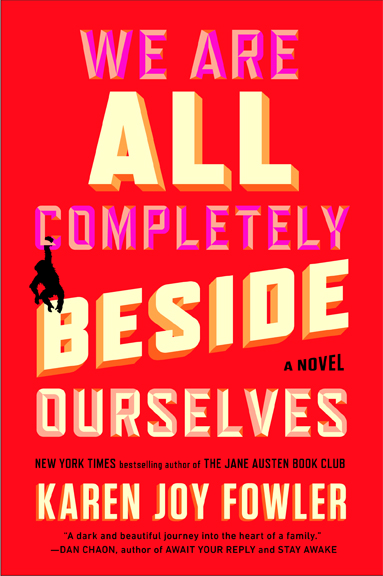
WeAreAllCompletely_paperback

If there’s anything to be said for going into a book completely clueless, it should be said about Karen Joy Fowler’s We Are All Completely Beside Ourselves. I didn’t go into it clueless (as I am categorically incapable of not reading back-cover blurbs) but a friend of mine did, and I’ve spent the better part of my standard review prep period (read: eating cashews and staring out the window) thinking about how different my experience with WAACBO would have been if I didn’t know from the very first page that Fern, the absentee sister about whom narrator Rosemary Cooke is writing, is [SPOILER] a chimp.

This information, while crucial to the novel’s plotβ€”WAACBO is, in fact, Rosemary’s adult reflection on growing up with, and then without, Fernβ€”isn’t officially revealed until page 77, which is a hell of a long time to leave the species of a main character intentionally ambiguous. And yet, whether by accident or tacit agreement among everyone involved with the publishing and promotion of this book, it is a hard spoiler to avoid: WAACBO’s cover (my version, at least) has a chimp on it, and Rosemary’s most pertinent quote on the matterβ€””I tell you Fern was a chimp and already you aren’t thinking of her as my sister”β€”is included in the plot summary on the back cover. Somewhat less egregiously, We Are All Completely Beside Ourselves has since its publication attained a reputation as an “animal rights novel,” which to the uninformed reader certainly begs the question: Wait, there’s an animal?

It is this facet of WAACBO, its unique presentation of the moral questions surrounding the scientific use of animals, that makes it impossible for me to review the novel without mentioning that Fern is indeed a chimpanzee. Apologies if you feel slighted by my decision, but let me assure you: This is a book whose spoilers are incidental, a beautifully written and impactful thought experiment that deserves every accolade it has already received, plus many more. Nuanced and engrossing and extremely relevant, WAACBO may be the best book I’ve read this year.

Continue reading “I am completely beside myself about We Are All Completely Beside Ourselves”

15 years late, I’ve joined the Neil Gaiman fan club

neverwhere

For even for the most casual observer of book publishing today, Neil Gaiman is something of a household name. He’s an author that seems almost serendipitously ubiquitous–one morning there’s an interview in the New York Times, a week later your friend mentions she loved Smoke and Mirrors, four days after that you scroll past a Facebook status praising American Gods. Nearly a decade ago now, those types of impromptu nudges finally drove me to pick up a paperback copy of Neverwhere at The Strand, and it’s languished on various bookshelves in my apartment ever since.

See, I am, for reasons that elude even me, oddly wary of fantasy books. If I had to guess, I would say it stems from some childhood fear of being nerdier than I already wasβ€”for most of my formative years I was rocking glasses, braces and a head of hair that went from bowl cut to rat’s nest before I caught on to conditioner somewhere in middle school. Indeed, those torturous limbo grades can be an unfortunate time for the acquisition of new interests, as one is misguidedly forming Opinions about things just a few years shy of the momentous realization that other people’s Opinions about things matter way less than they seem to. Perhaps I saw a foray into fantasy booksβ€”and all the cultishness and costumes and collectibles my 10-year-old self thought that impliedβ€”as a bridge too far, a surefire way to limit my romantic prospects to boys with Star Trek t-shirts and Magic: The Gathering cards. Little did I know those boys would grow up to be hipsters and I’d end up dating them anyway.

Continue reading “15 years late, I’ve joined the Neil Gaiman fan club”

I want to get drunk with Scott McClanahan

scott-mcclanahan-collected-works

The table of contents for Scott McClanahan’s The Collected Works Vol. 1 reads like a set list for a night of boozy storytelling. There’s “The Homeless Guy,” “The Chainsaw Guy” and “My Dad and the Cop.” There’s “Kidney Stones” and “Hernia Dog” and “The Prettiest Girl in Texas.” Truly, even before you read the first line of the first entry in this slim collection of stories, you have a sense of McClanahan the guy, and a sense of his work: These are tales like those we tell in person, over beers and among friends. They’re sometimes funny and sometimes bleak, and they reveal as much about ourselves as they do about anyone else in them.

I stumbled onto The Collected Works because of its cover (adages be damned), which is a cute (and legally ballsy?) imitation of a Penguin Classic, noticeably irreverent only on second glance. None of the 28 stories in the collection is more than a few pages, and most end in pseudo-philosophical punchlines that sometimes make you want to laugh and shed a tear at the same time. As author Sam Pink writes in the afterword:

“[McClanahan] writes in a way that is conscious of both his own absurdity and that of others, without overdoing either. He makes it really easy to like the narrator and to learn from the narrator’s experiences. Scott also knows how to balance humor and sadness.”

Continue reading “I want to get drunk with Scott McClanahan”

Put down your McNuggets and read The Meat Racket

bwoutlook0302011393112821

On the long list of careers at which I know I would fail miserably, farmer is near the top, right next to schoolteacher, personal trainer and anything involving dead bodies. Farming requires more than an extraordinary work ethic, a high tolerance for early-morning hours and physical exertion, and a certain resilience when it comes to the smell of poop. It calls for a stoic acquiescence to the whims of the universe, which has the power to make or break a farmer’s very livelihood with one infestation, one storm or one drought. Certainly everyone contends with the uncontrollableβ€”to do so is in some way to be humanβ€”but farmers do it more than most. Their business is with the planet, and their job is to impose ritual on its otherwise unfettered chaos.

To cede control to the capricious nature of…nature is an inevitable facet of agricultural life, up there with muddy boots and waking up before bars have even closed in New York. But the sacrifice is, theoretically, in pursuit of a greater good, of an American dream that has less to do with big houses and nice things and more to do with living off the land, with owning something and using that something to generate something, not just wealth.

America has a long history of attempting to level the playing field for farmers, with subsidies and regulations intended to limit the volatility wrought by both mother earth and the free market, equally fickle bitches. But perils persist: In 2012, the median farm income was negative $1,453. You read that right: Half of farmers are losing more than $1,453 a year. It’s no wonder that they commit suicide at a rate just under two times that of the general population. One need look no further than the produceβ€”and now meatβ€”sections at Walmart to understand that food has become Big Food, and where Big ___ goes, the slow suffocation of the average employee follows.

Christopher Leonard’s The Meat Racket is concerned with only a microcosm of a microcosm of the food business as a whole: The book focuses on the genesis of the now-ubiquitous Tyson Foods, a company that currently raises 1 of every 5 chickens eaten in the United States. But while Tyson is just one company, and chicken (plus, as Tyson expands, beef and pork) are just one agricultural sector, the Tyson story could and does easily stand in for the plight of farmers as a whole. TMR is a maddening, soul-sucking tour through the influence of big business, and the bumbling complicity of government and regulators in the endless conglomeration of the American private sector.

Continue reading “Put down your McNuggets and read The Meat Racket”