

I still haven’t recovered from The People In The Trees

img-thepeopleintreesjpg_171130278616

The Amazon reviews on Hanya Yanagihara’s The People in the Trees are a mixed bag, and fairly so: It’s a beautiful, fascinating and imaginative book—that can at times be highly unpleasant to read.

TPITT is, most immediately, an imagined memoir from doctor Norton Perina—the story is loosely based on IRL doctor D. Carleton Gajdusek—who in his 20’s stumbles upon a lost tribe on a remote Micronesian island. A portion of this tribe, who come to be known as “the dreamers,” suffer from a unique affliction that allows their bodies to stop aging while their minds continue to. Centuries old, while physically middle-aged and mentally childlike, the dreamers prove a career-making discovery for Perina, who goes on to become hugely famous and to adopt dozens of the tribe’s offspring. And yet Perina’s memoir is filtered through a second party, Ronald Kuboderia, a former lab assistant (the NYT review, perfectly, describes him as “Smithers to Perina’s Mr. Burns”) who we discover has asked Perina to write said memoir from prison, where Perina is serving time for pedophilia charges. Like I said: unpleasant.

Continue reading “I still haven’t recovered from The People In The Trees”
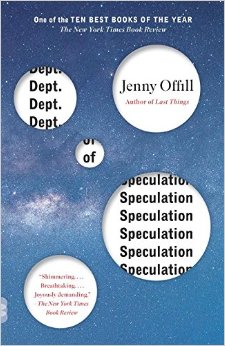
You know what’s punk rock about marriage?

51tWJT1BYdL._SY344_BO1,204,203,200_

It would be almost be worth my (hypothetical) husband having an affair—maybe worth going through life with a name reminiscent of both “awful” and “offal”—if it meant I could go on to write a book as spectacular as Jenny Offill’s Dept. of Speculation.

A slim treatise on the maturation of a marriage, DOS is so compact as to be easily mistaken for simplistic. There is a husband and there is a wife, who are for all intents and purposes normal. They argue over groceries, money, chores. They have a daughter. They go to therapy (referred to as the “Little Theater of Hurt Feelings”). But don’t be fooled. DOS’s nameless female lead, who refers to herself as I, she or the wife depending on where in the couple’s emotional timeline we are, is one of the most interesting narrators I’ve stumbled across in recent memory. And the book’s unique format—short bursts of text that run the gamut from anecdotes to literary quotes to philosophical musings—belies its sophistication. The otherwise humdrum resonates on a much deeper level here.

Continue reading “You know what’s punk rock about marriage?”

Lawrence Wright’s Going Clear is 500 pages of batshit insanity

51vFPxEaajL._SY344_BO1,204,203,200_

It would be difficult to overstate the number of unhinged anecdotes that appear in Lawrence Wright’s 2013 book, Going Clear: Scientology, Hollywood and the Prison of Belief, or in the HBO documentary adaptation that premieres on March 29. There’s the time David Miscavige, the current leader of the church, conducted a game of musical chairs among officers—to the soundtrack of Queen’s greatest hits—telling them that all but the winner would be shipped off to remote Scientology bases. There’s the time L. Ron Hubbard, Scientology’s founder, claimed to have access to an underground space station north of Corsica. And, of course, there’s Tom Cruise. So much Tom Cruise.

Born of interviews with 200 current and former Scientology members, Wright’s Going Clear details Scientology’s 1950s origin story through its present-day troubles, and earned him “innumerable” threatening letters from lawyers representing the church. HBO’s documentary, directed by Alex Gibney, covers a decent portion of Wright’s book, and features interviews with ex-Scientology members that include screenwriter Paul Haggis (35 years in the church) and actor Jason Beghe (13 years), as well as former Scientology higher-ups like Spanky Taylor, a member for 17 years who was John Travolta’s onetime point person; Mike Rinder, church spokesman from 1982 to 2007; and Hana Eltringham Whitfield, a founding member of the Sea Organization (Scientology’s clergy of sorts), who left the church in 1982 after 19 years.

“My goal wasn’t to write an exposĂ©,” Wright tells Gibney early in the documentary. “It was to understand Scientology…. I was interested in intelligent and skeptical people who are drawn into a belief system and wind up acting on those beliefs in ways they never thought they would.”

Continue reading “Lawrence Wright’s Going Clear is 500 pages of batshit insanity”

The Martian deserves everything it’s getting, Matt Damon included

The_Martian_2014

The most surprising thing about The Martian isn’t that it’s going to be a major Ridley Scott film starring [typecast?] astronaut Matt Damon in the leading role. Or that the novel’s author, Andy Weir, wrote some 350 page of extremely technical aerospace detail with little more than Google research. Or that he published the book himself through Amazon, where it is currently (having since been picked up by a major publisher) tooling around in the Top 10 science-fiction list. No, what’s most surprising about The Martian is that in spite of its Cinderella-story creation and enthusiastic technicality, in spite of its corny humor and disorganized pacing, in spite of the fact that it’s primarily narrated by one person who spends all his time completely alone, this is one of the most unique and excellent novels I’ve read in recent memory.

“The Martian,” in this case, is Mark Watney, a NASA astronaut (slash botanist slash engineer) who gets stranded on the red planet when a dust storm-related accident separates him from his crew, who assume him dead and have to get the hell out of Dodge (i.e. abort their mission). When Watney comes to—saved by a fluke congealed blood situation worthy of a reverse Darwin Award—he is left with the daunting task of figuring out how to survive on an uninhabitable planet until his only possible rescue: the next Mars mission, in four years. 

Continue reading “The Martian deserves everything it’s getting, Matt Damon included”

A Brief History of Seven Killings: not brief, includes about a billion killings

A_Brief_History_of_Seven_Killings.JPG

To go from reading A Brief History of Seven Killings to reading anything that isn’t A Brief History of Seven Killings is like running a marathon with ankle weights and then taking them off for a walk around the block. A challenging, sweeping, impressive novel, ABH7K is a mental and emotional workout. It taxes the brain and the heart—the former’s capacity for ensemble narration and multiple dialects, and the latter’s tolerance for brutality.

Spanning 1976 to 1991; Kingston, Jamaica, to New York City; ABH7K is a spiral of subplots and broader themes surrounding the (IRL) December 3, 1976 assassination attempt on Bob Marley, which took place two days before a free concert organized to foster peace between warring gangs (who were backed by opposing political parties, who were backed by—or opposed by—the CIA/U.S. government). At various points throughout the 70s and subsequent decades, we peer inside the heads of, among others, the gang members behind the shooting, a journalist hunting for the inside story, a Marley one-night stand desperate to get out of Jamaica, CIA agents stationed in Kingston, and a murdered politician narrating from beyond the grave. What emerges through these intertwined experiences is a window onto a cyclical power struggle of epic criminal and political proportions, a complex web of—to use the appropriate regional terminology—fuckery.

Continue reading “A Brief History of Seven Killings: not brief, includes about a billion killings”