My new role model

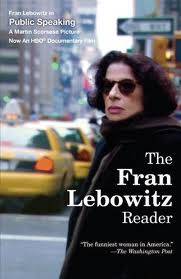
As a New Yorker by choice, rather than birthright, I’ve always had mixed feelings about the city’s somewhat incessant need to define its residents as either “natives” or “transplants.” Which isn’t to say that I don’t respect the unique blend of street savvy and odor tolerance that it takes to actually grow up in the Big Apple, but rather feel that the city isโ€”must be, reallyโ€”a byproduct of its residents in their entirety, not merely those who happen have owned Upper West Side co-ops since the late 1970s.

Still, as a dutiful transplant, I’d like to think that I’ve made a decent effort to avail myself of all that New York has to offer, not only in the sense of museums and landmarks, but also in history and culture. Of course New York’s more famous progenyโ€”Woody Allen comes to mind, as do the Rockefellers and Roosevelts after whom the entire city seems to be namedโ€”maintain reputations steeped in NYC charm even as their exports reach the country as a whole. But there are a whole host of other peopleโ€”from politicians to playwrights to restaurant proprietorsโ€”about whom a Maryland native like myself can be lambasted for not knowing, should they come up in conversation this side of the GW Bridge. To this day, not a month passes without my stumbling into some social faux pas whereby I reveal that I’ve never heard of Robert Moses, learned about Ed Koch or read anything by Gay Talese (for the record, only the last of these is still true.)

Continue reading “My new role model”
Super awesome printed artifact

When I started Super Sad True Love Story a few weeks ago, I knew just a few things about Gary Shteyngart:

  1. His last name is borderline impossible to spell. I’ve had to Google it every time I write it.
  2. He’s funny on Twitter.
  3. (actually 2b) Thanks to Jennifer Weiner, he occassionally watches and even more occassionally live-tweets The Bachelor. I mention this both because it is so fabulously out of character for a literary-minded person, and because it makes me feel about 48% better about my own Bachelor addiction.
  4. He was one of The New Yorker’s 20 Under 40 last year, which is how I first read an excerpt of Super Sad True Love Story (SSTLS from here on out).

As it turns out, with the exception of No. 1, these few things are completely appropriate factoids to have when going into SSTLS. The juxtaposition of Shteyngart’s amazing writing and almost unreal ability to both document and parody our current social/political/technological environment is bizarre, awesome and more than a little disconcerting. That this novel could feel both prescient, ludicrous and accurate all within the same page is a testament to how freaking interesting it is to read.

Continue reading “Super awesome printed artifact”

It’s Even Weirder Than It Sounds

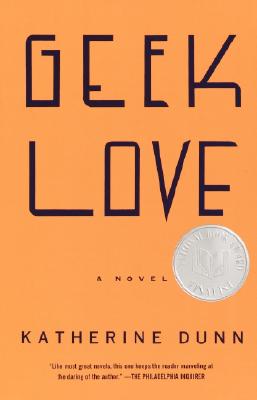
So I first heard about Geek Love from the person that lent it to me. Our exchange went something like this:

Friend: Have you read Geek Love?
Me: No, I haven’t heard of it.
Friend: Seriously!? TAKE THIS.

My curiosity was further piqued by the back cover:

Geek Love is the story of the Binewskis, a carny family whose mater- and paterfamilias set outโ€”with the help of amphetamine, arsenic and radioisotopesโ€”to breed their own exhibit of human oddities. There’s Arturo the Aquaboy, who has flippers for limbs and a megalomaniacal ambition worthy of Genghis Khan … Iphy and Elly, the lissome Siamese twins … albino hunchback Oly …and the outwardly normal Chick, whose mysterious gifts make him the family’s most preciousโ€”and dangerousโ€”asset.

As the Binewskis take their act across the backwaters of the U.S., inspiring fanatical devotion and murderous revulsion; as its members conduct their own Machiavellian version of sibling rivalry, Geek Love throws its sulfurous light on our notions of the freakish and the normal, the beautiful and the ugly, the holy and the obscene. Family values will never be the same.

Um, what? So many thoughts here, like “What does a geek mean in this situation? What kind of back blurb uses the words megalomaniacal and lissome in the same paragraph? What are you talking about FLIPPERS FOR LIMBS?!”

Continue reading “It’s Even Weirder Than It Sounds”

Some serious people-watching

I’ve often thought that my first novelโ€”I plan to write it in my early 30s and will swiftly rise to meteoric fame and become impossibly richโ€”will be about reality television. Not because I consider the topic particularly fascinating (to others), but because it is something about which I know a great deal and a subject on which, one might say (I do), I am an unlicensed expert.

Now, if there were anyone in the world to whom I would entrust such a task, in the event that I die a tragic early death at the hands of a rare incurable disease or late-night hobo mugging, it would be Matt McDonough. But if he weren’t around (or happened to die with me at the hands of said hobo), I’d settle for Chuck Klosterman.

Generally speaking, I find that people who’ve read Klosterman tend to fall in one of three camps: (1) Love (2) Hate, or (3) “Sex, Drugs and Cocoa Puffs was pretty good.” Klosterman, like David Foster Wallace, has the sort of unique nonfiction style that earns him both critics and fans, a style to which he is forever associated and from which he struggles to separate himself. As with DFW, some Klosterman adherents are less keen on his fiction, which began in earnest with his 2009 novel Downtown Owl. Before that, Klosterman was known primarily for the aforementioned Sex, Drugs and Cocoa Puffs, as well as Fargo Rock City, Killing Yourself to Live and columns in magazines like Spin and Esquire.

Me, I fall definitively in (1) Love. I agree that his nonfiction is both more accessible and more entertaining, and I agree that he can come across as needlessly self-important. But the topics he loves mostโ€”sports, television, music, media’s influence on societyโ€”are so generally unimportant (in the grand scheme of world issues) that I find it hard to get worked up about some perceived Klosterman pretension. I can’t begrudge the man his rather strong and overworked opinions on pop culture; I only wish someone would pay me to document my own. 

Continue reading “Some serious people-watching”

Barefoot, fruitarian, genius

For weeks now, I’ve been mad at the Internet. Not for its usual folliesโ€”I’m all about animals riding skateboardsโ€”but for making it nearly impossible to avoid at least a dozen or more spoilers from the new Steve Jobs biography by Walter Isaacson.

I suppose it’s weird to consider tidbits from one of the most widely anticipated books of the year “spoilers,” but as someone who knew very little about the Apple founder outside of his job title and health status, I had been looking forward to the Isaacson book as a way to learn everything about the man in one fell (500-page) swoop. So you can imagine my frustration when every fifth Tweet (actual proportion exaggerated) for the last three weeks has contained some unanticipated factoid, some “aha” moment from the book that I might have otherwise savored for the first time when I cracked its spine last week.

…Alright, that’s kind of a lie. The truth is I started reading the Jobs book not because I found myself so truly interested in the world’s most interesting man, but because all the cool kids were reading it. (While we’re being honest, I don’t really like biographies. There are very few people about whom I care enough to read their life story, especially when a Wikipedia entry and a few well-researched magazine articles will suffice.) When a book attains a level of commercial success that makes it unavoidable, I simply feel compelled to jump on the bandwagon, slave that I am to pop culture. 

Continue reading “Barefoot, fruitarian, genius”