What Would Dickens Do?

It should come as no surprise to anyone who’s read this blog that I have a bit of a …problem with bookstores. Once (stupidly), I even tallied up the money I’d spent in such stores over the course of a year. Let’s just say it came frighteningly close to an entire month’s rent.

And yet, despite the fact that I buy books far more frequently than a non-robot could finish them, I’ve never come down hard on myself for this particular vice. After all, I’m not compulsively buying cheeseburgers, or Beanie Babies, or bank stocks. Even when e-readers take over and everyone converts their paperbacks into coffee tables, books don’t expire. Forty-year-old me can still curl up with a hardcover and a disproportionately large glass of wine.

For me, books are an investment. Not only in my intellectual fulfillment, and not only in guaranteed commute fodder for literally decades to come. I love reading, and so I invest in the people who make it possible. I want Jonathan Franzen to sit at home all day, ruminating on his next 600-page analysis of the 21st century marriage. I want David Sedaris to lackadaisically roam France for months on end, penning diatribes on everything from the language barrier to the mating habits of local spiders. To me, there would be nothing sadder than Don DeLillo working a day job at Starbucks.  Continue reading “What Would Dickens Do?”

Thoughts on the “9/11 Novel”

I don’t know about you guys, but I’m a little September-11thed out. Maybe it’s because I live in New York, maybe it’s because I read news all day, most likely it’s a combination of the two, but I’m more than ready to go back to how things were a month ago, when we beat the terrorists simply by caring about Kim Kardashian. After all, that’s the real American spirit: sheer unmitigated narcissism.

Not that the whirlwind of September 11 media coverage wasn’t to be expected, or that I haven’t done my share of thinking about what we’ve managed to “accomplish” as a nation in the last decade. I just feel a little worn down by the ubiquity of it all, a sentiment that culminated in this week’s kerfuffle over a New York Post item claiming Rachel Uchitel (of Tiger Woods and Celebrity Rehab fame) said she was “happy” her fiancé had died in the towers. Seriously America, this is why they hate us.

Surprisingly to me though, the media hoopla has also included a few articles on how books—and more specifically novels—fit into our remembrance of September 11. According to the BBC, 164 fiction books have been written about 9/11 since the attacks (in addition to 1,433 nonfiction titles.) In an essay published in 2009, author Zadie Smith wondered why we read September 11 books at all—after all, no one in 1915 clamored for a novel on the Lusitania. And The Wall Street Journal’s Adam Kirsch has questioned whether fiction as a genre is even capable of effectively describing tragedy.

There’s a part of me that sees Smith’s argument—perhaps our global obsession with commentary means we are too interested in (figurative) post-mortems—but a bigger part of me finds her indignation annoying. September 11 is hardly the first tragedy to receive attention in literature; per the BBC article, “the Spanish Civil War spawned Hemingway’s For Whom the Bell Tolls; the bombing of Dresden gave rise to Kurt Vonnegut’s Slaughter-House Five [and] the single bloodiest day in the history of human warfare, the Battle of Borodino in 1812, features in Tolstoy’s magnum opus War and Peace.” (A cursory Amazon search also yields books on serial killers, Oklahoma City and Columbine.)

Personally, I never set out to read “a 9/11 book.” But through the years they wove their way onto my shelves, where I never found them ineffective approximations of tragedy, but rather nuanced explorations of a nation profoundly changed. See: the friendship formed between Hans van den Broek and Chuck Ramkissoon in Netherland. See: the darkly comic relief Joyce and Marshall Harriman feel about each other’s (inaccurately) presumed deaths in A Disorder Peculiar to the Country. See: the arresting denouement of Falling Man. It’s silly to suggest that any author, let alone these authors, wrote a September11 novel as a response to some national demand for analysis. It seems far more likely that the need to process the attacks through literature was theirs internally.

Certainly, no novel—9/11 or otherwise—could compete on an emotional level with a personal memory, or even with a tragedy’s nonfiction (see: Survival in Auschwitz). But I don’t think anyone, including authors, expects otherwise. Fiction’s inability to live up to experience is a challenge the genre has always faced. It doesn’t exploit anything to admit that a few authors have risen to the occasion.
Lobster, considered

I really didn’t want to read this book. Or at least I wasn’t supposed to.

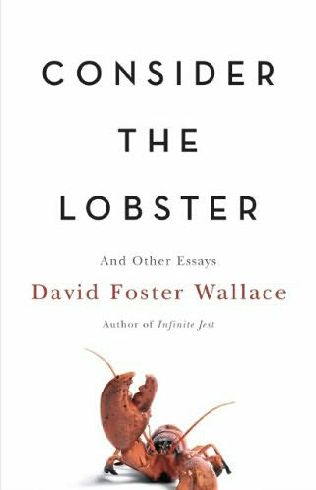
Now don’t get me wrong, I love David Foster Wallace. I think he was one of a kind, which is why it pains me every time I decide to read one of his books. Because I know there are a finite number of them; once I’ve read the last one, fin. …I suppose that’s true of many authors, including the classics’, but the circumstance and timing of DFW’s death make it feel relatable, more familiar. In reading his work, I’ve found myself upset that I’ll never know his insight on the current time period–on Obama or Twitter or the Biebs, on Shake Weight, or Watson or 3D movies–because I know his humor, his neurotic thoroughness and unrelenting cynicism, would have made that insight so unique and perfect. Instead I soak up his inner monologues on things like McCain’s 2000 campaign, and pore over his descriptions of a fictional futuristic world eerily like our actual present. And really wish he was still alive to write.

Sigh. Back to the task at hand. So reading any DFW book feels moderately epic. In addition, though I’m a fan of his short stories and novels, I’m partial to his nonfiction books, of which Consider the Lobster is one. Not one, but my last, because I am weak-willed and powerless over a good essay. Also, there’s a lobster on the cover. I can’t be held accountable for that kind of temptation.

Long story short, I’ve decided to drag this one out an extra week, a decision aided by the fact that DFW frequently includes half-page footnotes in footnote-size typeface, and that these footnotes frequently themselves have footnotes in even smaller typeface, so that one feels they’ve read entire pages when they’ve really just managed three lines of a footnote’s footnote. But also, because I want to enjoy it.

Son of a Preacher Man

So I kind of took a week off last week. I know! I know, it’s bad. But you guys, there’s just so. much. television. And work. And dinners to attend, bars to frequent, friends to visit. And iPhone Tetris. Oh sweet Lord, the iPhone Tetris. Truth be told, my 2011 hasn’t gone well so far in terms of distractions from the printed word. On the upside, I haven’t bought any books either (hey, every cloud has a silver lining).

But I’m determined to get back on the wagon after a series of defeats (though I maintain that Too Big To Fail was, well, too big). This week’s read comes highly recommended from a friend/coworker, whose suggestions always stand out to me since she tolerates more or less nonstop book and TV chatter from my side of the cube farm. (Think about it–can you imagine sitting next to me all day?) Gilead, by Marilynne Robinson, is something of a reflection on life, written in the voice of an aging rural preacher who is hoping to bequeath his knowledge of this world and the next to his son before he dies (the father, not the son).

I have anticipatory angst over this book, since it won both the Pulitzer and the National Book Award in 2005. Which is to say that if I don’t like it, I’m probably an uncultured idiot (something I’ve refused to accept despite bountiful evidence). So, wish me luck–at the very least with avoiding the remote control this week.

Almost as important as Oprah’s book club

In addition to guilt-tripping me into completing books, I had hoped that some part of this endeavor would be discovering things about myself and my reading habits; maybe in some way stumbling across what exactly turned me from a “books first, everything else later” kind of girl into “Did you guys see the last episode of Bad Girls Club?” As luck would have it, I’ve made my first discovery already, and it has everything to do with choosing what to read next.

You see, as I stopped worrying so much about finishing one book before moving on to the next, the weight of my reading choices diminished significantly. If, say, 50 pages in I felt even the slightest bit displeased or bored with a book, I could easily add it to the pile on the nightstand (whose shelves are devoted entirely to half-finished novels) and pick up something else. Nothing was set in stone.

Today, staring at my shelves, whose 200+ unread books are themselves a veritable library of options, I found myself hamstrung by an inability to decide what comes next. And it’s because I no longer have the liberty of indecision — whatever I choose I have to finish, and I have to devote a significant amount of time over the next seven days to the task. There will be no tossing aside, or leaving at home in favor of getting 20 pages further in some other half-read novel. I feel like I’m committing to a weeklong cruise with someone I’ve just met, whereas before it was more like, you know, meeting a guy in a bar. You’ve got my attention for now, but I can’t say I won’t be talking to someone else in a half hour. It dawns on me that this indecision/lack of commitment isn’t unprecedented for me, or by any means exclusive to books. Look at television: five years ago, I had to sit down and watch a show when it was on. Maybe I’d try to juggle the three-plus remotes it took to successfully record something, but for the most part whatever I watched was a commitment, something I was determined to participate in as it happened.

Continue reading “Almost as important as Oprah’s book club”