
Enough about suicide already

So I’m in a bit of a funk this morning, which I’ll need to get past in short order as I’m soon headed to Penn State for a night of good old-fashioned state-school drinking. In any case, this morning I read about Mark Madoff, the elder son of disgraced financier (and current prison resident) Bernard Madoff. Mark committed suicide yesterday, undoubtedly due to the number of lawsuits pending against him and the rest of his family, and what I can only imagine have been years of criticisms and death threats against him for his alleged involvement in the Ponzi scheme. Which is particularly sad since it was both Mark and his brother who told authorities about the scheme as soon as they found out, thereby setting the stage for their own father’s 150-year prison sentence.

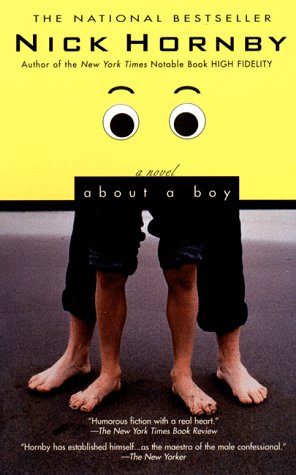
I guess it was only appropriate that a real-life tragedy would occur on the morning that I finished this week’s read, Nick Hornby’s About a Boy. I know what you’re thinking: If the Hugh Grant movie is any indication, About a Boy isn’t a sad story–it’s about a mildly bizarre 12-year-old who befriends an affable but clueless middle-aged guy who otherwise hates kids and meaningless social interaction (in other words, every Hugh Grant character ever). But if you’ll remember, the catalyst for the development of that relationship is the weird boy’s mother’s attempt to kill herself, which is discovered by Marcus (the boy) and Hugh Grant on their first day together. Indeed, much of About a Boy is really about life, and whether it’s worth living, and if so, why. This isn’t unprecedented territory for Hornby who, despite his reputation for writing generally humorous novels, actually uses a comedic voice to touch on fairly poignant issues: High Fidelity was about lost love; How to Be Good was about failed marriages; Juliet, Naked was about unfulfilled aspirations. And A Long Way Down was, well that one was pretty much entirely about suicide. If I had to hazard a guess, I would say the point of life, or lack thereof, is something Hornby has given a considerable amount of thought.Reading About A Boy–which I’ve owned for so long that the pages were yellowed–years after having seen the movie (which I’ve seen multiple times) was an interesting experience. Certainly I’ve read books that have become movies before, but I generally prefer to do it the other way around, where the book is my first impression of the story and I’m then free to judge the caliber of the cinematic adaptation. It’s more difficult to see the movie first; the sense of discovery that comes with reading is a bit lost, since you already know how everything turns out. Particularly with Nick Hornby, whose novels read so much like movies that much of the dialogue is exactly the same, it felt a little redundant. I will say that the movie version, which Hornby had a hand in, is pretty much perfection. The voices and qualities of the characters are near-identical, and the overall temperament of many of the scenes, which is some odd cross between existential crisis and mundane hilarity, is spot-on. More than once I would read a line in the book and remember fondly its delivery in the film.

Continue reading “Enough about suicide already”

To ma’am, with love

Unlike journalist, veterinarian and inventor of self-cleaning bathrooms, teacher was never on my short list of potential careers. For one, I don’t particularly like children, and I certainly don’t enjoy talking to people who are, by definition, stupider than me. One might argue that my undeniable lack of compassion for others wouldn’t have made for a very good teacher anyhow, but I like to think the choice was all mine.

So it’s always been with some degree of awe that I regard the teaching profession. That some people in this world are willing to get up at the crack of dawn to impart knowledge of algebra, American history or biology to generally unreceptive adolescents is enough for me to swallow; that still others actually enjoy this endeavor is almost outside my comprehension.

“Ms. Hempel Chronicles” documents the generally mundane adventures of one such brave soul: a young and relatively inexperienced English teacher. A blurb from the Washington Post refers to the book as a novel, but “Hempel” is really a collection of stories, many of which appeared on their own in various literary magazines. The themes and characters are the same throughout–indeed, these are the ties that bind the stories together–but the book is absent the sort of beginning/middle/end structure that I would typically consider necessary for noveldom.Similarly misleading (as was pointed out to me by a friend, who also read “Hempel”) is the book’s cover, which if taken literally, seems to indicate a woman 50 feet tall teaching a sea of students who are all the same height, dress like the Amish and have an unnatural affinity for clogs. Even figuratively, the cover’s message is off: For one, “Hempel” is set in modern times; one story even discusses Ms. Hempel’s unconscious adaptation of her students’ slang.

Continue reading “To ma’am, with love”

Well, that was easy

Four days. A new Sorry Television record.

I was unquestionably aided in this week’s reading endeavor by the Thanksgiving holiday, which right now means I wish I had brought an extra pair of stretchy pants but a day or so ago meant hours of uninterrupted reading time, thwarted only occasionally by my mother’s well-intentioned attempts to initiate conversation–attempts I rebuffed by grunting monosyllabic replies from behind my paperback. Because aren’t endless solitary hours of quiet reading time what Thanksgiving is really all about?

And certainly, I had the right book in hand. “The Girl with the Dragon Tattoo” has plenty of simultaneous compelling plots (to the point that after what was arguably the book’s major reveal, I was surprised to find there were still another 100 pages of denouement) and manages to cover the familiar crime-fiction territory of murder and intrigue without seeming stale. The book follows main character Mikael Blomkvist, an investigative reporter and magazine editor who early on is charged with libel and consequently resigns his magazine post to spend a year in self-imposed exile, writing a family history for affable Swedish captain of industry Henrik Vanger, who has given Blomkvist the simultaneous (and more important) task of finding out what happened to a female family member that disappeared 30 years earlier.  Along the way Mikael joins forces with Lisbeth Salander, a 20-something hacker and the famed owner of said dragon tattoo.

For a crime novel, “Dragon Tattoo” gets off to a slow start, which in retrospect I think has something to do with Larsson having written and submitted all three novels at once–200 pages of exposition seems less excessive in the context of three 700-page paperbacks than one. But the relationships so thoroughly established in the beginning–between Blomkvist and his colleague/longtime lover Erika Berger, between Salander and her employer, between Henrik Vanger and Blomkvist–prove relevant in the rest of the story, and in a way the time devoted to each person’s character makes the plot’s “whodunit” elements that much more compelling. Still, I would say the story truly picks up a little before the halfway point, and the last 100 pages have as much excitement as the first 400 combined.

Continue reading “Well, that was easy”

A problem only turkey can solve

Generally, I love books of essays. Really, it’s one of my favorite genres. But there are times, such as incredibly busy pre-holiday weeks when television is calling to me from the next room in all its prime time fall-programming glory, when it’s tough to get through them. Books of essays, that is. Consequently, I don’t think I gave “Half Empty” a fair shake this week.

Don’t get me wrong, I enjoyed it. David Rakoff has an incredibly sharp wit, the kind of negative attitude I appreciate and a more or less unparalleled vocabulary (the closest I’ve seen is David Foster Wallace, who had a thing for multisyllabic words. And I mean multisyllabic). Many of Rakoff’s essays cover topics true to my heart—New York, work, aspirations, cynicism. He skewers the plot of “Rent,” tells how he insulted the now-deceased author of “The First Wives Club” whilst she was in a coma, and gives a poignant-without-being-cheesy account of his second (yes, second) encounter with cancer. He draws a distinction between being negative for negativity’s sake and simply being pessimistic to the point of preparedness (he defends both). There’s even an essay about porn.

So I don’t know why it was so hard for me to get into this book. It wasn’t quite long enough, or quick enough; it wasn’t post-beer train reading, due to the aforementioned vocabulary and his propensity for run-on sentences (something I can relate to). The essays also at times felt too unrelated, like a series of magazine columns plopped together in a book. Except for a bevy of Jewish humor, not much was consistent throughout.

And yet, despite finding myself apathetically underwhelmed by “Half Empty”, I still intend to read “Fraud,” the only Rakoff book remaining to me. And why? Because no matter how grumpy or tired or grumpily tired I found myself last week, this one paragraph, where Rakoff is ending things with his therapist, who then confesses that he will miss their sessions, is so ridiculously dead-on that I suspect perhaps this man and I are actually kindred spirits and my averse reaction to the book has everything to do with a sincere jealousy over his ability to word my darkest interior monologues. Enjoy.

“(Sigh. Should you happen to be possessed of a certain verbal acuity coupled with a relentless, hair-trigger humor and surface cheer spackling over a chronic melancholia and loneliness—a grotesquely caricatured version of your deepest Self which you trot out at the slightest provocation to endearing and glib comic effect, thus rendering you the kind of fellow who is beloved by all yet loved by none, all of it to distract, however fleetingly, from the cold and dead-faced truth that with each passing year you face the unavoidable certainty of a solitary future in which you will perish one day while vainly attempting the Heimlich maneuver on yourself over the back of a kitchen chair—then this confirmation that you have triumphed once again and managed to gull yet another mark, except this time it was the one person you’d hoped might be immune to your ever-creakier, puddle-shallow sideshow-barker variation on “adorable,” even though you’d been launching this campaign weekly with a single-minded concentration from day one … well, it conjures up feelings that are best described as mixed, to say the least.)

See what I mean?

🏆🏆

At the end of the day, I think the reason I didn’t love “Half Empty” had everything to do with me: It really did feel a lot like reading my own thoughts, and typically so much of reading (books, at least) is an attempt on my part to escape them. I can hardly begrudge Rakoff his inability to help me cast off the doldrums of everyday life, especially when the book’s title is an indisputable reference to negative thinking. But I can grumpily give it two paper cuts; since he’s a true pessimist, Rakoff would have probably expected no different.


TITLE: “Half Empty
—————————————
AUTHOR: David Rakoff
—————————————
PAGES: 224 (in hardcover)
—————————————-
ALSO WROTE: Don’t Get Too Comfortable“, “Fraud
—————————————–
SORTA LIKE: Dry” meets “A Supposedly Fun Thing I’ll Never Do Again
——————————————
FIRST LINE: “We were so happy. It was miserable.”
——————————————

Carnival of carnage

devil-in-white

This may very well the best nonfiction book I’ve ever read.

See, when I mentioned to friends that I was reading “The Devil in the White City,” I heard some resounding praise, but at least two people admitted they’d liked the book but never finished it. As someone who loathes not finishing books—even before this endeavor, I’d convinced myself that none of my half-read novels were abandoned so much as on hold—the possibility that I was about to embark upon a journey of which I’d grow bored halfway through was distressing. I pictured myself falling asleep to in-depth descriptions of 1890s Chicago, and waking up at 3 a.m. with drool on my glasses.

Thankfully that wasn’t the case.

The details of “Devil” simultaneously are and aren’t important. As a potential reader, you should know it follows two people during the time around Chicago’s 1893 hosting of the World’s Fair: the architect mastermind behind almost the entire event, and a serial killer who masqueraded as a businessman while preying on women in the same city. If you have some sort of niche affinity for Chicago history, this is definitely the book for you, but I would be remiss to pretend any interest in Chicago, architecture or history itself is a prerequisite for enjoying “The Devil in the White City.” Rather, the details are important only insomuch as there are tons of them. Every scene of every chapter is researched with such stunning thoroughness that “Devil” reads like a novel, and I found myself more than once stopping to consider the amount of research that must have gone into this book. (It doesn’t take much imagination: “Devil” has 390 endnotes, and its bibliography lists more than 130 sources). Perhaps the biggest testament to this breadth of work is the dichotomy between the two stories, which intersect only indirectly. Given America’s interest in true crime and the minds of criminals, I thought the story of H.H. Holmes, the killer, would be by far the more compelling of the two. Gas chambers, dissection, secret cellars full of mad scientist paraphernalia—this is the stuff of “Law & Order.” And indeed, Holmes’ story, phenomenally bolstered by excerpts from his own half-fabricated memoir, is riveting. Today, the idea of serial murder simply for the thrill of it seems borderline mundane, but in the late 1800s it was almost unheard of; Jack the Ripper had only recently made headlines. Perhaps this is why Holmes managed to dispose of nearly a dozen of his closer acquaintances without the police catching on (it was pursuit of insurance fraud that ultimately led authorities to discover his more heinous crimes).

Continue reading “Carnival of carnage”